
Thanks to Source: Amazing Discoveries
Category Archives: World Organisations

Exposing The Jesuits
A presentation by Walter Veith: this time Exposing the Jesuits, Lucifers New World Order
Thanks to Source: End Time Truths Ministries
Share this:

The Jesuits & The Counter Reformation

Freemasonry Links to The Jesuits
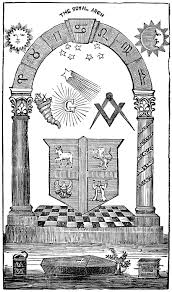
NEW YORK
PRESS CLUB,
January 11th, 1877.
ʺIn response to your letter, I willingly furnish the information desired with respect to the antiquity and Isis Unveiled Vol II 358 present condition of Freemasonry. This I do the more cheerfully since we belong to the same secret societies, and you can thus better appreciate the necessity for the reserve which at times I shall be obliged to exhibit. Continue reading Freemasonry Links to The Jesuits
Share this:

The Jesuits
Society of Jesus
From Wikipedia, the free encyclopedia
“Jesuit” redirects here. For the punk band, see Jesuit (band). For the personal philosophy encompassing the moral teachings of Jesus, see Jesuism.
“Black Robes” redirects here. For other uses, see Black robe.
 |
|
| Abbreviation | S.J., Jesuits |
|---|---|
| Motto | Ad maiorem Dei gloriam For the Greater Glory of God |
| Formation | 27 September 1540 |
| Type | Catholic religious order |
| Headquarters | Church of the Gesù (Mother Church), General Curia (administration) |
| Location |
|
| Coordinates | 41°54′4.9″N 12°27′38.2″ECoordinates: 41°54′4.9″N 12°27′38.2″E |
| Very Rev. Adolfo Nicolás, S.J. | |
|
Key people
|
Ignatius of Loyola— co-founder Francis Xavier— co-founder Peter Faber— co-founder |
|
Main organ
|
General Curia |
|
Staff
|
16,740 |
| Website | www.sjweb.info |

| Society of Jesus | |
|
History of the Jesuits Jesuit Hierarchy Ignatian Spirituality Notable Jesuits |
|

See also: Suppression of the Society of Jesus
The Society of Jesus (Latin: Societas Iesu, S.J., SJ or SI) is a male religious congregation of the Catholic Church. The members are called Jesuits. The society is engaged in evangelization and apostolic ministry in 112 nations on six continents. Jesuits work in education (founding schools, colleges, universities and seminaries), intellectual research, and cultural pursuits. Jesuits also give retreats, minister in hospitals and parishes, and promote social justice and ecumenical dialogue.
Ignatius of Loyola founded the society after being wounded in battle and experiencing a religious conversion. He composed the Spiritual Exercises to help others follow the teachings of Jesus Christ. In 1534, Ignatius and six other young men, including Francis Xavier and Peter Faber, gathered and professed vows of poverty, chastity, and later obedience, including a special vow of obedience to the Pope in matters of mission direction and assignment. Ignatius’s plan of the order’s organization was approved by Pope Paul III in 1540 by a bull containing the “Formula of the Institute”.
Ignatius was a nobleman who had a military background, and the members of the society were supposed to accept orders anywhere in the world, where they might be required to live in extreme conditions. Accordingly, the opening lines of the founding document declared that the Society was founded for “whoever desires to serve as a soldier of God[1] (Spanish: “todo el que quiera militar para Dios”),[2] to strive especially for the defense and propagation of the faith and for the progress of souls in Christian life and doctrine.”[3] Jesuits are thus sometimes referred to colloquially as “God’s Soldiers”,[4] “God’s Marines”, or “the Company”, references to Ignatius’ history as a soldier and the society’s commitment to accepting orders anywhere and to endure any conditions.[5] The Society participated in the Counter-Reformation and, later, in the implementation of the Second Vatican Council in the Catholic Church.
The Society of Jesus is consecrated under the patronage of Madonna Della Strada, a title of the Blessed Virgin Mary, and it is led by a Superior General, currently Adolfo Nicolás.[6][7]
The headquarters of the society, its General Curia, is in Rome.[8] The historic curia of St. Ignatius is now part of the Collegio del Gesù attached to the Church of the Gesù, the Jesuit Mother Church.
In 2013, Jorge Mario Bergoglio became the first Jesuit Pope, as Pope Francis.
Share this:

The Pope’s Knights
The Roman Catholic Church uses military-like orders or societies to carry out their aims and protect the Church. Continue reading The Pope’s Knights
Share this:

Beatification and Canonization of the Grand Master of the Sovereign Order of Malta
Rome, 13/02/2015
For the first time in the modern era canonization has been proposed for a Grand Master of the Sovereign Order of Malta
The opening session of the diocesan inquiry into the Cause of the Beatification and Canonization of the Servant of God Fra’ Andrew Bertie, 78th Prince and Grand Master of the Sovereign Order of Malta, will take place on 20 February at 11.30 in the Rome Vicariate at St. John Lateran. Cardinal Agostino Vallini, Vicar General of his Holiness for the Diocese of Rome, will preside over the solemn act. The hearing will be preceded by a Holy Mass celebrated in the Basilica of St. John Lateran by Cardinal Raymond Leo Burke, Cardinalis Patronus of the Sovereign Order of Malta. This historic event will be attended by the Grand Master of the Sovereign Order of Malta, Fra’ Matthew Festing, accompanied by the Sovereign Council, the relatives of the late Grand Master and the heads of the Order of Malta’s Grand Priories and National Associations from the five continents. Some three hundred faithful are expected from Germany alone.
A man with an intense spiritual life and profoundly convinced of the need to continuously strengthen the international solidarity network, Andrew Bertie was admitted to the Order when he was only 27 and devoted his life to prayer and charitable works, honouring the task entrusted to him until his death after illness in February 2008. Fra’ Andre Bertie oversaw great changes within the Order of Malta such as the expansion of the humanitarian activities and the reform of the constitutional charter. His legacy also includes a renewed emphasis on the spiritual life of the members of the Order. Furthermore, during his magistery, the Order’s bilateral diplomatic relations rose from 49 to 100.
In office from 1988 to 2008, Grand Master Andrew Bertie’s life was always inspired by principles of faith. His profound spiritual and human virtues, and not least his commitment to practise the Order of Malta’s founding motto “witnessing the faith and assistance to the poor” (Tuitio Fidei, Obsequium Pauperum), meant that in February 2013, only five years after his death (the minimum term envisaged by canon law) the request to initiate the procedure for his Beatification and Canonization was presented. This was a significant anniversary, because in that year the Order of Malta celebrated the 900th anniversary of its official recognition by Pope Paschal II.
The work Fra’ Andrew Bertie performed during his lifetime was for many an example of moral integrity and spiritual inspiration, hence his many faithful followers both in Italy and abroad, and in particular in those countries where the Order of Malta is present with its humanitarian activities.
– See more at: noodls.com
Rome, 20/02/2015
The Grand Master sends a message to the Holy Father to renew the Order of Malta’s adherence to the papal magisterium
Some 1,300 came to Rome from all over the world to participate this morning in the mass and opening of the diocesan inquiry on the Cause of Beatification and Canonisation of the Servant of God Fra’ Andrew Bertie. A very significant event for the Order of Malta, as it is the first time in its millenary history that a Grand Master has been proposed for sainthood.
Accompanied by a pale, almost springlike sun, the ceremony began with a procession inside the Basilica of St. John Lateran, the first of the four papal basilicas of Rome and the oldest in the West. Members in religious habit and volunteers, filed along the nave of the Basilica to take their places for the celebration of Holy Mass, officiated by the Cardinalis Patronus of the Sovereign Order of Malta, Cardinal Raymond Leo Burke.
The relatives of the late Grand Master – his brother and family – were present with many friends and faithful followers for whom he was a humane and spiritual guide, as well as the entire Sovereign Council, many presidents of the Order’s Associations worldwide and ambassadors of the accredited diplomatic corps.
“You’ve arrived from 35 different countries to join us in expressing our affection and our great respect for an exceptional man of profound spirituality and I would like to thank you all,” said Grand Master Fra’ Matthew Festing in his official speech. “It is a mark of special devotion towards this Grand Master, so beloved by the Order and by each of you individually. A valid testament to vox populi“.
In his address, Fra’ Matthew Festing recalled the intense spiritual life and great love of learning that had always motivated Fra’ Andrew Bertie, brilliant student of the United Kingdom’s best schools and universities, a multilingual journalist and later a literature professor. “But it was above all his dedication to the service of God and to the poor and the sick that illuminated his path,” said the Grand Master, describing his predecessor as a “reformer” and a “modernizer” and recalling Fra’ Andrew Bertie’s constant commitment to involving young people in the life of the Order.
During his mastership from 1988 to 2008 Fra’ Andrew Bertie oversaw great changes in the life of the Order, from the development of its humanitarian work to the reform of the constitutional charter. His legacy also includes a new emphasis on the spiritual life of the Order’s members. These are the reasons why the request for initiating the procedure for his beatification and canonization was presented only five years after his death – the minimum term specified by canon law.
The formal opening of the inquiry was presided over by Cardinal Agostino Vallini, Vicar General of His Holiness for the Diocese of Rome. The process will now continue in camera. Given the number of devoted present the official opening of the process for beatification took place in the Basilica instead of the Vicariate’s Palace. This has only ever happened once before when the process for the beatification of John Paul II was opened.
The Grand Master’s message to Pope Francis
On this important occasion, Grand Master Fra’ Matthew Festing sent a message to Pope Francis to express the Order of Malta’s profound and sincere adherence to the Holy Father’s magisterium, stressing his guidance and the encouragement for an “increasingly intense realization of Obsequium Pauperum for our poor and marginalised brothers”.
– See more at: noodls.com
Share this:

Sovereign Military Order of Malta
| Sovereign Military Hospitaller Order of Saint John of Jerusalem of Rhodes and of Malta | ||||||
|---|---|---|---|---|---|---|
|
||||||
| Motto: “Tuitio Fidei et Obsequium Pauperum” (Latin) “Defence of the faith and assistance to the poor” |
||||||
| Anthem: Ave Crux Alba (Latin) Hail, thou White Cross |
||||||
| Capital | Palazzo Malta, Rome, Italy Via dei Condotti, 68 | |||||
| Official languages | Italian, Latin | |||||
| Government | ||||||
| – | Prince and Grand Master | Fra’ Matthew Festing | ||||
| – | Grand Commandera | Fra’ Ludwig von Rumerstein | ||||
| – | Grand Chancellor | Albrecht von Boeselager | ||||
| Establishment | ||||||
| – | Established | c. 1099 | ||||
| – | Papal recognition of Sovereignty | 1113 | ||||
| – | Loss of Malta | 1798 | ||||
| – | Headquarters in Rome | 1834 | ||||
| Population | ||||||
| – | estimate | 3 citizens[1][2] 13,000 members and 80,000 volunteers[3][4] |
||||
| Currency | Maltese scudob | |||||
| Website orderofmalta.int |
||||||
| a. | “Lieutenant ad Interim”. | |||||
| b. | Euro for postage stamps. | |||||


From Wikipedia, the free encyclopedia – This article is about the sovereign international order. For the present-day republic, see Malta. For other organisations styled or derived from the “Order of Malta”, see Knights of Malta (disambiguation) and Order of St. John (disambiguation).
The Sovereign Military Hospitaller Order of Saint John of Jerusalem of Rhodes and of Malta (Italian: Sovrano Militare Ordine Ospedaliero di San Giovanni di Gerusalemme di Rodi e di Malta, Latin: Supremus Ordo Militaris Hospitalis Sancti Ioannis Hierosolymitani Rhodius et Melitensis), also known as the Sovereign Military Order of Malta (SMOM), Order of Malta or Knights of Malta, is a Roman Catholic lay religious order of, traditionally, a military, chivalrous and noble nature.[5] It is the world’s oldest surviving order of chivalry.[6] The Sovereign Military Order of Malta is headquartered in Rome, Italy, and is widely considered a sovereign subject of international law.[7]
SMOM is the modern continuation of the original medieval order of Saint John of Jerusalem,[8] known as the Fraternitas Hospitalaria and later as the Knights Hospitaller, a group founded in Jerusalem around the year 1050 as an Amalfitan hospital to provide care for poor and sick pilgrims to the Holy Land. After the conquest of Jerusalem in 1099 during the First Crusade, it became a military order under its own charter. Following the loss of Christian held territories of the Holy Land to Muslims, the order operated from Rhodes (1310–1523), and later from Malta (1530–1798), over which it was sovereign.
Although this state came to an end with the ejection of the order from Malta by Napoleon Bonaparte, the order as such survived. It retains its claims of sovereignty under international law and has been granted permanent observer status at the United Nations.[9] The order is notable for issuing its own international passports for travel, postal stamps, along with its formal insignia, often portrayed as a white or gold Maltese cross. The order nominally invokes the Blessed Virgin Mary under the venerated Marian title of “Our Lady of Mount Philermos” as its patroness and spiritual intercessor.
Today the order has about 13,000 members, including Knights and Dames as well as auxiliary members; 80,000 permanent volunteers; and 20,000 medical personnel including doctors, nurses, auxiliaries and paramedics in more than 120 countries.[3] The goal is to assist the elderly, handicapped, refugeed, children, homeless, those with terminal illness and leprosy in all parts of the world, without distinction of race or religion.[3] In several countries—including France, Germany and Ireland—the local associations of the order are important providers of first aid training, first aid services and emergency medical services. Through its worldwide relief corps—Malteser International—the order is also engaged to aid victims of natural disasters, epidemics and armed conflicts.
In February 2013 the order celebrated its 900th anniversary recognising the Papal bull of sovereignty “Pie Postulatio Voluntatis” formally issued by Pope Paschal II on 15 February 1113, with a general audience given by Pope Benedict XVI[10] and a Holy Mass celebrated by Vatican Secretary of State Cardinal Tarcisio Bertone at Saint Peter’s Basilica.
Contents
Name and insignia

Bust portrait of a Knight of Malta
The order has a large number of local priories and associations around the world, but there also exist a number of organizations with similar-sounding names that are unrelated, including numerous fraudulent (self-styled) orders seeking to capitalize on the name.[11]
In the ecclesiastical heraldry of the Roman Catholic Church, the Order of Malta is one of only two orders (along with the Order of the Holy Sepulchre) whose insignia may be displayed in a clerical coat of arms. (Laypersons have no such restriction.) The shield is surrounded with a silver rosary for professed knights, or for others the ribbon of their rank. Members may also display the Maltese Cross behind their shield instead of the ribbon.[12]
History
Main article: Knights Hospitaller
The birth of the order dates back to around 1048. Merchants from the ancient Marine Republic of Amalfi obtained from the Caliph of Egypt the authorisation to build a church, convent, and hospital in Jerusalem, to care for pilgrims of any religious faith or race. The Order of St. John of Jerusalem – the monastic community that ran the hospital for the pilgrims in the Holy Land – became independent under the guidance of its founder, the Blessed Gerard. With the Bull of 15 February 1113, Pope Paschal II approved the foundation of the Hospital and placed it under the aegis of the Holy See, granting it the right to freely elect its superiors without interference from other secular or religious authorities. By virtue of the Papal Bull, the hospital became an order exempt from the control of the local church. All the Knights were religious, bound by the three monastic vows of poverty, chastity and obedience.
The constitution of the Kingdom of Jerusalem regarding the crusades obliged the order to take on the military defence of the sick, the pilgrims, and the territories that the crusaders had captured from the Muslims. The order thus added the task of defending the faith to that of its hospitaller mission.
As time went on, the order adopted the white eight-pointed Cross that is still its symbol today. The eight points represent the eight “beatitudes” that Jesus referred to in his Sermon on the Mount.
Rhodes
When the last Christian stronghold in the Holy Land fell after the Siege of Acre in 1291, the order settled first in Cyprus and then, in 1310, led by Grand Master Fra’ Foulques de Villaret, on the island of Rhodes. From there, defense of the Christian world required the organization of a naval force; so the Order built a powerful fleet and sailed the eastern Mediterranean, fighting many famous battles for the sake of Christendom, including Crusades in Syria and Egypt.
In the early 14th century, the institutions of the order and the knights who came to Rhodes from every corner of Europe were grouped according to the languages they spoke. The initial seven such groups, or Langues (Tongues) – Provence, Auvergne, France, Italy, Aragon (Navarre), England (with Scotland and Ireland), and Germany – became eight in 1492, when Castille and Portugal were separated from the Langue of Aragon. Each Langue included Priories or Grand Priories, Bailiwicks, and Commanderies.
The order was governed by its Grand Master (the Prince of Rhodes) and Council. From its beginning, independence from other nations granted by pontifical charter and the universally recognised right to maintain and deploy armed forces constituted grounds for the international sovereignty of the Order, which minted its own coins and maintained diplomatic relations with other States. The senior positions of the order were given to representatives of different Langues.
Malta
Main article: History of Malta under the Order of Saint John
After six months of siege and fierce combat against the fleet and army of Sultan Suleiman the Magnificent, the Knights were forced to surrender in 1523 and left Rhodes with military honours. The order remained without a territory of its own until 1530, when Grand Master Fra’ Philippe de Villiers de l’Isle Adam took possession of the island of Malta, granted to the order by Emperor Charles V, Holy Roman Emperor and his mother Queen Joanna of Castile as monarchs of Sicily, with the approval of Pope Clement VII, for which the order had to honour the conditions of the Tribute of the Maltese Falcon.
The Reformation which split Western Europe into Protestant and Roman Catholic states affected the Knights as well. In several countries, including England and Scotland, the order was disestablished. In others, including the Netherlands and Germany, entire bailiwicks or commanderies (administrative divisions of the order) experienced religious conversions. The “Johanniter orders” are the continuations of these converted divisions in Germany, the Netherlands, Sweden, and other countries, including the United States and South Africa. It was established that the order should remain neutral in any war between Christian nations.
- Great Siege
Main article: Great Siege of Malta
In 1565 the Knights, led by Grand Master Fra’ Jean de Vallette (after whom the capital of Malta, Valletta, was named), defended the island for more than three months during the Great Siege by the Turks. The fleet of the order contributed to the ultimate destruction of the Ottoman naval power in the Battle of Lepanto in 1571, led by Don Juan of Austria, half brother of King Philip II of Spain.
Caribbean
Main article: Hospitaller colonization of the Americas

The order’s colonies in the Caribbean
From 1651 to 1665, the Order of Saint John ruled four islands in the Caribbean. On 21 May 1651, it acquired the islands of Saint Barthélemy, Saint Christopher, Saint Croix and Saint Martin. These were purchased from the French Compagnie des Îles de l’Amérique which had just been dissolved. In 1665 the four islands were sold to the French West India Company.
Exile
Two hundred years later, in 1798, the order surrendered the Maltese islands to the French First Republic. The knights were expelled from Malta.[13]
The Treaty of Amiens (1802) obliged the United Kingdom to evacuate Malta which was to be restored to a recreated Order of St. John, whose sovereignty was to be guaranteed by all of the major European powers, to be determined at the final peace. However, this was not to be because objections to the treaty quickly grew in the UK.
Bonaparte’s rejection of a British offer involving a ten-year lease of Malta prompted the reactivation of the British blockade of the French coast; Britain declared war on France on 18 May.[14]
The 1802 treaty was never implemented. The UK gave its official reasons for resuming hostilities as France’s imperialist policies in the West Indies, Italy and Switzerland.[15]
Rome
After having temporarily resided in Messina, Catania, and Ferrara, in 1834 the precursor of the Sovereign Military Order of Malta settled definitively in Rome, where it owns, with extraterritorial status, the Magistral Palace in Via Condotti 68 and the Magistral Villa on the Aventine Hill.
The original hospitaller mission became the main activity of the order, growing ever stronger during the last century, most especially because of the contribution of the activities carried out by the Grand Priories and National Associations in so many countries around the world. Large-scale hospitaller and charitable activities were carried out during World Wars I and II under Grand Master Fra’ Ludovico Chigi Albani della Rovere (1931–1951). Under the Grand Masters Fra’ Angelo de Mojana di Cologna (1962–1988) and Fra’ Andrew Bertie (1988–2008), the projects expanded.
Return to Malta

Flags of Malta and the SMOM on Fort Saint Angelo.
Two bilateral treaties have been concluded with the Government of the Maltese State. The first treaty is dated 21 June 1991 and is now no longer in force.[16] The second treaty was signed on 5 December 1998, but ratified on 1 November 2001.[17]
This agreement grants the Order the use with limited extraterritoriality of the upper portion of Fort St Angelo in the city of Birgu. Its stated purpose is “to give the Order the opportunity to be better enabled to carry out its humanitarian activities as Knights Hospitallers from Saint Angelo, as well as to better define the legal status of Saint Angelo subject to the sovereignty of Malta over it”.[citation needed]
The agreement has a duration of 99 years, but the document allows the Maltese Government to terminate it at any time after 50 years.[18][19] Under the terms of the agreement, the flag of Malta is to be flown together with the flag of the Order in a prominent position over Saint Angelo. No asylum may be granted by the Order and generally the Maltese courts have full jurisdiction and Maltese law shall apply.
A number of immunities and privileges are mentioned in the second bilateral treaty. No such immunities were contemplated by the first treaty.[20]
International status
See also: Foreign relations of the Sovereign Military Order of Malta, List of Permanent Observers of the Sovereign Military Order of Malta to the United Nations, List of diplomatic missions of the Sovereign Military Order of Malta and List of diplomatic missions to the Sovereign Military Order of Malta
With its unique history and unusual present circumstances, the exact status of the Order in international law has been the subject of debate. It describes itself as a “sovereign subject of international law.” Its two headquarters in Rome — the Palazzo Malta in Via dei Condotti 68, where the Grand Master resides and Government Bodies meet, and the Villa del Priorato di Malta on the Aventine, which hosts the Grand Priory of Rome — Fort Saint Angelo on the island of Malta, the Embassy of the Order to Holy See and the Embassy of the Order to Italy have all been granted extraterritoriality.[21]

Coat of arms of the Knights of Malta,
from the façade of the church of San Giovannino dei Cavalieri, Florence.
from the façade of the church of San Giovannino dei Cavalieri, Florence.
Unlike the Holy See, however, which is sovereign over Vatican City and thus has clear territorial separation of its sovereign area and that of Italy, SMOM has had no territory since the loss of the island of Malta in 1798, other than only those current properties with extraterritoriality listed above. Italy recognizes, in addition to extraterritoriality, the exercise by SMOM of all the prerogatives of sovereignty in its headquarters. Therefore, Italian sovereignty and SMOM sovereignty uniquely coexist without overlapping.[22] The United Nations does not classify it as a “non-member state” or “intergovernmental organization” but as one of the “other entities having received a standing invitation to participate as observers.”[23] For instance, while the International Telecommunication Union has granted radio identification prefixes to such quasi-sovereign jurisdictions as the United Nations and the Palestinian Authority, SMOM has never received one. For awards purposes, amateur radio operators consider SMOM to be a separate “entity”, but stations transmitting from there use an entirely unofficial callsign, starting with the prefix “1A”.[24] Likewise, for internet and telecommunications identification, the SMOM has neither sought nor been granted a top-level domain or international dialling code, whereas the Vatican City uses its own domain (.va),[25] and has been allocated the country code +379.[26]
There are differing opinions as to whether a claim to sovereign status has been recognized. Ian Brownlie, Helmut Steinberger, and Wilhelm Wengler are among experts who say that the claim has not been recognized. Even taking into account the Order’s ambassadorial diplomatic status among many nations, a claim to sovereign status is sometimes rejected.[27] The Order maintains diplomatic missions around the world and many of the states reciprocate by accrediting ambassadors to the Order.

Vehicle registration plate of the Order, as seen in Rome.
Wengler—a German professor of international law—addresses this point in his book Völkerrecht (1964), and rejects the notion that recognition of the Order by some states can make it a subject of international law. Conversely, professor Rebecca Wallace —writing more recently in her book International Law (1986)—explains that a sovereign entity does not have to be a country, and that SMOM is an example of this.[28] This position appears to be supported by the number of nations extending diplomatic relations to the Order, which more than doubled from 49 to 100 in the 20-year period to 2008.[29] In 1953, the Holy See decreed that the Order of Malta’s quality as a sovereign institution is functional, to ensure the achievement of its purposes in the world, and that as a subject of international law, it enjoys certain powers, but not the entire set of powers of sovereignty “in the full sense of the word.”[30] On 24 June 1961, Pope John XXIII approved the Constitutional Charter, which contains the most solemn reaffirmations of the sovereignty of the Order. Article 1 affirms that “the Order is a legal entity formally approved by the Holy See. It has the quality of a subject of international law.” Article 3 states that “the intimate connection existing between the two qualities of a religious order and a sovereign order do not oppose the autonomy of the order in the exercise of its sovereignty and prerogatives inherent to it as a subject of international law in relation to States.”[31]
SMOM has formal diplomatic relations with 105 states[32] and has official relations with another six countries and the European Union. Additionally it has relations with the International Committee of the Red Cross and a number of international organizations, including observer status at the UN and some of the specialized agencies.[33] Its international nature is useful in enabling it to pursue its humanitarian activities without being seen as an operative of any particular nation. Its sovereignty is also expressed in the issuance of passports, licence plates,[34] stamps,[35] and coins.[36]

SMOM foreign relations
diplomatic relations
other relations
The SMOM coins are appreciated more for their subject matter than for their use as currency; SMOM postage stamps, however, have been gaining acceptance among Universal Postal Union member nations.
The SMOM began issuing euro-denominated postage stamps in 2005, although the scudo remains the official currency of the SMOM. Also in 2005, the Italian post agreed with the SMOM to deliver internationally most classes of mail other than registered, insured, and special-delivery mail; additionally 56 countries recognize SMOM stamps for franking purposes, including those such as Canada and Mongolia that lack diplomatic relations with the Order.[37]
Governance

Flags of Knights Hospitaller in St. Peter’s Castle, Bodrum, Turkey.
Left to right: Fabrizio Carretto (1513–1514);
Amaury d’Amboise (1503–1512);
Pierre d’Aubusson (1476–1503);
Jacques de Milly (1454–1451).
Left to right: Fabrizio Carretto (1513–1514);
Amaury d’Amboise (1503–1512);
Pierre d’Aubusson (1476–1503);
Jacques de Milly (1454–1451).
The proceedings of the Order are governed by its Constitutional Charter and the Order’s Code. It is divided internationally into six territorial Grand Priories, six Sub-Priories and 47 national associations.
The supreme head of the Order is the Grand Master, who is elected for life by the Council Complete of State, holds the precedence of a cardinal of the Church since 1630 and received the rank of Reichsfürst (Prince of the Holy Roman Empire) in 1607.[38][39] Fra’ Matthew Festing was elected by the Council as 79th Grand Master on 11 March 2008, succeeding Fra’ Andrew Bertie, who was Grand Master until his death on 7 February 2008. Electors in the Council include the members of the Sovereign Council, other office-holders and representatives of the members of the Order. The Grand Master is aided by the Sovereign Council (the government of the Order), which is elected by the Chapter General, the legislative body of the Order. The Chapter General meets every five years; at each meeting, all seats of the Sovereign Council are up for election. The Sovereign Council includes six members and four High Officers: the Grand Commander, the Grand Chancellor, the Grand Hospitaller[40] and the Receiver of the Common Treasure.[41] The Grand Commander is the chief religious officer of the Order and serves as “Interim Lieutenant” during a vacancy in the office of Grand Master. The Grand Chancellor, whose office includes those of the Ministry of the Interior and Ministry of Foreign Affairs, is the head of the executive branch; he is responsible for the Diplomatic Missions of the Order and relations with the national Associations. The Grand Hospitaller’s responsibilities include the offices of Minister for Humanitarian Action and Minister for International Cooperation; he coordinates the Order’s humanitarian and charitable activities. Finally, the Receiver of the Common Treasure is the Minister of Finance and Budget; he directs the administration of the finances and property of the Order.
Patrons of the order since 1961
The patron, who is always a cardinal, promotes the spiritual interests of the Order and its members, and its relations with the Holy See.
- Paolo Giobbe (8 August 1961 – 3 July 1969)
- Giacomo Violardo (3 July 1969 – 17 March 1978)
- Paul-Pierre Philippe, O.P. (10 November 1978 – 9 April 1984)
- Sebastiano Baggio (26 May 1984 – 21 March 1993)
- Pio Laghi (8 May 1993 – 11 January 2009)
- Paolo Sardi (6 June 2009 – 8 November 2014)
- Raymond Leo Burke (8 November 2014 – present)
Membership

A Knight of Grace and Devotion in contemporary habit.
Membership in the order is divided into three classes and subdivided into several categories, i.e.:[42]
- First Class, containing only one category: Knights of Justice or Professed Knights, and the Professed Conventual Chaplains, who take religious vows of poverty, chastity, and obedience and form what amounts to a religious order (until the 1990s membership in this class was restricted to members of families with noble lineages).
- Second Class: Knight and Dames of Obedience, similarly restricted until recently, these knights and dames make a promise, rather than a vow, of obedience. This class is subdivided into three categories, namely that of Knight and Dames of Honour and Devotion in Obedience, Knight and Dames of Grace and Devotion in Obedience, and Knight and Dames of Magistral Grace in Obedience.
- Third Class, which is subdivided into six categories: Knights and Dames of Honour and Devotion, Conventual Chaplains ad honorem, Knights and Dames of Grace and Devotion, Magistral Chaplains, Knights and Dames of Magistral Grace, and Donats (male and female) of Devotion. All categories of this class are made up of members who take no vows and who had to show a decreasingly extensive history of nobility (knights of magistral grace need not prove any noble lineage and are the commonest class of knights in the United States).
Within each class and category of knights are ranks ranging from bailiff grand cross (the highest) through knight grand cross, and knight — thus one could be a “knight of grace and devotion,” or a “bailiff grand cross of justice.” The final rank of donat is offered to some who join the order in the class of “justice” but who are not knights. Bishops and priests are generally honorary members, or knights, of the Order of Malta. However, there are some priests who are full members of the Order, and this is usually because they were conferred knighthood prior to ordination. The priests of the Order of Malta are ranked as Honorary Canons, as in the Order of the Holy Sepulchre; and they are entitled to wear the black mozetta with purple piping and purple fascia.
Prior to the 1990s, all officers of the Order had to be of noble birth (i.e., armigerous for at least a hundred years), as they were all knights of justice or of obedience. However, Knights of Magistral Grace (i.e., those without noble proofs) now may make the Promise of Obedience and, at the discretion of the Grand Master and Sovereign Council, may enter the novitiate to become professed Knights of Justice.
Worldwide, there are over 13,000 knights and dames, a small minority of whom are professed religious. Membership of the Order is by invitation only and solicitations are not entertained.
The Order’s finances are audited by a Board of Auditors, which includes a President and four Councillors, all elected by the Chapter General. The Order’s judicial powers are exercised by a group of Magistral Courts, whose judges are appointed by the Grand Master and Sovereign Council.
Military corps of the order

SMOM SM.82 at the Italian Air Force Museum
The Order states that it was the hospitaller role that enabled the Order to survive the end of the crusading era; nonetheless, it retains its military title and traditions. On March 26, 1876 the Association of the Italian Knights of the Sovereign Military Order of Malta (ACISMOM) formed a Military Corps to provide medical support to the Italian Army, that on April 9, 1909 did officially become a special auxiliary volunteer corps of the Italian Army under the name Corpo Militare dell’Esercito dell’ACISMOM (Army Military Corps of the ACISMOM), wearing Italian uniforms.[43] Since then the Military Corps have operated with the Italian Army both in wartime and peacetime in medical or paramedical military functions, and in ceremonial functions for the Order, such as standing guard around the coffins of high officers of the Order before and during funeral rites.[44] Fausto Solaro del Borgo, President of the Italian Association of the Sovereign Military Order of Malta, stated in a speech given in London in November 2007:[43]
I believe that it is a unique case in the world that a unit of the army of one country is supervised by a body of another sovereign country. Just think that whenever our staff (medical officers mainly) is engaged in a military mission abroad, there is the flag of the Order flying below the Italian flag.
Hospital trains
The Military Corps has become known in mainland Europe for its operation of hospital trains,[45] a service which was carried out intensively during both World Wars. The Military Corps still operate a modern 28 cars hospital train with 192 hospital beds, serviced by a medical staff of 38 medics and paramedics provided by the Order and a technical staff provided by the Italian Army Railway Engineers Regiment.[46]
Aircraft of the order

SMOM roundel
In 1947, after the post-World War II peace treaty forbade Italy to own or operate bomber aircraft and only operate a limited number of transport aircraft, the Italian Air Force opted to transfer some of its SM.82 aircraft to the Sovereign Military Order of Malta, pending the definition of their exact status (the SM.82 were properly long range transport aircraft that could be adapted for bombing missions). These aircraft were operated by Italian Air Force personnel temporarily flying for the Order, carried the Order’s roundels on the fuselage and Italian ones on the wings, and were used mainly for standard Italian Air Force training and transport missions but also for some humanitarian tasks proper of the Order of Malta (like the transport of sick pilgrims to the Lourdes sanctuary). In the early ’50s, when the strictures of the peace treaty had been much relaxed by the Allied authorities, the aircraft returned under full control of the Italian Air Force. One of the aircraft transferred to the Order of Malta, still with the Order’s fuselage roundels, is preserved in the Italian Air Force Museum.[47]
Medals, awards and orders
See also


- History of Malta
- History of religion in Malta
- Knights Hospitaller
- List of Grand Masters of the Knights Hospitaller
- Order of Malta Ambulance Corps
- Order pro merito Melitensi
- Postage stamps and postal history of the Sovereign Military Order of Malta
- Religion in Malta
- Jonathan Riley-Smith
- The Alliance of the Orders of St. John of Jerusalem
Share this:

Tuaregs – Open Letter to UN 2014
Open letter to UN May 2014
Assi walet Hitta, Tuareg political organizer and leader of the Azawad Women’s Association, has issued an open letter to Bert Koenders, Representative to the United Nations in Mali.
Continue reading Tuaregs – Open Letter to UN 2014
Share this:

Tuaregs – Orphans of the Sahara
Who are the Tuareg people
The Tuareg people are Berber-speakers who trace their ancestry to the indigenous peoples of North Africa in ancient times. Continue reading Tuaregs – Orphans of the Sahara
Share this:

Mandaeism
| Part of a series on | |||
| Gnosticism | |||
|---|---|---|---|
 |
|||
| History | |||
| Proto-Gnostics | |||
| Scriptures | |||
|
|||
| Lists | |||
| Related articles | |||
| Part of a series on |
| Mandaeism |
|---|
| Mandaean saints |
| Related religious groups |
| Practices |
| Scriptures |
|
| Gnosticism portal |
Redirected here from Johannism
From Wikipedia, the free encyclopedia
“Mandaean” redirects here. For the ethno-religious group, see Mandaeans.
“Mandean” redirects here. For the language family in West Africa, see Mande languages.
Mandaeism or Mandaeanism (Modern Mandaic: מנדעיותא Mandaʻiūtā; Arabic: مندائية Mandāʼīyah/Mandāʾiyyah) is a gnostic religion[1]:4 with a strongly dualistic worldview.
Its adherents, the Mandaeans, revere Adam, Abel, Seth, Enos, Noah, Shem, Aram and especially John the Baptist, but reject Abraham, Moses and Jesus. The Aramaic manda means “knowledge,” as does Greek gnosis.[2][3]
According to most scholars, Mandaeans migrated from the Southern Levant to Mesopotamia in the first centuries CE, and are of pre-Arab and pre-Islamic origin. They are Semites and speak a dialect of Eastern Aramaic known as Mandaic. They may well be related to the Nabateans who were pagan, Aramaic-speaking indigenous pre-Arab and pre-Islamic inhabitants of southern Iraq.[4]
Mandaeans appear to have settled in northern Mesopotamia, but the religion has been practised primarily around the lower Karun, Euphrates and Tigris and the rivers that surround the Shatt-al-Arab waterway, part of southern Iraq and Khuzestan Province in Iran. There are thought to be between 60,000 and 70,000 Mandaeans worldwide.[5] Until the 2003 Iraq war, almost all of them lived in Iraq.[6] Many Mandaean Iraqis have since fled their country (as have many other Iraqis) because of the turmoil created by the 2003 invasion of Iraq and subsequent occupation by U.S. armed forces, and the related rise in sectarian violence by Muslim extremists.[7] By 2007, the population of Mandaeans in Iraq had fallen to approximately 5,000.[6] Most Mandaean Iraqis have sought refuge in Iran,[citation needed] with fellow Mandaeans there. Others have moved to northern Iraq. There has been a much smaller influx into Syria and Jordan, with smaller populations in Sweden, Australia, the United States and other Western countries.
The Mandaeans have remained separate and intensely private—reports of them and of their religion have come primarily from outsiders, particularly from the Orientalist Julius Heinrich Petermann, Nicolas Siouffi (a Yazidi) and Lady Drower. An Anglican vicar, Rev. Peter Owen-Jones, included a short segment on a Mandaean group in Sydney, Australia, in his BBC series, Around the World in 80 Faiths.
Contents
- 1 Origin of name
- 2 History
- 3 Beliefs
- 4 Possibly related groups
- 5 Mandaeans today
- 6 See also
- 7 References
- 8 Bibliography
- 9 External links
Origin of name
The term Mandaeism comes from Classical Mandaic Mandaiia and appears in Neo-Mandaic as Mandeyānā. On the basis of cognates in other Aramaic dialects, Semiticists such as Mark Lidzbarski and Rudolf Macuch have translated the term manda, from which Mandaiia derives, as “knowledge” (cf. Aramaic מַנְדַּע mandaʻ in Dan. 2:21, 4:31, 33, 5:12; cf. Hebrew: מַדַּע maddaʻ, with characteristic assimilation of /n/ to the following consonant, medial -nd- hence becoming -dd-[8]). This etymology suggests that the Mandaeans may well be the only sect surviving from late Antiquity to identify themselves explicitly as Gnostics.
Other scholars[who?] derive the term mandaiia from Mandā d-Heyyi (Mandaic manda ḏ-hiia “Knowledge of Life,” reference to the chief divinity hiia rbia “the Great Life”) or from the word (bi)mandi,[1]:81[1]:167 which is the cultic hut in which many Mandaean ceremonies are performed (such as the baptism, which is the central sacrament of Mandaean religious life). This last term is possibly to be derived from Pahlavi m’nd mānd (“house”).[citation needed]
Within the Middle East, but outside of their community, the Mandaeans are more commonly known as the Ṣubba (singular: Ṣubbī). The term Ṣubba is derived from the Aramaic root related to baptism, the neo-Mandaic is Ṣabi.[9] In Islam, the term “Sabians” (Arabic: الصابئون al-Ṣābiʾūn) is used as a blanket term for adherents to a number of religions, including that of the Mandaeans, in reference to the Sabians of the Qur’an. Occasionally, Mandaeans are called Christians of Saint John, based upon preliminary reports made by members of the Discalced Carmelite mission in Basra during the 16th century.[citation needed]
A mandī (Arabic: مندى) is a place of worship for followers of Mandaeism. A mandī must be built beside a river in order to perform maṣbattah (baptism) because water is an essential element in the Mandaeic faith. Modern mandīs sometimes have a bath inside a building instead.
History
The evidence about Mandaean history has been almost entirely confined to some of the Mandaean religious literature. While the majority view, and the Mandean opinion, was that Manaeism formed in pre-Christian times, some – for example Duchesne-Guillemin – suggests that Mandaeanism formed later than Christianity.[10]
Arab sources of early Qur’anic times (7th century) make some references to Sabians. They are counted among the Ahl al-Kitāb (People of the Book), and several hadith feature them. Some scholars hold that these Sabians are those currently referred to as Mandaeans, while others contend that the etymology of the root word ‘Sabi’un’ points to origins either in the Syriac or Mandaic word ‘Sabian’, and suggest that the Mandaean religion originated with Sabeans who came under the influence of early Hellenic Sabian missionaries, but preferred their own priesthood. The Sabians believed they “belong to the prophet Noah;”[11] similarly, the Mandaeans claim direct descent from Noah.
Early in the 9th century, a group in the northern Mesopotamian city of Harran declared themselves Sabians when facing persecution; an Assyrian Christian writer[who?][when?] said that the true ‘Sabians’ or Sabba lived in the marshes of lower Iraq. The earliest account we have about the Mandaeans is that of the Assyrian writer Theodore Bar Konai (in the Scholion, 792). In the Fihrist (“Book of Nations”) of Arabic scholar Al-Nadim (c. 987), the Mogtasilah (Mughtasila…, “self-ablutionists”) are counted among the followers of El-Hasaih. Called a “sect” of “Sabians,” they are located in southern Mesopotamia.[12] No verbatim reference to Mandaeans, which were a distinct group by then, seems to have been made by Al-Nadim; Mogtasilah was not that group’s endonym, and the few details on rituals and habit are similar to Mandaeans ones. Mogtasilah may thus have been Al-Nadim’s term for the Mandaeans, but they may just as well have been a related group which does not exist anymore today.
Elchasai’s religious community seems to have prospered for a while, but ultimately splintered. The Mandaeans may have originated in a schism where they renounced the Torah, while the mainstream Sampsaeans[citation needed] held on to it (as Elchasai’s followers did)—if so, this must have happened around the mid-late 1st millennium CE. Al-Biruni (writing at the beginning of the 11th century) said that the ‘real Sabians’ were “the remnants of the Jewish tribes who remained in Babylonia when the other tribes left it for Jerusalem in the days of Cyrus and Artaxerxes. These remaining tribes…adopted a system mixed-up of Magism and Judaism.”[13] However, it is not clear exactly which group he referred to, for by then the Elchasaite sects may have been at their most diverse. Some disappeared subsequently; for example, the Sampsaeans are not well attested in later sources. The Ginza Rba, one of the chief holy scriptures of the Mandaeans, appears to originate around the time of Elchasai or somewhat thereafter[citation needed]. Unfortunately, none of the Manichaean scriptures has survived in its entirety, and it seems that the remaining fragments have not been compared to the Ginza Rba.
Around 1290, a learned Dominican Catholic from Tuscany, Ricoldo da Montecroce, or Ricoldo Pennini, was in Mesopotamia where he met the Mandaeans. He described them as follows:
“A very strange and singular people, in terms of their rituals, lives in the desert near Baghdad; they are called Sabaeans. Many of them came to me and begged me insistently to go and visit them. They are a very simple people and they claim to possess a secret law of God, which they preserve in beautiful books. Their writing is a sort of middle way between Syriac and Arabic. They detest Abraham because of circumcision and they venerate John the Baptist above all. They live only near a few rivers in the desert. They wash day and night so as not to be condemned by God…”
Some Portuguese Jesuits had met some “Saint John Christians” or Mandaeans around the Strait of Hormuz in 1559, when the Portuguese fleet fought with the Ottoman Turkish army in Bahrain. These Mandaean seemed to be willing to obey the Catholic Church. They learned and used the seven Catholic sacraments and the related ceremonies in their lives.[14]
Beliefs
Mandaeism, as the religion of the Mandaean people, is based more on a common heritage than on any set of religious creeds and doctrines. A basic guide to Mandaean theology does not exist. The corpus of Mandaean literature, though quite large, covers topics such as eschatology, the knowledge of God and the afterlife — in an unsystematic manner. Moreover, it is known only to the priesthood and a few laypeople.[15][need quotation to verify]
Fundamental tenets
According to E.S. Drower, the Mandaean Gnosis is characterized by nine features, which appear in various forms in other gnostic sects:[16]
- A supreme formless Entity, the expression of which in time and space is creation of spiritual, etheric, and material worlds and beings. Production of these is delegated by It to a creator or creators who originated in It. The cosmos is created by Archetypal Man, who produces it in similitude to his own shape.
- Dualism: a cosmic Father and Mother, Light and Darkness, Right and Left, syzygy in cosmic and microcosmic form.
- As a feature of this dualism, counter-types, a world of ideas.
- The soul is portrayed as an exile, a captive; its home and origin are the supreme Entity, to which the soul eventually returns.
- Planets and stars influence fate and human beings, and are also places of detention after death.
- A saviour spirit or saviour spirits which assist the soul on the journey through life and after it to ‘worlds of light.’
- A cult-language of symbol and metaphor. Ideas and qualities are personified.
- ‘Mysteries’, i.e. sacraments to aid and purify the soul, to ensure rebirth into a spiritual body, and ascent from the world of matter. These are often adaptations of existing seasonal and traditional rites to which an esoteric interpretation is attached. In the case of the Naṣoreans this interpretation is based upon the Creation story (see 1 and 2), especially on the Divine Man, Adam, as crowned and anointed King-priest.
- Great secrecy is enjoined upon initiates; full explanation of 1, 2, and 8 being reserved for those considered able to understand and preserve the gnosis.
Mandaeans believe in marriage and procreation, and in the importance of leading an ethical and moral lifestyle in this world. They also place a high priority upon family life. Consequently, Mandaeans do not practice celibacy or asceticism. Mandaeans will, however, abstain from strong drink and red meat. While they agree with other gnostic sects that the world is a prison governed by the planetary archons, they do not view it as a cruel and inhospitable one.[citation needed]
Scriptures
The Mandaeans have a large corpus of religious scriptures, the most important of which is the Ginza Rba or Ginza, a collection of history, theology, and prayers.[17][need quotation to verify]
The Ginza Rba is divided into two halves—the Genzā Smālā or “Left Ginza,” and the Genzā Yeminā or “Right Ginza”. By consulting the colophons in the Left Ginza, Jorunn J. Buckley has identified an uninterrupted chain of copyists to the late 2nd or early 3rd century AD.[citation needed] The colophons attest to the existence of the Mandaeans or their predecessors during the late Arsacid period at the very latest, a fact corroborated by the Harrān Gāwetā legend, which says that the Mandaeans left Judea after the destruction of Jerusalem in the 1st century CE, and settled within the Arsacid empire. Although the Ginza continued to evolve under the rule of the Sassanians and the Islamic empires, few textual traditions can lay claim to such extensive continuity.
Other important books include the Qolastā, the “Canonical Prayerbook of the Mandaeans,” which was translated by E. S. Drower.[18] and here[19] One of the chief works of Mandaean scripture, accessible to laymen and initiates alike, is the Draša D-Iahia “The Book of John the Baptist” (text; German translation), which includes a dialogue between John and Jesus. In addition to the Ginza, Qolusta, and Draša, there is the Dīvān, which contains a description of the ‘regions’ the soul ascends through, and the Asfar Malwāshē, the “Book of the Zodiacal Constellations.” Finally, there are some pre-Muslim artifacts which contain Mandaean writings and inscriptions, such as some Aramaic incantation bowls.
The language in which the Mandaean religious literature was originally composed is known as Mandaic, and is a member of the Aramaic family of dialects. It is written in a cursive variant of the Parthian chancellory script. Many Mandaean lay people do not speak this language, though some members of the Mandaean community resident in Iran and Iraq continue to speak Neo-Mandaic, a modern version of this language.
Cosmology

Image of Abatur from Diwan Abatur
As noted above Mandaean theology is not systematic. There is no one single authoritative account of the creation of the cosmos, but rather a series of several accounts. Some scholars, such as Edmondo Lupieri,[20] maintain that comparison of these different accounts may reveal the diverse religious influences upon which the Mandaeans have drawn and the ways in which the Mandaean religion has evolved over time.
In contrast with the religious texts of the western Gnostic sects formerly found in Syria and Egypt, the earliest Mandaean religious texts suggest a more strictly dualistic theology, typical of other Iranian religions such as Zoroastrianism, Zurvanism, Manichaeism, and the teachings of Mazdak. In these texts, instead of a large pleroma, there is a discrete division between light and darkness. The ruler of darkness is called Ptahil (similar to the Gnostic Demiurge), and the originator of the light (i.e. God) is only known as “the great first Life from the worlds of light, the sublime one that stands above all works.” When this being emanated, other spiritual beings became increasingly corrupted, and they and their ruler Ptahil created our world. The name Ptahil is suggestive of the Egyptian Ptah—the Mandaeans believe that they were resident in Egypt for a while—joined to the semitic El, meaning “god.”
The issue is further complicated by the fact that Ptahil alone does not constitute the demiurge but only fills that role insofar as he is the creator of our world. Rather, Ptahil is the lowest of a group of three “demiurgic” beings, the other two being Yushamin (a.k.a. Joshamin) and Abathur. Abathur’s demiurgic role consists of his sitting in judgment upon the souls of mortals. The role of Yushamin, the senior being, is more obscure; wanting to create a world of his own, he was severely punished for opposing the King of Light. The name may derive from Iao haš-šammayim (in Hebrew: Yahweh “of the heavens”).[21]
Chief prophets
Mandaeans recognize several prophets. Yahya ibn Zakariyya, known by Christians as John the Baptist, is accorded a special status, higher than his role in Christianity and Islam. Mandaeans do not consider John to be the founder of their religion but revere him as one of their greatest teachers, tracing their beliefs back to Adam.
Mandaeans maintain that Jesus was a mšiha kdaba “false messiah”[22] who perverted the teachings entrusted to him by John. The Mandaic word k(a)daba, however, might be interpreted as being derived from either of two roots: the first root, meaning “to lie,” is the one traditionally ascribed to Jesus; the second, meaning “to write,” might provide a second meaning, that of “book;” hence some Mandaeans, motivated perhaps by an ecumenical spirit, maintain that Jesus was not a “lying Messiah” but a “book Messiah,” the “book” in question presumably being the Christian Gospels. This seems to be a folk etymology without support in the Mandaean texts.[23]
Likewise, the Mandaeans believe that Abraham and Moses were false prophets,[24] but recognize other prophetic figures from the Abrahamic religions, such as Adam, his sons Hibil (Abel) and Šitil (Seth), and his grandson Anuš (Enosh), as well as Nuh (Noah), his son Sam (Shem) and his son Ram (Aram)[citation needed]. The latter three they consider to be their direct ancestors.
Mandaeans consider the holy spirit that is known as Ruha d-Qudsha in the Talmud and Bible to be an evil being.
Priests and laymen

Image of Abatur at the scales from Diwan Abatur
There is a strict division between Mandaean laity and the priests. According to E.S. Drower (The Secret Adam, p. ix):
[T]hose amongst the community who possess secret knowledge are called Naṣuraiia—Naṣoreans (or, if the emphatic ‹ṣ› is written as ‹z›, Nazorenes). At the same time the ignorant or semi-ignorant laity are called ‘Mandaeans’, Mandaiia—’gnostics.’ When a man becomes a priest he leaves ‘Mandaeanism’ and enters tarmiduta, ‘priesthood.’ Even then he has not attained to true enlightenment, for this, called ‘Naṣiruta’, is reserved for a very few. Those possessed of its secrets may call themselves Naṣoreans, and ‘Naṣorean’ today indicates not only one who observes strictly all rules of ritual purity, but one who understands the secret doctrine.[25]
There are three grades of priesthood in Mandaeism:
- the tarmidia “disciples” (Neo-Mandaic tarmidānā),
- the ganzibria “treasurers” (from Old Persian ganza-bara “id.,” Neo-Mandaic ganzeḇrānā) and
- the rišamma “leader of the people.”
This last office, the highest level of the Mandaean priesthood, has lain vacant for many years. At the moment, the highest office currently occupied is that of the ganzeḇrā, a title which appears first in a religious context in the Aramaic ritual texts from Persepolis (c. 3rd century BCE) and which may be related to the kamnaskires (Elamite <qa-ap-nu-iš-ki-ra> kapnuskir “treasurer”), title of the rulers of Elymais (modern Khuzestan) during the Hellenistic age. Traditionally, any ganzeḇrā who baptizes seven or more ganzeḇrānā may qualify for the office of rišamma, though the Mandaean community has yet to rally as a whole behind any single candidate.
The contemporary priesthood can trace its immediate origins to the first half of the 19th century. In 1831, an outbreak of cholera devastated the region and eliminated most if not all of the Mandaean religious authorities. Two of the surviving acolytes (šgandia), Yahia Bihram and Ram Zihrun, reestablished the priesthood on the basis of their own training and the texts that were available to them.
In 2009, there were two dozen Mandaean priests in the world, according to the Associated Press.[26]

“Mandaean cross” (darfash)
Elkasaites
According to the Fihrist of ibn al-Nadim, the Mesopotamian prophet Mani, the founder of Manichaeism, was brought up within the Elkasaite (Elcesaite or Elchasaite) sect, this being confirmed more recently by the Cologne Mani Codex. The Elkasaites were a Judeo-Christian baptismal sect which seem to have been related, and possibly ancestral, to the Mandaeans (see Sabians). The members of this sect, like the Mandaeans, wore white and performed baptisms. They dwelt in east Judea and Assyria, whence the Mandaeans claim to have migrated to southern Mesopotamia, according to the Harran Gawaitā legend. Mani later left the Elkasaites to found his own religion. In a comparative analysis, Mandaean scholar Säve-Söderberg indicated that Mani’s Psalms of Thomas were closely related to Mandaean texts.[27] This would imply that Mani had access to Mandaean religious literature, or that both derived from the same source.
4th-century Nazarenes
The Haran Gawaita uses the name Nasoreans for the Mandaeans arriving from Jerusalem. Consequently, the Mandaeans have been connected with the 4th-century Nazarenes described by Epiphanius.
Dositheans
They are connected with the Dositheans by Theodore Bar Kōnī in his Scholion.
Mughtasila, baptizers
Ibn al-Nadim also mentions a group called the Mughtasila, “the self-ablutionists,” who may be identified with one or the other of these groups. The members of this sect, like the Mandaeans, wore white and performed baptisms.
Identifications
Whether groups such as the Elkasaites, the Mughtasila, the Nasoraeans, and the Dositheans can be identified with the Mandaeans or one another is a difficult question. While it seems certain that a number of distinct groups are intended by these names, the nature of these sects and the connections between them are less than clear. At least according to the Fihrist (see above), these groups seem all to have emerged from or developed in parallel with the “Sabian” followers of El-Hasaih; “Elkasaites” in particular may simply have been a blanket term for Mughtasila, Mandaeans, the original Sabians and even Manichaeans.
Mandaeans today
Main article: Mandaeans
During the last decade the indigenous Mandaic community of Iraq, which used to number 60,000 to 70,000 people, has collapsed due to the Iraq War, with most of the community relocating to nearby Iran, Syria and Jordan and forming diaspora communities outside of the Middle East. According to a 2009 article in The Holland Sentinel, the Mandaean community in Iran has also been dwindling, numbering between 5,000 to 10,000 people, with approximately 1,000 Iranian Mandaeans emigrating to the United States since 2002, after the State Department granted them protective refugee status, which was not accorded to Iraqi Mandaeans until 2007.[26] However, Alarabiya has put the number of Iranian Mandaeans as high as 60,000 in 2011.[28]
See also
- Abatur
- Aramaic
- Iraqi people
- Marsh Arabs
- Transpersonal psychology, a “spiritual psychology”, integrates the spiritual and transcendent aspects of the human experience
Share this:

UN Agenda 21 2030 – Exposed – Must Watch

Jesus speaks to Peter, the Church and the world
I am telling you the truth: when you were young, you used to get ready and go anywhere you wanted to; but when you are old, you will stretch out your hands and someone else will tie you up and take you where you don’t want to go.” (In saying this, Jesus was indicating the way in which Peter would die and bring glory to God.) Then Jesus said to him, “Follow me!”
(Joh 21:18-19)
When Jesus made this statement to Peter, it was the third time he had appeared to the disciples after His resurrection. Peter had just told Jesus he loves Him; Jesus, tells him to feed His sheep. Then, Jesus -giving Peter an indication of what lay ahead of him[Peter], in his future- says emphatically “Follow me!”.
The prophetic insight provided in the word of God
Continue reading Jesus speaks to Peter, the Church and the world
Share this:

COP25 – Really?
Committee Of Propaganda 25
“A lie told once remains a lie but a lie told a thousand times becomes the truth” ~ Joseph Goebbels
“Our starting point is not the individual:
We do not subscribe to the view that one should feed the hungry, give drink to the thirsty, or clothe the naked … Our objectives are different: We must have a healthy people in order to prevail in the world.”
―
Continue reading COP25 – Really?
Share this:

Fundamentalist Vaccines
Thanks to Source: Third Angels Message David Barron
Here’s what pope Francis has to say about “Catholic” fundamentalists
Thanks to Source: LifeSiteNews
Furthermore
Thanks to Source: Doctrinal Watchdog
GodSeesEverything asks:
Are you a fundamentalist (for the Pope and Bill Gates are against you) – See Below
Continue reading Fundamentalist Vaccines
Share this:

The Jesuits and the Counter Reformation
The Jesuits and the Counter Reformation
Share this:

Population controller who says all Catholics are ‘terrorists’ coming to speak at Vatican | Blogs | LifeSite

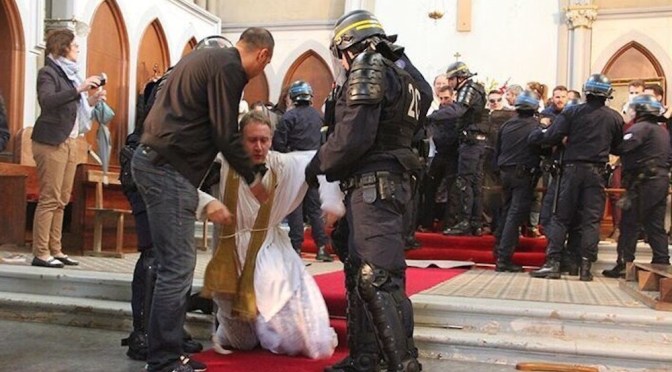
Police used teargas to remove parishioners during traditional Mass in France
“A traditional Mass community is trying to save a century-old church from demolition.”
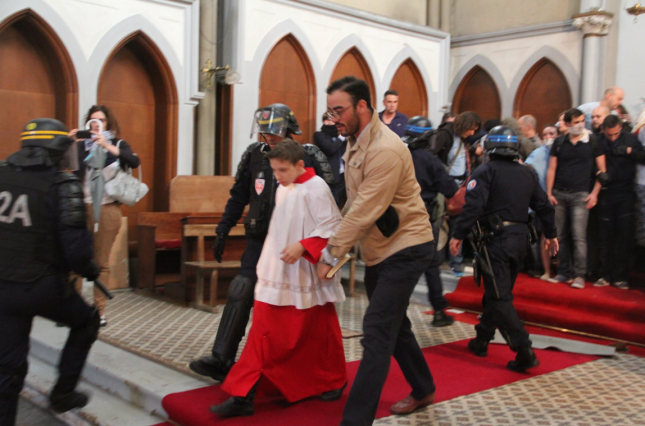
PARIS, France, August 5, 2016 (LifeSiteNews) — The Parisian church of Saint-Rita was evacuated by force on Wednesday morning by riot police while the traditional Mass was being celebrated.
Law enforcement stormed the building after having broken down the doors in order to evict everyone inside and remove the furnishings in application of an administrative order obtained by the property developer who intends to take down the century-old church to build apartments.
Photos of the evacuation were circulated widely on social networks. They showed a young priest, Father Jean-Francois Billot, being dragged bodily to the altar steps by riot police while the celebrant, Father Guillaume de Tanoüarn, who had not finished the consecration, quickly consumed the Host in order to avoid desecration. He was escorted out of the building in full traditional vestments.

Read more from the Source: lifesitenews.com
Share this:

The coming deception – Nephilim
Thanks to Source: SHOFAR MINISTRIES
GodSeesEverything says the fallen angels, nephilim, are real. The greatly popularised phenomenon of ufology is the work of demons. The world will make disclosure regarding UFO’s – this is a deception by Lucifer. Remember the Vatican has already said that they would baptise aliens (see here) and that there may have to be a re-think about the gospel (see here). So even the Roman Catholic Church are part of this deception. Don’t be deceived!
And I saw heaven opened, and behold a white horse; and he that sat upon him was called Faithful and True, and in righteousness he doth judge and make war. His eyes were as a flame of fire, and on his head were many crowns; and he had a name written, that no man knew, but he himself. And he was clothed with a vesture dipped in blood: and his name is called The Word of God. And the armies which were in heaven followed him upon white horses, clothed in fine linen, white and clean. And out of his mouth goeth a sharp sword, that with it he should smite the nations: and he shall rule them with a rod of iron: and he treadeth the winepress of the fierceness and wrath of Almighty God. And he hath on his vesture and on his thigh a name written, KING OF KINGS, AND LORD OF LORDS. And I saw an angel standing in the sun; and he cried with a loud voice, saying to all the fowls that fly in the midst of heaven, Come and gather yourselves together unto the supper of the great God; That ye may eat the flesh of kings, and the flesh of captains, and the flesh of mighty men, and the flesh of horses, and of them that sit on them, and the flesh of all men, both free and bond, both small and great. And I saw the beast, and the kings of the earth, and their armies, gathered together to make war against him that sat on the horse, and against his army. And the beast was taken, and with him the false prophet that wrought miracles before him, with which he deceived them that had received the mark of the beast, and them that worshipped his image. These both were cast alive into a lake of fire burning with brimstone. And the remnant were slain with the sword of him that sat upon the horse, which sword proceeded out of his mouth: and all the fowls were filled with their flesh.
(Rev 19:11-21)
Share this:


Palestine – Protected by the U.N. – “Useless Nobodies”
Thanks to Source: Greens EFA
Continue reading Palestine – Protected by the U.N. – “Useless Nobodies”
Share this:

SECRET INSTRUCTIONS OF THE JESUITS
SECRET INSTRUCTIONS OF THE JESUITS,
Faithfully translated from the Latin of an old genuine London copy.
WITH AN HISTORICAL SKETCH &c. &c.
BY W C- BROWNLEE D-D. OF THE COLLEGIATE REFORMED DUTCH CHURCH.
NEW YORK, CHARLES K. I«EOORE, ^t thr, offi.cz of thr, ^ PrU slant Vindicatory^ \^ Kassau stre 2%, 1811. Grtt Mr«. Hennen Jennings April 26, 1933
HISTORICAL SKETCH, &c.
“Swear — forswear — and the truth deny!”
“Jura, perjura, veritatemque denega!” Jesuit Maxim,
The Society of the Jesuits was founded in 1540, just eleven years after the Christian church had come out of the Roman sect, and assumed the name of Protestants. The singular originator of the new order, was Ignatius Loyola, a native of Biscay. He had, when a soldier, received a severe wound in the service of Ferdinand V. of Spain in 1521 ; and he had been long confined in a place where he had access, probably, to no other books than The Lives of the Saints, It is not to be wondered at that his mind was thence turned away from military enthusiasm, to ghostly fanaticism. When recovered, he speedily gave proofs of his insane fanaticism by assuming the name and office of *’ Knight of the Virgin Mary.” And like a good type of the future Don Quixote, he pursued with solemn gravity, a course of the wildest and most extravagant adventures ; in the belief that he was her most exalted favourite. Continue reading SECRET INSTRUCTIONS OF THE JESUITS
Share this:

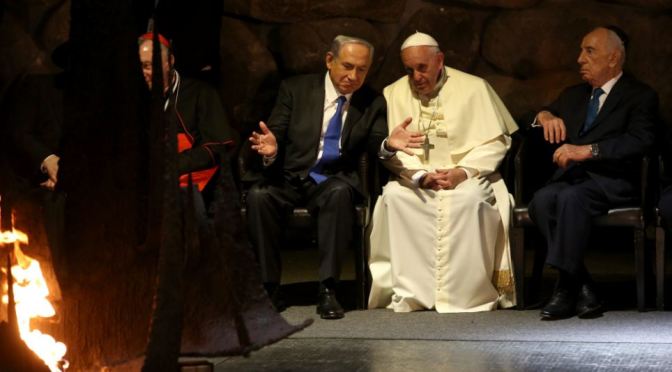
Pope: World is at war but it’s not a war of religions but for power
2016-07-27 (Vatican Radio) Referring to recent acts of violence, Pope Francis said on Wednesday that the world is at war but stressed
“it is not a war of religions but for power. “It is,” he continued, “a war about (economic) interests, money, natural resources and the domination of peoples.”
Continue reading Pope: World is at war but it’s not a war of religions but for power
Share this:

Pope Francis says Church should apologise to gays. But what does the Catechism say?
27 June 2016
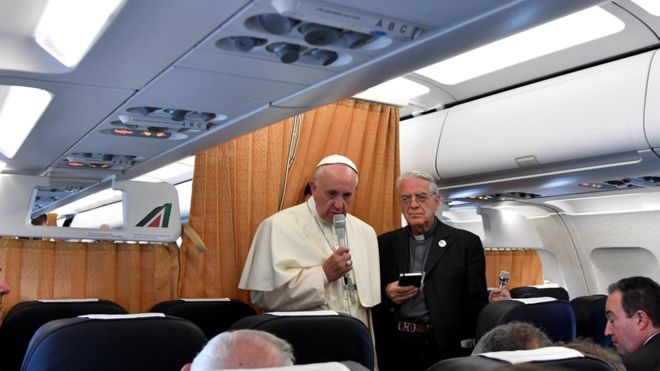
Pope Francis has said that the Roman Catholic Church should apologise to gay people for the way it has treated them. Continue reading Pope Francis says Church should apologise to gays. But what does the Catechism say?
Share this:

False Flags & deception

Crisis Management Role play Actors -is there a link to false flag events?
CrisisCast produces disaster dramas and role play actors specially trained by psychologists in criminal and victim behaviour for crisis management and disaster recovery simulations.
We provide highly interactive live scenarios with roleplay, injects, film clips and TV breaking news stories, social and print media posts drilling and exercising a wide variety of potential risks and all facilitated by an experienced Gold Command trainer.
Some of the leading independent schools in the world have used CrisisCast to reassure themselves that the critical incident plan they have in place is adequate, to exercise their management teams in key responses. The added value of a learning experience that builds confidence and strengthens ties within the Incident Response Team – or any school team – is proving to be of major added value to clients.
All of our school scenarios build towards an exciting press conference with lights, cameras and hostile reporters.
Source: CrisisCast
A legitimate training resume illustrated on their website? Is it feasible that this could be utilised by governments and NGOs to facilitate their own political agendas and propaganda – of course it could. So all you need would be a bank of trained actors.
So my thought for today would be – for every event involving emotional turmoil and mass murder being reported on mainstream media, stop and ask yourself the questions: Could this be a bunch of actors? Are there any bodies? Disbelieve it to begin with – and go factfind the truth for yourself. Until you find the truth – it’s a false flag and someone is pushing their agenda!
NB: One of CrisisCast clients was G4S – how interesting?
Share this:

Satanic Ritual: Tunnel in Switzerland.
If you believe in Jesus, this is why you should say your prayers. The people participating in this video clearly do not see anything wrong in what they are doing.
This is an invocation of the devil- baphomet wrapped sneakily in with modern art and Paganism. To the dignatories attending this tunnel opening, you witnessed yet another welcoming to the antichrist. May God forgive you all.
If you believe that there is nothing wrong with this video …I pray for you.
Thanks to source: TRUTH SHOCK TV
Share this:


Temple of Baal- Gateway to Satan in London and New York in 19 April 2016, then 1000 cities worldwide
There is nothing “triumphal” about the Arch of Palmyra – as this is the gateway to the temple of Baal.
Posted 18/4/16 @ 02:14 [last Updated 18/4/16 19:15]
Satan with his use of deception uses many names and BAAL is one of them. Continue reading Temple of Baal- Gateway to Satan in London and New York in 19 April 2016, then 1000 cities worldwide
Share this:

”the path of the Christian does not tolerate climbers, who show off & strut when following Jesus”-Francis
Share this:

Can it be true? A Catholic Croat’s protest
Not even when he received the protest sent him by Dr. Prvislav Grisogno, a Catholic Croat and former Minister in the Royal Yugoslav cabinet, did Archbishop Stepinac speak up. Continue reading Can it be true? A Catholic Croat’s protest
Share this:

Did The Vatican Make Nazism Possible in Germany and Croatia
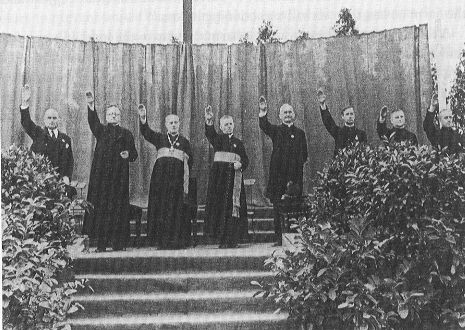
Did the Catholic Church help German Nazism? A look at the record.
“Antagonism to the Jews of today must not be extended to the books of Pre-Christian Judaism.” – Cardinal Michael von Faulhaber in the Advent sermons, delivered in 1933.
The Vatican’s definitive statement, “We Remember: Reflections on the Holocaust,” claims that Nazism was the antithesis of the Catholic church: Continue reading Did The Vatican Make Nazism Possible in Germany and Croatia

 The Loud Cry
You must be logged in to post a comment.