According to documents obtained by Children’s Health Defense, reports of injuries and deaths following COVID-19 vaccines — including a child injured by the Pfizer vaccine during a clinical trial and a fatal vaccine-induced case of myocarditis — reached NIH researchers, Dr. Anthony Fauci and others in 2021 and 2022.
Several adverse event reports from people injured by the COVID-19 vaccines reached National Institutes of Health (NIH) researchers in 2021 and 2022 — including a report of a child injured by the Pfizer-BioNTech vaccine during a clinical trial, according to documents obtained by Children’s Health Defense (CHD).
Meet the pope’s astronomer, who says he’d baptize an alien if given the chance
NEW YORK (RNS) With Christmas just around the corner, Brother Guy Consolmagno gets a lot of questions this time of year about the star of Bethlehem that led the Magi to Jesus in the manger.
Christians will not immediately need to renounce their faith in God “simply on the basis of the reception of [this] new, unexpected information of a religious character from extraterrestrial civilizations.” Continue reading Father Giuseppe Tanzella-Nitti SJ→
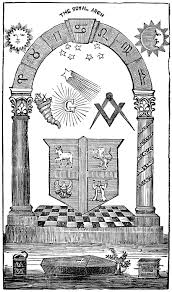
ʺIn response to your letter, I willingly furnish the information desired with respect to the antiquity and Isis Unveiled Vol II 358 present condition of Freemasonry. This I do the more cheerfully since we belong to the same secret societies, and you can thus better appreciate the necessity for the reserve which at times I shall be obliged to exhibit. Continue reading Freemasonry Links to The Jesuits→
The Society of Jesus (Latin: Societas Iesu, S.J., SJ or SI) is a male religious congregation of the Catholic Church. The members are called Jesuits. The society is engaged in evangelization and apostolic ministry in 112 nations on six continents. Jesuits work in education (founding schools, colleges, universities and seminaries), intellectual research, and cultural pursuits. Jesuits also give retreats, minister in hospitals and parishes, and promote social justice and ecumenical dialogue.
Ignatius of Loyola founded the society after being wounded in battle and experiencing a religious conversion. He composed the Spiritual Exercises to help others follow the teachings of Jesus Christ. In 1534, Ignatius and six other young men, including Francis Xavier and Peter Faber, gathered and professed vows of poverty, chastity, and later obedience, including a special vow of obedience to the Pope in matters of mission direction and assignment. Ignatius’s plan of the order’s organization was approved by Pope Paul III in 1540 by a bull containing the “Formula of the Institute”.
Ignatius was a nobleman who had a military background, and the members of the society were supposed to accept orders anywhere in the world, where they might be required to live in extreme conditions. Accordingly, the opening lines of the founding document declared that the Society was founded for “whoever desires to serve as a soldier of God[1] (Spanish: “todo el que quiera militar para Dios”),[2] to strive especially for the defense and propagation of the faith and for the progress of souls in Christian life and doctrine.”[3] Jesuits are thus sometimes referred to colloquially as “God’s Soldiers”,[4] “God’s Marines”, or “the Company”, references to Ignatius’ history as a soldier and the society’s commitment to accepting orders anywhere and to endure any conditions.[5] The Society participated in the Counter-Reformation and, later, in the implementation of the Second Vatican Council in the Catholic Church.
The headquarters of the society, its General Curia, is in Rome.[8] The historic curia of St. Ignatius is now part of the Collegio del Gesù attached to the Church of the Gesù, the Jesuit Mother Church.
In 2013, Jorge Mario Bergoglio became the first Jesuit Pope, as Pope Francis.
The Society of the Jesuits was founded in 1540, just eleven years after the Christian church had come out of the Roman sect, and assumed the name of Protestants. The singular originator of the new order, was Ignatius Loyola, a native of Biscay. He had, when a soldier, received a severe wound in the service of Ferdinand V. of Spain in 1521 ; and he had been long confined in a place where he had access, probably, to no other books than The Lives of the Saints, It is not to be wondered at that his mind was thence turned away from military enthusiasm, to ghostly fanaticism. When recovered, he speedily gave proofs of his insane fanaticism by assuming the name and office of *’ Knight of the Virgin Mary.” And like a good type of the future Don Quixote, he pursued with solemn gravity, a course of the wildest and most extravagant adventures ; in the belief that he was her most exalted favourite. Continue reading SECRET INSTRUCTIONS OF THE JESUITS→
“The Rev. Thomas Rosica is CEO of Canada’s Salt and Light Catholic Media Foundation and English-language media attache to the Holy See Press Office.”
(CNN)Pope Francis seems to be obsessed with the devil.His tweets and homilies about the devil, Satan, the Accuser, the Evil One, the Father of Lies, the Ancient Serpent, the Tempter, the Seducer, the Great Dragon, the Enemy and just plain “demon” are now legion.For Francis, the devil is not a myth, but a real person. Many modern people may greet the Pope’s insistence on the devil with a dismissive, cultural affectation, indifference, or at the most indulgent curiosity.
Yet Francis refers to the devil continually. He does not believe him to be a myth, but a real person, the most insidious enemy of the church. Several of my theologian colleagues have said that he has gone a bit overboard with the devil and hell! We may be tempted to ask, why in the devil is Pope Francis so involved with the prince of demons?
This intelligent Jesuit Pope is diving into deep theological waters, places where very few modern Catholic clerics wish to tread.
Francis’ seeming preoccupation with the devil is not a theological or eschatological question as much as a call to arms, an invitation to immediate action, offering very concrete steps to do combat with the devil and the reign of evil in the world today.
In his homilies, Francis warns people strongly to avoid discouragement, to seize hope, to move on with courage and not to fall prey to negativity or cynicism.
1 of 802 pope quote 02098 photos: The quotable Pope: Some of his more surprising sayings
2 of 803 pope quote 02098 photos: The quotable Pope: Some of his more surprising sayings
3 of 804 pope quote 02098 photos: The quotable Pope: Some of his more surprising sayings
He is drawing on the fundamental insight of St. Ignatius of Loyola, founder of the Society of Jesus, the Pope’s own religious family. With his continual references to the devil, Pope Francis parts ways with the current preaching in the church, which is far too silent about the devil and his insidious ways or reduces him to a mere metaphor.
During the first months of Francis’ pontificate in 2013, the Evil One appeared frequently in his messages. In his first major address to the cardinals who elected him, the Argentine pontiff reminded them: “Let us never yield to pessimism, to that bitterness that the devil offers us every day.”
In several daily homilies in the chapel of the Vatican guest house, the Pope shared devilish stories with the small congregations rapt in attention as he homilized on taboo topics.
He has offered guidelines on how to rout the demon’s strategy: First, it is Jesus who battles the devil.
The second is that “we cannot obtain the victory of Jesus over evil and the devil by halves,” for as Christ said in the Gospel of Matthew, “who is not with me is against me, and he who does not gather with me scatters.”
The Pope has stressed that we must not be naive: “The demon is shrewd: he is never cast out forever, this will only happen on the last day.”
Francis has also issued calls to arms in his homilies: “The devil also exists in the 21st century, and we need to learn from the Gospel how to battle against him,” the Pope warned, adding that Christians should not be “naive” about the evil one’s ways. The devil is anything but a relic of the past, the pontiff said.
Acknowledging the devil’s shrewdness, Francis once preached: “The devil is intelligent, he knows more theology than all the theologians together.”
Before a crowd of people on Palm Sunday in 2013, the newly elected Pope even dared to say that when Christians face trials, Jesus is near, but so is “the enemy — the devil,” who “comes, often disguised as an angel and slyly speaks his word to us.”
Most recently, on July 12, in the prepared text he was to deliver (in typical fashion he instead gave a masterful, unscripted address to 600,000 young people at a rally in Paraguay), the Pope presented the job description of the devil:
“Friends: the devil is a con artist. He makes promises after promise, but he never delivers. He’ll never really do anything he says. He doesn’t make good on his promises. He makes you want things which he can’t give, whether you get them or not. He makes you put your hopes in things which will never make you happy.
“… He is a con artist because he tells us that we have to abandon our friends, and never to stand by anyone. Everything is based on appearances. He makes you think that your worth depends on how much you possess.”
Since the beginning of his papacy, Francis has been warning that whoever wants to follow Jesus must be aware of the reality of the devil. The life of every Christian is a constant battle against evil, just as Jesus during his life had to struggle against the devil and his many temptations.
For Francis, the spirit of evil ultimately does not want our holiness, he does not want our Christian witness, he does not want us to be disciples of Christ.
In all of these references to the devil and his many disguises, Pope Francis wishes to call everyone back to reality. The devil is so frequently active in our lives and in the church, drawing us into negativity, cynicism, despair, meanness of spirit, sadness and nostalgia.
We must react to the devil, Francis says, as did Jesus, who replied with the Word of God. With the prince of this world one cannot dialogue.
Dialogue is necessary among us, it is necessary for peace, it is an attitude that we must have among ourselves in order to hear each other, to understand each other. Dialogue is born from charity, from love.
But with the Dark Prince one cannot dialogue; one can only respond with the Word of God that defends us.
4 of 807 pope quote REDO 02098 photos: The quotable Pope: Some of his more surprising sayings
5 of 806 pope quotes 02098 photos: The quotable Pope: Some of his more surprising sayings
6 of 805 pope quote 02098 photos: The quotable Pope: Some of his more surprising sayings
7 of 810 pope quote 02098 photos: The quotable Pope: Some of his more surprising sayings
8 of 801 pope quote 02098 photos: The quotable Pope: Some of his more surprising sayings
The devil has made a comeback in this pontificate and is playing an important role in Francis’ ministry. Francis is dead serious about the devil! And he takes every opportunity he can to tell the devil to get the hell out of our lives and our world.
It’s not that Francis has been focusing on the evil one’s power, nor has he been mesmerized by the Harry Potter movies or by a desire to do sequels to the “Exorcist” movie: This Pope doesn’t watch TV!
All of the temptations Francis speaks about so often are the realistic flip side to the heart of the Argentine Jesuit Pope’s message about the world that is charged with the grandeur, mercy, presence and fidelity of God. Those powers are far greater than the devil’s antics.
Pope Francis tries on a traditional sombrero he received as a gift from a Mexican journalist on Friday, February 12, aboard a plane during his flight from Rome to Habana, Cuba. The voyage kicks off his week-long trip to Mexico. With his penchant for crowd-pleasing and spontaneous acts of compassion, Pope Francis has earned high praise from fellow Catholics and others since he replaced Pope Benedict XVI in March 2013. 1 of 34
Pope Francis arrives for his visit with prisoners in Santa Cruz, Bolivia, on Friday, July 10. The Pope emphasized the plight of the poor during his eight-day tour of South America, which also included stops in Ecuador and Paraguay. 2 of 34
Bolivian President Evo Morales presents the Pope with a gift of a crucifix carved into a wooden hammer and sickle — the Communist symbol uniting laborers and peasants — in La Paz, Bolivia, on Wednesday, July 8. 3 of 34
Pope Francis greets a crowd of Italian Catholic boy scouts and girl guides at St. Peter’s Square on Saturday, June 13. 4 of 34
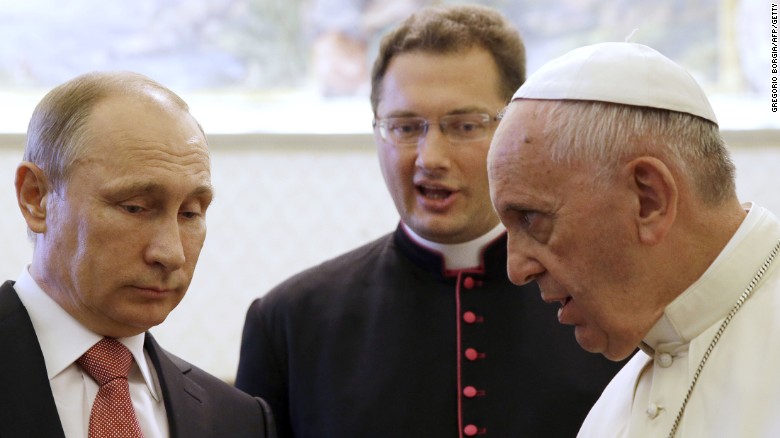
Russian President Vladimir Putin, left, meets Pope Francis at the Vatican on Wednesday, June 10. The Pope gave Putin a medallion depicting the angel of peace, Vatican spokesman Federico Lombardi said. The Vatican called it “an invitation to build a world of solidarity and peace founded on justice.” Lombardi said the pontiff and President talked for 50 minutes about the crisis in Ukraine and violence in Iraq and Syria. 5 of 34
Pope Francis meets with Cuban President Raul Castro at the Vatican on Sunday, May 10. Castro thanked the Pope for his role in brokering the rapprochement between Havana and Washington. 6 of 34
The Pope prays face down on the floor of St. Peter’s Basilica during Good Friday celebrations at the Vatican on Friday, April 3. 7 of 34
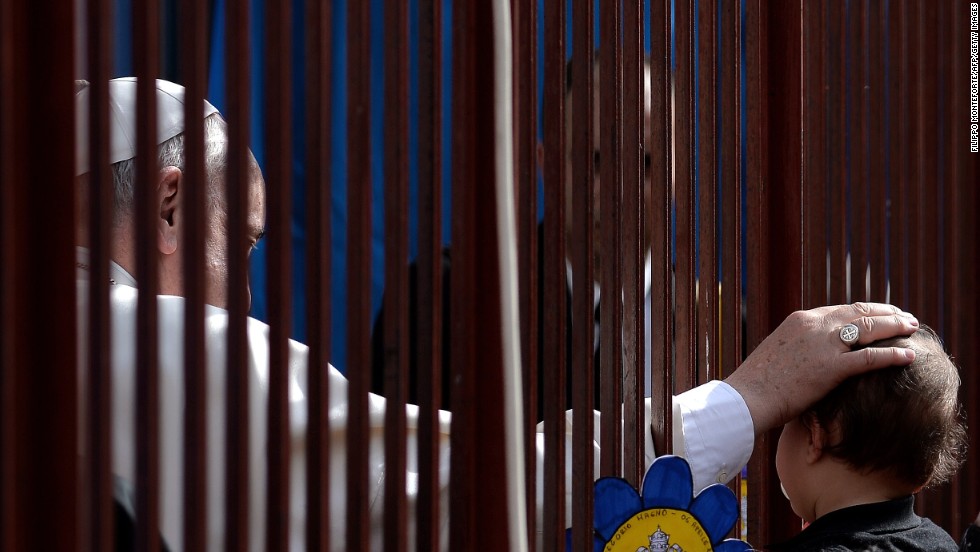
Pope Francis touches a child’s face as he arrives for a meeting in the Vatican on Friday, March 6. 8 of 34
Hindu priest Kurakkal SivaSri T. Mahadeva presents a shawl to Pope Francis in Colombo, Sri Lanka, on Tuesday, January 13. 9 of 34
The Pope attends Christmas Eve Mass at St. Peter’s Basilica in Vatican City. 10 of 34
Pope Francis and Ecumenical Patriarch Bartholomew I address the faithful in Istanbul on Sunday, November 30. 11 of 34
Pope Francis speaks during the feast-day Mass while on a one-day trip to the Calabrian region of Italy in June 2014. The Pope spoke out against the Mafia’s “adoration of evil and contempt for the common good,” and declared that “mafiosi are excommunicated, not in communion with God.” 12 of 34
Pope Francis prays next to a rabbi at the Western Wall in Jerusalem’s Old City in May 2014. The Pope went on a three-day trip to the Holy Land, and he was accompanied by Jewish and Muslim leaders from his home country of Argentina. 13 of 34
The Pope meets faithfuls as he visits the San Gregorio Parish in Rome in April 2014. 14 of 34
Queen Elizabeth II and Prince Philip, Duke of Edinburgh, have an audience with the Pope during their one-day visit to Rome in April 2014. 15 of 34
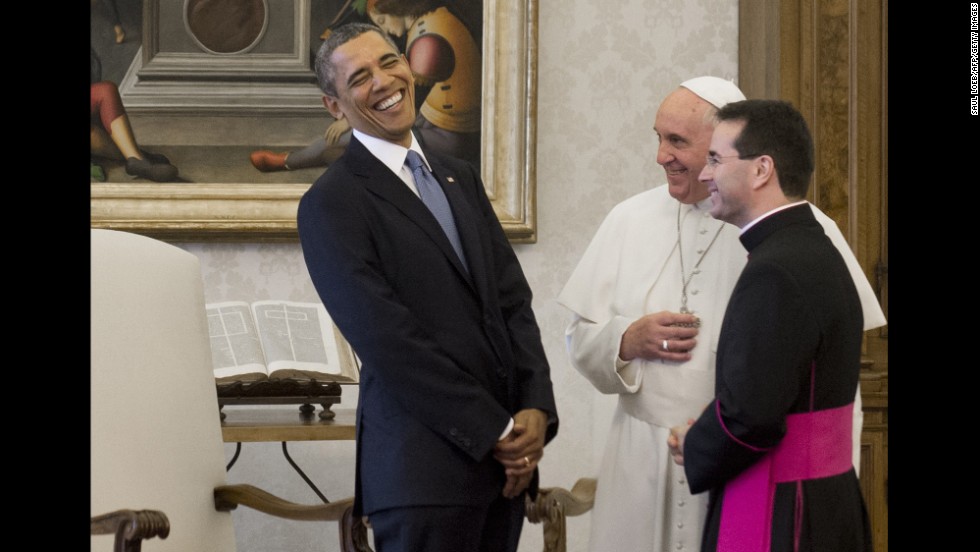
Francis speaks with U.S. President Barack Obama, who visited the Vatican in March 2014. 16 of 34
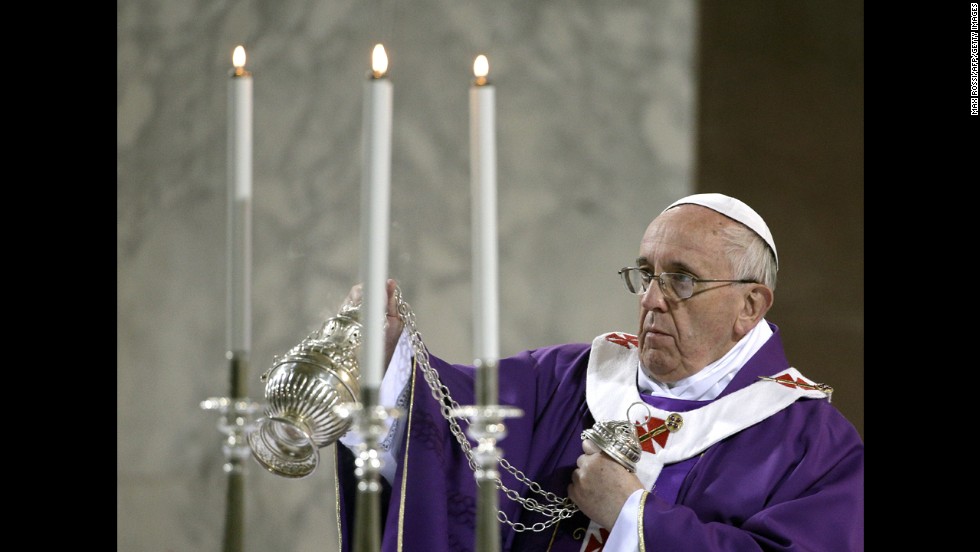
The Pope blesses the altar at Rome’s Santa Sabina church as he celebrates Mass on Ash Wednesday in March 2014. 17 of 34
Daniele De Sanctis, a 19-month-old child dressed up as a pope, is handed to Francis as the pontiff is driven through the crowd in St. Peter’s Square in February 2014. 18 of 34
Wind blows the papal skullcap off Pope Francis’ head in February 2014. 19 of 34
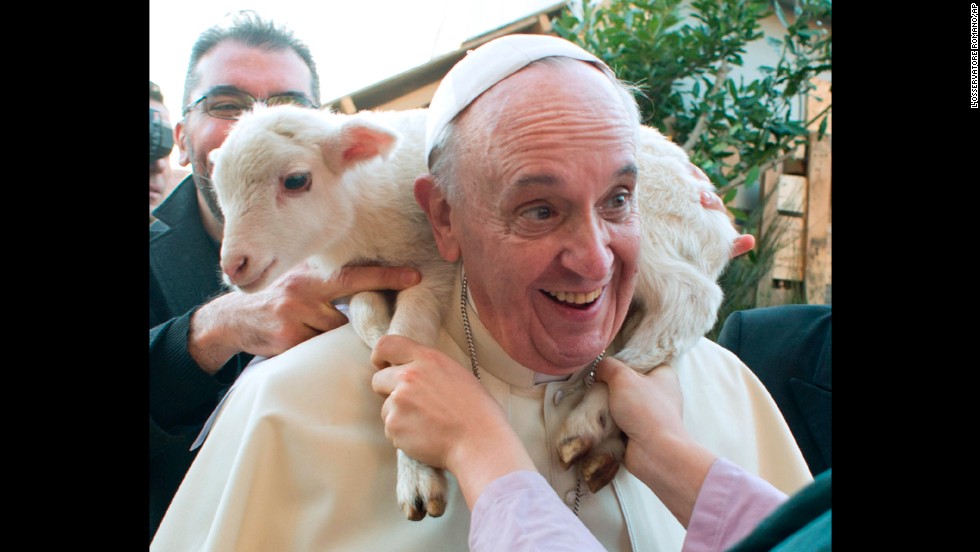
A lamb is placed around Francis’ neck in January 2014 as he visits a living nativity scene staged at a church on the outskirts of Rome. 20 of 34
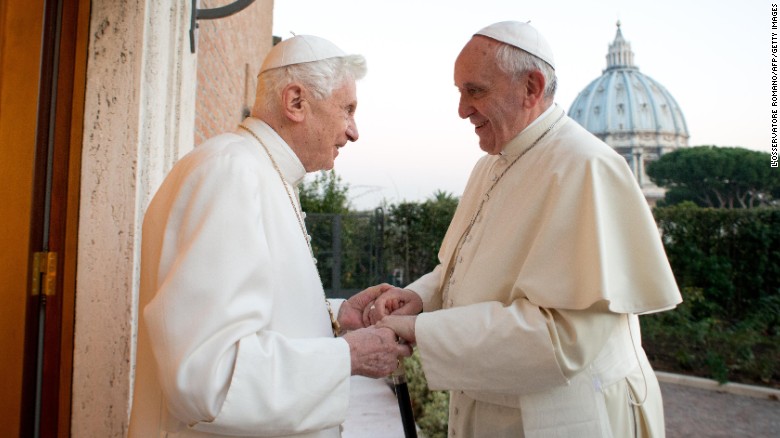
Pope Francis meets with Pope Emeritus Benedict XVI in the Vatican in December 2013. Benedict surprised the world by resigning “because of advanced age.” It was the first time a pope has stepped down in nearly 600 years. 21 of 34
Pope Francis marked his 77th birthday in December 2013 by hosting homeless men to a Mass and a meal at the Vatican. One of the men brought his dog. 22 of 34
Pope Francis embraced Vinicio Riva, a disfigured man who suffers from a non-infectious genetic disease, during a public audience at the Vatican in November 2013. Riva then buried his head in the Pope’s chest. 23 of 34
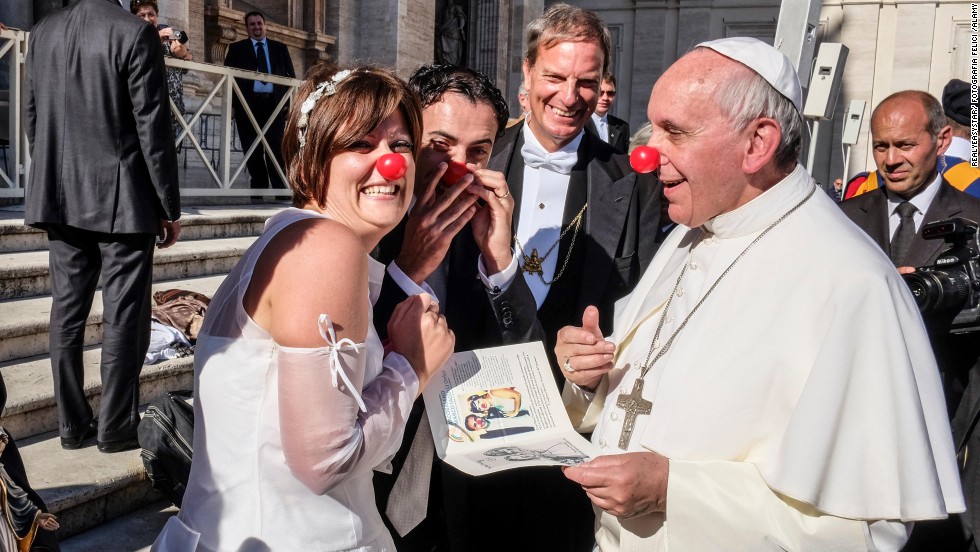
Pope Francis jokes in November 2013 with members of the Rainbow Association, which uses clown therapy in hospitals, nursing homes and orphanages. 24 of 34
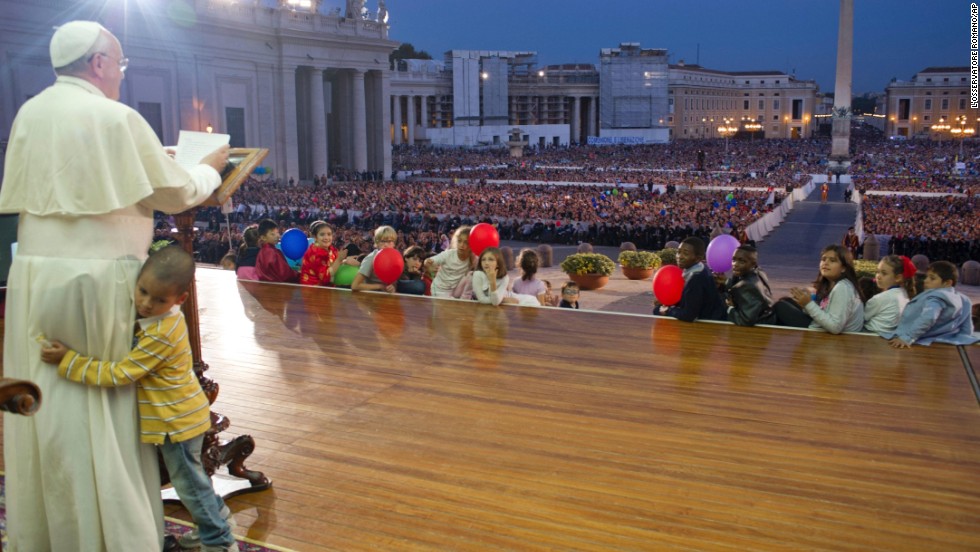
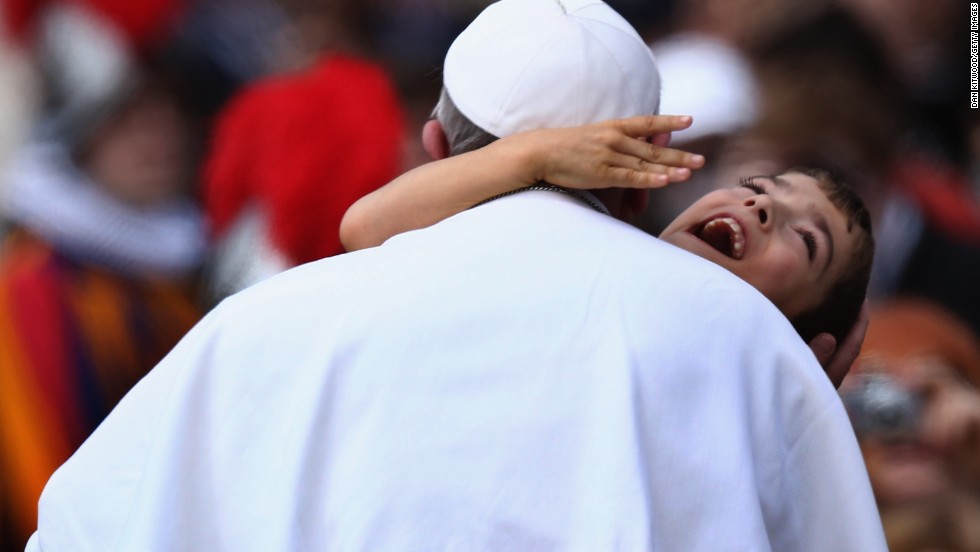
A young boy hugs Francis as he delivers a speech in St. Peter’s Square in October 2013. The boy, part of a group of children sitting around the stage, played around the Pope as the Pope continued his speech and occasionally patted the boy’s head. 25 of 34
Francis has eschewed fancy cars. Here, Father Don Renzo Zocca, second from right, offers his white Renault 4L to the Pope during a meeting at the Vatican in September 2013. 26 of 34
Francis has his picture taken inside St. Peter’s Basilica with youths who came to Rome for a pilgrimage in August 2013. 27 of 34
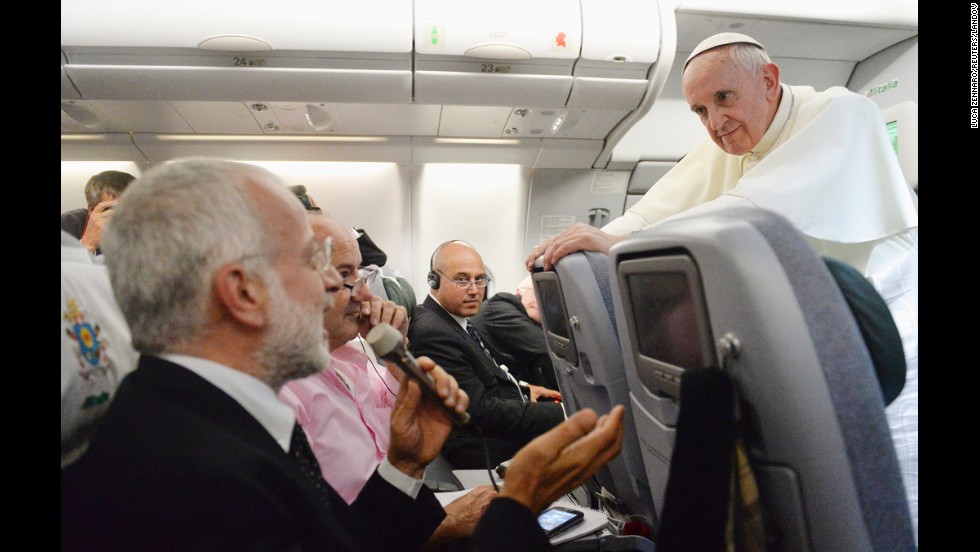
During an impromptu news conference in July 2013, while on a plane from Brazil to Rome, the Pope said about gay priests, “Who am I to judge?” Many saw the move as the opening of a more tolerant era in the Catholic Church. 28 of 34
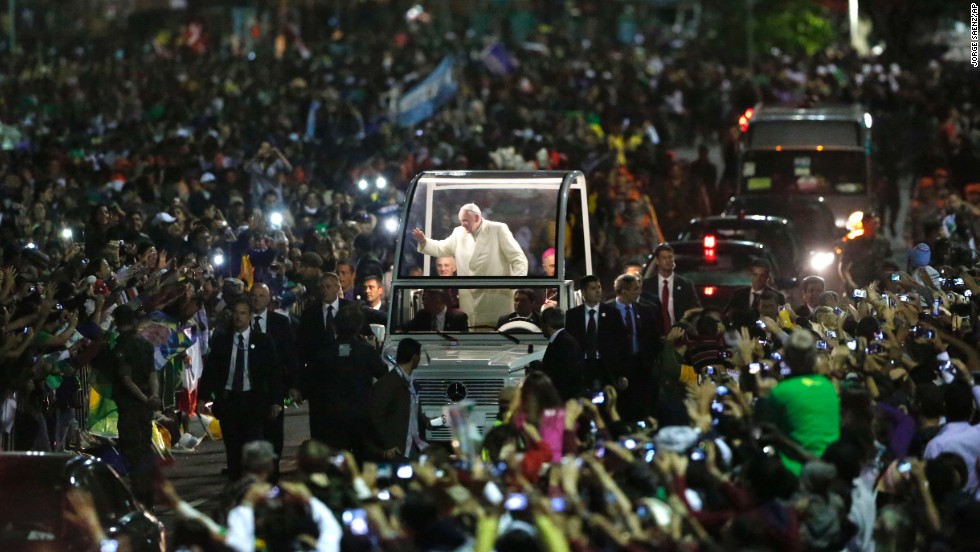
Crowds swarm the Pope as he makes his way through World Youth Day in Rio de Janeiro in July 2013. According to the Vatican, 1 million people turned out to see the Pope. 29 of 34
Francis frees a dove in May 2013 during his weekly general audience in St. Peter’s Square. 30 of 34
Francis embraces a young boy with cerebral palsy in March 2013 — a gesture that many took as a heartwarming token of the Pope’s self-stated desire to “be close to the people.” 31 of 34
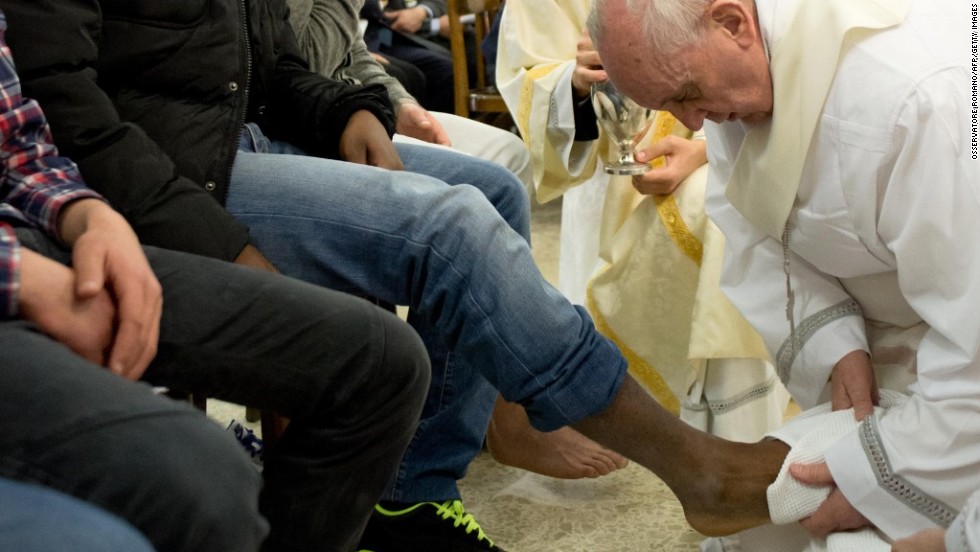
The Pope washes the feet of juvenile offenders, including Muslim women, as part of Holy Thursday rituals in March 2013. The act commemorates Jesus’ washing of the Apostles’ feet during the Last Supper. 32 of 34
Francis stands at the reception desk of the Domus Internationalis Paulus VI residence, where he paid the bill for his stay during the conclave that would elect him leader of the world’s 1.2 billion Catholics. 33 of 34
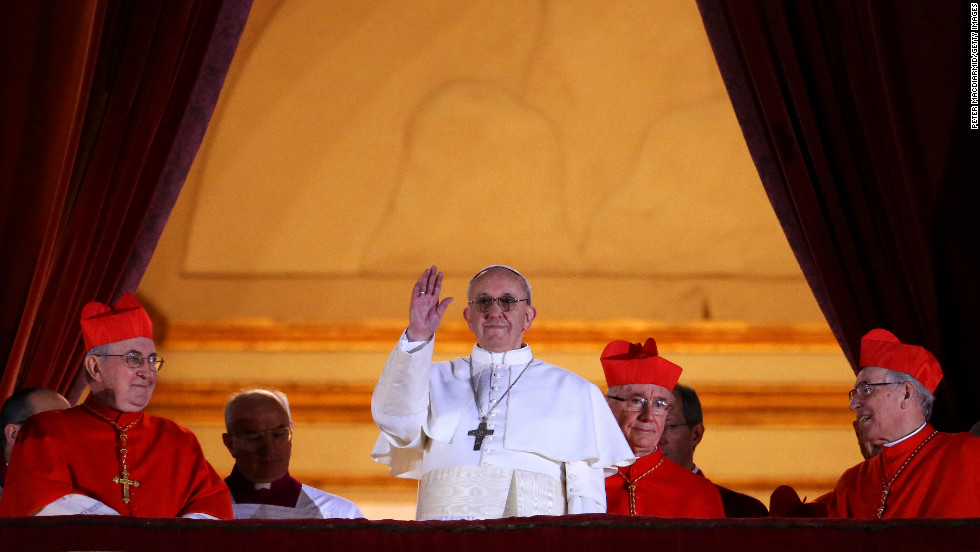
Francis, formerly known as Argentine Cardinal Jorge Mario Bergoglio, was elected the Roman Catholic Church’s 266th Pope in March 2013. The first pontiff from Latin America was also the first to take the name Francis. 34 of 34
(Vatican Radio)Pope Francis spoke to members of the Neocatacumenal Way on Friday in the Vatican’s Paul VI audience hall.
In his address, the Holy Father focused on three words: unity, glory, and world.
Below is a Vatican Radio English translation of the Holy Father’s prepared remarks:
Dear brothers and sisters, good morning!I’m glad to meet you and thank you for coming in such great numbers. I send a special greeting to those who are about to set off! You have accepted the call to evangelize: I bless the Lord for this, for the gift of the Way and for the gift of each of you. I would like to highlight three words that the Gospel has just handed you, as a mandate for the mission: unity, glory and world.
Unity.
Jesus prays to the Father so that his (followers) be ” brought to perfection as one” (Jn 17:23): he wants them to be “one” (v. 22), like Himself and the Father. It is his last request before the passion, the most heartfelt: that there be communion in the Church. Communion is essential. God’s and man’s enemy, the devil, is no match for the Gospel, cannot compete against the humble power of prayer and the Sacraments, but can do much harm to the Church by tempting our humanity. The devil provokes pride, being judgmental of others, he causes closures and divisions. He himself is “the divider” and often starts off by making us believe that we are good, perhaps better than others: thus the land is ready for the sowing of discord. It is the temptation of all communities and it can insinuate itself even in the most beautiful charism.
You have received a great charism for the baptismal renewal of life. Every charism is a grace of God to intensify communion. But this charism can deteriorate if you close in or if you boast about it, when you want to distinguish yourselves from the others. So we have to safeguard it. How? Following the main path: of humble and obedient unity. If there is this, the Holy Spirit continues to operate, just as it did in Mary, who was open, humble and obedient. It is always necessary to keep an eye on the charism, cleaning out the eventual human excesses through the search for unity with all and obedience to the Church. This is how to breathe in the Church and with the Church; this is how to stay docile children of the “Holy Mother Hierarchical Church” with a “soul which is prepared and ready” for the mission (cf. St. Ignatius of Loyola, Spiritual Exercises, 353).
I stress this point: the Church is our Mother. Just as children carry, imprinted in their faces, a similarity to their mother, we all look like our Mother, the Church. After Baptism we no longer live as isolated individuals, but we have become men and women of communion, and we are called to be operators of communion in the world. Because Jesus not only founded the Church for us, but he founded us as Church. From her we are born again, she feeds us the Bread of life, from her we receive words of life, and we are forgiven and accompanied home. This is the fruitfulness of the Church, who is Mother: not an organization that seeks followers, or a group that goes ahead following the logic of its ideas, but a mother who transmits the life received from Jesus.
This fruitfulness is expressed through the ministry and the guidance of Pastors. The institution is in fact a charisma, because rooted in the same source, which is the Holy Spirit. He is the living water, but the water can continue to give birth only if the plant is well maintained and pruned. Quench your thirst from the fountain, the Spirit, and take care, with delicacy and respect, of the whole ecclesial body, especially the most fragile parts, because all grow together, harmonious and fruitful.
The second word is: glory.
Before his Passion, Jesus foretells that He will be “glorified” on the cross: there his glory will appear (cf. Jn 17, 5). But it is a new glory: worldly glory manifests itself when one is important, admired, when one has assets and success. But God’s glory is revealed on the cross: it is love shines out and is spread. It is a paradoxical glory with clamour, no gain and no applause. This is the only glory that makes the Gospel fruitful. The Mother Church too is fruitful when it imitates the merciful love of God, that offers itself, it never imposes itself. It is humble, it’s like the rain on the earth, like the air we breathe, like a small seed that bears fruit in silence. Whoever proclaims that love can do so only with the same loving approach.
And the third word is world.
“God so loved the world” that He sent Jesus (cf. Jn 3:16). He who loves does not stay away, but comes towards. God is not attracted by worldliness, in fact, He detests it; but He loves the world he has created, and He loves His children in the world, just as they are, wherever they live, even if they are “far away.” Show the children the tender gaze of the Father and considered the realities you will encounter as a gift; become familiar with the cultures and the languages and respect local customs, recognizing the seeds of grace which the Spirit has already spread. Without yielding to the temptation to transplant acquired models, spread the news: “what is most beautiful, most grand, most appealing and at the same time most necessary” (Apost. Exhort. Evangelii Gaudium, 35). It is the good news that must always be in the forefront, otherwise faith risks becoming a cold and lifeless doctrine. To evangelize as families, experiencing unity and simplicity, is already a proclamation of life, a beautiful witness, for which I thank you so much. I accompany you and encourage you, and I ask you, please, do not forget to pray for me.
Let me first say with regard to Pope Francis, who am I to judge. God has his place ready -for sure.
When he misleads, misguides and misinterprets Holy Scripture with intent to undermine Jesus; when he uses language so abhorrent to put Jesus underfoot; when he clearly uses doublespeak-with outrageous comments- to continue his agenda, then I as a believer in Jesus Christ, true God and true man, will refute the words of his mouth – not for any self gain, but for the greater glory of God and the protection and saving of souls here on earth.
The article above is headed with the typical papal propaganda of the 21st century. This is not the way of a man who follows Jesus. This is the way of a regime who is trying to sell a message – which is the antithesis of Jesus – but is cleverly wrapped up in statements using doublespeak and propaganda. Why can’t everyone see it?
This is the secret of propaganda: The saturation of a group of people-with propagandist ideas without their noticing it. Of course it has a goal, but the goal must be so clever-and so brilliantly concealed- that the people who it influences don’t notice anything. – Goebbels(Hitler’s Henchman)
Pope Francis’ statement, typically, envelopes subtle – “brilliantly concealed” goals:
Following the main path: of humble and obedient unity – blind acceptance, but not to God – to man
keep an eye on the charism – monitor those around you, self-policing
cleaning out the eventual human excesses through the search for unity with all – root out the non-conformists
this is how to stay docile children – be easilymanagedorhandled; readilytrainedortaught;teachable.
of the “Holy Mother Hierarchical Church” – “rule of a high priest”, from ἱεράρχης, know your place and do what you’re told. Accept it -don’t question, it’s the church
a “soul which is prepared and ready” for the mission – be ready to do what you’re told to do what ever the mission is that is imposed upon you
we are called to be operators of communion in the world – operators are generally managed and maintained
she feeds us the Bread of life – infers sustenance is only possible through the church
This is the fruitfulness of the Church, who is Mother: not an organization that seeks followers – yet Jesus told His apostles to go proclaim the good news
This is the fruitfulness of the Church, who is Mother: not a group that goes ahead following the logic of its ideas – so what about the doctrine of the church?; theology?; what about the Word of God given in the Bible?
This is the fruitfulness of the Church, who is Mother: a mother who transmits the life received from Jesus. – this is the attempt at empowering an organization to become bigger than it’s founder and then remove the need for the founder. This sentence in this prepared statement is wholly ridiculous! And is not unlike many other sentences, here, and in many other statements.
These points above raise concerns about how Francis describes “what the church is”, referencing Jesus, God and motherhood. But in essence the crux of the message, like any other propaganda, Jesus and God are used as the vehicle of concealment of the subtlety to be submissive; monitor and police those around you; give up the non-conformists; accept; don’t question; do your mission because you are the operator. The plan will be transmitted from the hierarchy. This was not the instructions that Jesus gave to the apostles. And His version of “church” would be no different from then til now.
It’s Interesting to note that Jesus doesn’t pray for the world. Jesus states clearly in His prayer to His, and the only Holy, Father:
“I am asking on their behalf. I am not asking on behalf of the world, but on behalf of those you gave me, because they are yours. All that is mine is yours, and what is yours is mine, and I have been glorified through them. I am no longer in the world, but they are in the world, and I am coming to you. Holy Father, protect them by your name, the name that you gave me, so that they may be one, as we are one. While I was with them, I protected them by the authority that you gave me. I guarded them, and not one of them became lost except the one who was destined for destruction, so that the Scripture might be fulfilled.
(Joh 17:9-12)
Jesus tells us that we are called to love.
God gives us the commandments
Jesus tells us that what eternal life is in His prayer
Jesus loves us, calls us to Him, asks us to repent and sin no more.
Jesus was Almighty God’s spokesman.
Therefore, this is what the LORD says: “If you repent, I’ll take you back and you will stand before me. If you speak what is worthwhile, instead of what is worthless, then you will be my spokesman. People will turn to you, but you aren’t to turn to them. I’ll make you a fortified wall of bronze to this people. They’ll fight against you, but they won’t prevail against you, for I am with you to save you and deliver you,” So I’ll deliver you from the hand of the wicked, and redeem you from the grasp of the ruthless.”
(Jer 15:19-21)
Sadly Pope Francis is not a spokesman of God, he speaks of what is worthless and he turns to the people. The prepared statement above is not Neocatechumenal, it is anti-Catholic and anti-Christian.
#WalkWithJesus and always stay close to Jesus in your personal prayer. Your personal relationship with Jesus will safeguard your soul from the evil one.
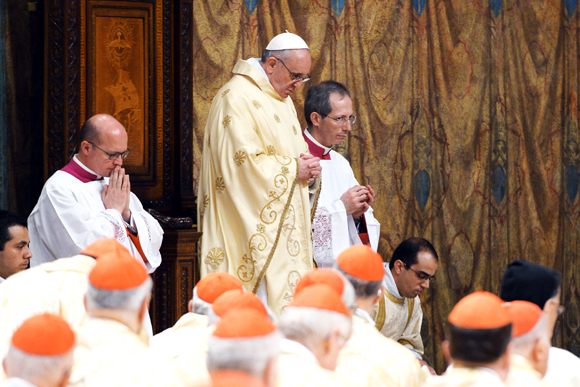
Image: Bergoglio with Military Dictator General Jorge Videla
By Bill Van Auken, March 16, 2013
For over a week, the media has subjected the public to a tidal wave of euphoric banality on the Roman Catholic Church’s selection of a new pope.
This non-stop celebration of the dogma and ritual of an institution that for centuries has been identified with oppression and backwardness is stamped with a deeply undemocratic character. It is reflective of the rightward turn of the entire political establishment and its repudiation of the principles enshrined in the US Constitution, including the wall of separation between church and state.
Argentine President Cristina Fernández de Kirchner recently referred to Bergoglio as a relic of “medieval times and the Inquisition.” At the time, El Presidente was referring to the new Pope’s position on same sex marriage while serving as Archbishop of Buenos Aires back in 2010. But was that all she meant?
To understand, we need to go back to the time of the Dirty War in Argentina.
Cardinal Jorge Mario Bergoglio and Argentina’s “Dirty War”
By Prof Michel Chossudovsky, September 25, 2015
In the course of the last two years, Pope Francis has been portrayed in chorus by the Western media as an antiwar activist and a left leaning champion of “Liberation Theology” committed to World peace and global poverty alleviation. His September 24 speech to the US Congress was described as “stunning in the breadth, depth, and conviction of its progressivism.” “If President Barack Obama had delivered the text of Pope Francis’s speech to Congress Thursday [September 24, 2015] as a State of the Union address, he would have risked being denounced by Republicans as a socialist.” Continue reading “Washington’s Pope”? Who is Pope Francis?→
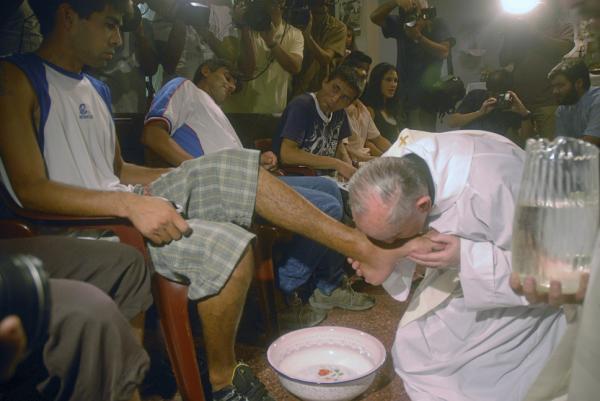
In this picture taken March 20, 2008 Argentina’s cardinal Jorge Bergoglio, right, kisses the feet of a man during a mass with youth trying to overcome drug addictions in Buenos Aires, Argentina. Bergoglio, who chose the name of Pope Francis, is the 266th pontiff of the Roman Catholic Church. The famous words uttered to announce that a leader of the Catholic Church has been chosen now have special resonance for Latin America, which had felt neglected by the Vatican and has finally produced the New World’s first pope.(AP Photo/Str )
By MICHAEL WARREN March 14, 2013 5:47 PM
BUENOS AIRES, Argentina (AP) — It’s beyond dispute that Jorge Mario Bergoglio, like most other Argentines, failed to openly confront the 1976-1983 military junta as it kidnapped and killed thousands of people in a “dirty war” to eliminate leftist opponents.But human rights activists differ on how much responsibility Pope Francis personally deserves for the Argentine church’s dark history of supporting the murderous dictatorship. Continue reading New pope tied up in Argentina’s ‘dirty war’ debate→
Pope Francis was born in Buenos Aires on 17 December 1936, the son of Italian immigrants.
His father Mario was an accountant employed by the railways and his mother Regina Sivori was a committed wife dedicated to raising their five children. He graduated as a chemical technician and then chose the path of the priesthood, entering the Diocesan Seminary of Villa Devoto. On 11 March 1958 he entered the novitiate of the Society of Jesus. He completed his studies of the humanities in Chile and returned to Argentina in 1963 to graduate with a degree in philosophy from the Colegio de San José in San Miguel. From 1964 to 1965 he taught literature and psychology at Immaculate Conception College in Santa Fé and in 1966 he taught the same subject at the Colegio del Salvatore in Buenos Aires. From 1967-70 he studied theology and obtained a degree from the Colegio of San José.
On 13 December 1969 he was ordained a priest by Archbishop Ramón José Castellano. He continued his training between 1970 and 1971 at the University of Alcalá de Henares, Spain, and on 22 April 1973 made his final profession with the Jesuits. Back in Argentina, he was novice master at Villa Barilari, San Miguel; professor at the Faculty of Theology of San Miguel; consultor to the Province of the Society of Jesus and also Rector of the Colegio Máximo of the Faculty of Philosophy and Theology.
On 31 July 1973 he was appointed Provincial of the Jesuits in Argentina, an office he held for six years. He then resumed his work in the university sector and from 1980 to 1986 served once again as Rector of the Colegio de San José, as well as parish priest, again in San Miguel. In March 1986 he went to Germany to write a doctoral thesis on Romano Guardini; his superiors then sent him to the Colegio del Salvador in Buenos Aires and next to the Jesuit Church in the city of Córdoba as spiritual director and confessor.
It was Cardinal Antonio Quarracino, Archbishop of Buenos Aires, who wanted him as a close collaborator. So, on 20 May 1992 Pope John Paul II appointed him titular Bishop of Auca and Auxiliary of Buenos Aires. On 27 May he received episcopal ordination from the Cardinal in the cathedral. He chose as his episcopal motto, miserando atque eligendo, and on his coat of arms inserted the ihs, the symbol of the Society of Jesus.
He gave his first interview as a bishop to a parish newsletter, Estrellita de Belém. He was immediately appointed Episcopal Vicar of the Flores district and on 21 December 1993 was also entrusted with the office of Vicar General of the Archdiocese. Thus it came as no surprise when, on 3 June 1997, he was raised to the dignity of Coadjutor Archbishop of Buenos Aires. Not even nine months had passed when, upon the death of Cardinal Quarracino, he succeeded him on 28 February 1998, as Archbishop, Primate of Argentina and Ordinary for Eastern-rite faithful in Argentina who have no Ordinary of their own rite.
Three years later at the Consistory of 21 February 2001, John Paul ii created him Cardinal, assigning him the title of San Roberto Bellarmino. He asked the faithful not to come to Rome to celebrate his creation as Cardinal but rather to donate to the poor what they would have spent on the journey. As Grand Chancellor of the Catholic University of Argentina, he is the author of the books: Meditaciones para religiosos (1982), Reflexiones sobre la vida apostólica (1992) and Reflexiones de esperanza (1992).
In October 2001 he was appointed General Relator to the 10th Ordinary General Assembly of the Synod of Bishops on the Episcopal Ministry. This task was entrusted to him at the last minute to replace Cardinal Edward Michael Egan, Archbishop of New York, who was obliged to stay in his homeland because of the terrorist attacks on September 11th. At the Synod he placed particular emphasis on “the prophetic mission of the bishop”, his being a “prophet of justice”, his duty to “preach ceaselessly” the social doctrine of the Church and also “to express an authentic judgement in matters of faith and morals”.
All the while Cardinal Bergoglio was becoming ever more popular in Latin America. Despite this, he never relaxed his sober approach or his strict lifestyle, which some have defined as almost “ascetic”. In this spirit of poverty, he declined to be appointed as President of the Argentine Bishops’ Conference in 2002, but three years later he was elected and then, in 2008, reconfirmed for a further three-year mandate. Meanwhile in April 2005 he took part in the Conclave in which Pope Benedict XVI was elected.
As Archbishop of Buenos Aires — a diocese with more than three million inhabitants — he conceived of a missionary project based on communion and evangelization. He had four main goals: open and brotherly communities, an informed laity playing a lead role, evangelization efforts addressed to every inhabitant of the city, and assistance to the poor and the sick. He aimed to re-evangelize Buenos Aires, “taking into account those who live there, its structure and its history”. He asked priests and lay people to work together. In September 2009 he launched the solidarity campaign for the bicentenary of the Independence of the country. Two hundred charitable agencies are to be set up by 2016. And on a continental scale, he expected much from the impact of the message of the Aparecida Conference in 2007, to the point of describing it as the “Evangelii Nuntiandi of Latin America”.
Rachel Mike, who won a settlement in a case involving Father Poole, at her confirmation in the summer of 1975. Behind her is Father George Endal, accused of raping or molesting several boys and allegedly walking in on another priest performing oral sex on a 6-year-old boy and doing nothing to stop it.
Alaska Natives are accusing the Catholic Church of using their remote villages as a “dumping ground” for child-molesting priests—and blaming the president of Seattle University for letting it happen.
by Brendan Kiley
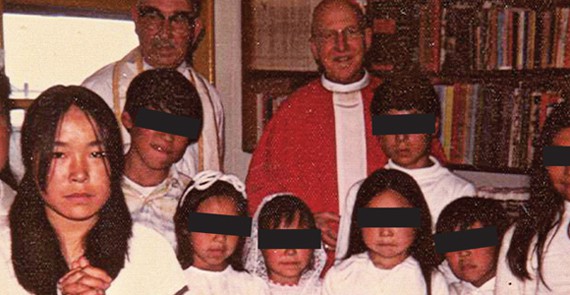
Father James Poole in Nome, Alaska, with parish kids, in a photo taken sometime in the 1970s.
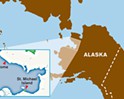
The remote region in Alaska the lawsuit alleges was a molester priest “dumping ground.”
One spring afternoon in 1977, 15-year-old Rachel Mike tried to kill herself for the third time. An Alaska Native, Rachel was living in a tiny town called Stebbins on a remote island called St. Michael. She lived in a house with three bedrooms and nine siblings. Rachel was a drinker, depressed, and starving. “When my parents were drinking, we didn’t eat right,” she says. “I just wanted to get away from the drinking.”
Rachel walked to the bathroom to fetch the family rifle, propped in the bathtub with the dirty laundry (the house didn’t have running water). To make sure the gun worked, Rachel loaded a shell and blew a hole in her bedroom wall. Her father, passed out on his bed, didn’t hear the shot. Rachel walked behind their small house. Her arms were too short to put the rifle to her head, so she shot herself in her right leg instead.
Rachel was found screaming in a pool of blood by her Auntie Emily and flown 229 miles to a hospital in Nome. The doctor asked if she wanted to see a priest. She said yes. In walked Father James Poole—a popular priest, radio personality on KNOM, and, according to allegations in at least five lawsuits, serial child rapist. Father Poole has never been convicted of a crime, but the Jesuits have settled numerous sex-abuse claims against him since 2005, in excess of $5 million, according to an attorney involved in four of those five lawsuits. Exact figures aren’t available because some of the settlements involve confidentiality agreements. The Jesuits have never let a single case against Father Poole go to trial.
In a 2005 deposition, Rachel testified that she had been molested by Father Poole in 1975, while in Nome for her second suicide attempt, an attempted overdose of alcohol and pills. He’d come sit by her bed, put his hand under the hospital blanket, and fondle her, she said.
She traveled between Stebbins and Nome several times in the late 1970s, spending time in hospitals and receiving homes. By 1977, Rachel testified, Poole had given her gonorrhea, and by 1978 she was pregnant with his child. In an interview with The Stranger, she said Poole encouraged her to get an abortion and tell the doctors she had been raped by her father. She followed his advice. “He brainwashed me,” she said. “He messed up my head, man.”
Rachel Mike’s father died in 2004. A year later, she heard Elsie Boudreau, another survivor of Poole’s abuse, being interviewed on the radio. Listening to Boudreau, Rachel was moved to finally tell the truth.
“He’s gone, and I’ll never have a chance to tell him in person,” she said, talking about her father between heaving sobs. “I was scared. In a way he knew, but—he never even touched me.”
“This man,” says Anchorage-based attorney Ken Roosa, referring to Poole, “has left a trail of carnage behind him.”
The only reason Poole is not in jail, Roosa says, is the statute of limitations. And the reason he’s still a priest, being cared for by the church?
“Jim Poole is elderly,” answered Very Reverend Patrick J. Lee, head of the Northwest Jesuits, by e-mail. “He lives in a Jesuit community under an approved safety plan that includes 24-hour supervision.”
Roosa has another theory—that Poole knows too much. “They can’t put him on the street and take away his reason for keeping quiet,” Roosa says. “He knows all the secrets.”
Father James Poole’s story is not an isolated case in Alaska. On the morning of January 14 in Seattle, Ken Roosa and a small group Alaska Natives stood on the sidewalk outside Seattle University to announce a new lawsuit against the Jesuits, claiming a widespread conspiracy to dump pedophile priests in isolated Native villages where they could abuse children off the radar.
“They did it because there was no money there, no power, no police,” Roosa said to the assembled cameras and microphones. “It was a pedophile’s paradise.” He described a chain of poor Native villages where priests—many of them serial sex offenders—reigned supreme. “We are going to shine some light on a dark and dirty corner of the Jesuit order.”
The suit, filed in the superior court of Bethel, Alaska, the day before, accuses several priests of being offenders and conspirators. Among the alleged conspirators is Father Stephen Sundborg, who is the current president of Seattle University and was Provincial of the Oregon Province of Jesuits from 1990 through 1996. (The Oregon Province includes Washington, Oregon, Montana, Idaho, and Alaska; as Provincial, Sundborg was head of the entire province.) The suit alleges that while Sundborg was head of the Northwest Jesuits, he had access to the personnel files of several pedophile priests, including one named Father Henry Hargreaves, whom he allowed to remain in the ministry. “As a direct result of Father Sundborg’s decision,” the suit alleges, “Father Hargreaves was able to continue molesting children, including but not limited to James Doe 94, who was raped by Father Hargreaves in 1992, when James Doe was approximately 6 years old.”
Roosa and his associate Patrick Wall (a former Benedictine monk who once worked as a sex-abuse fixer for the Catholic Church) said they knew of 345 cases of molestation in Alaska by 28 perpetrators who came from at least four different countries.
This concentration of abuses is orders of magnitude greater than Catholic sex-abuse cases in other parts of the United States. Today, Roosa said, there are 17,000 Catholics in the diocese of Fairbanks, though there was a much smaller number during the peak of the abuse. Roosa compared this lawsuit to the famous Los Angeles suits of 2001, which claimed 550 victims of abuse in a Catholic population of 3.4 million.
These abusers in Alaska, Wall said, were specifically sent to Alaska “to get them off the grid, where they could do the least amount of damage” to the church’s public image.
One by one, the Alaska Natives—including Elsie Boudreau, the woman whom Rachel Mike had heard on the radio—took their turns before the cameras and microphones, talking softly and nervously and choking back tears. “I am Flo Kenny,” a woman with a gray ponytail and sunglasses said carefully. “I am 74 years old. And I’ve kept silent for 60 years. I am here for all the ones who cannot speak—who are dead, who committed suicide, who are homeless, who are drug addicts. There’s always been a time, an end of secrets. This is the time.”
Alphonsus Abouchuk, wearing a black leather jacket and sunglasses, talked about how poor his family was and how the priests used to give him quarters after abusing him.
Rena Abouchuk, his sister, cried while she read a letter to a Franciscan monk named Anton Smario (currently living in Concord, California) who taught her catechism classes. “You did so many evil things to young children,” she read, gripping her letter in one hand and an eagle feather tied to a small red sachet in the other. “God will never forgive you… You took a lot of lives.” Six of her cousins, she later said, committed suicide because of Brother Smario.
The lawsuit states that Brother Smario offered children food and juice to coax them to stay after class: “He then would unzip his pants, and completely expose his genitals to these children, and masturbate to ejaculation as he walked around the classroom. He would ask the girls to touch his penis and would rub his erect penis on their backs, necks, and arms. Sometimes he would wipe or rub his semen on the girls after he ejaculated.”
According to the allegations, Father Joseph Lundowski molested or raped James Does 29, 59–71, and 73–94, plus Janet Does 4–7—a total of 40 children—giving them “hard candy, money he stole from the collection plate, cooked food, baked goods, beer, sacramental wine, brandy, and/or better grades (silver, blue, or gold stars) on their catechism assignments in exchange for sexual favors.”
The lawsuit also alleges Father George Endal raped and molested several boys—and, as Smario and Lundowski’s boss, was the person who put Lundowski in charge of the boys dormitory in the Holy Rosary Mission School in Dillingham, Alaska, where catechism classes were split between Smario (in charge of the girls) and Lundowski (in charge of the boys). On separate occasions, Father Endal and another priest named Norman E. Donohue—who allegedly raped James Doe 69—walked in on Lundowski while he was molesting children and either quietly left the room or did nothing to stop it.
Father Francis Fallert, principal of the Copper Valley School and head of the all the Alaska Jesuits from 1976 to 1982, is accused of molesting Janet Doe 6.
The sheer concentration of known sex offenders in these isolated communities begins to look less like an accident than a plan. Their institutional protection looks less like an embarrassed cover-up than aiding and abetting. And the way the church has settled case after case across the country, refusing to let most of them go to trial for a public airing, is starting to look like an admission of guilt.
When Patrick Wall wore monk’s robes, he must’ve looked like Friar Tuck. A former all-state football lineman, Wall has broad shoulders, a brawny neck, short reddish hair, and a habit of calling people “bro.”
We met last week in Sea-Tac Airport’s Alaska Airlines Board Room—a two-story business lounge, just past the security check, with conference tables, ergonomic chairs next to computer stations, and free espresso. He and Ken Roosa were there to meet with a client. Wall lives in California, Roosa lives in Anchorage, and many of their clients are on the West Coast, so they’ve done a lot of business in the Board Room. “I like to spend the night at home,” Wall says, setting his airplane reading—The Name of the Rose—on the conference-room table.
Wall’s first call as a sex-abuse fixer knocked on his door one morning in 1991, while he was brushing his teeth. Wall was not yet a priest, just a monk studying at St. John’s University in Minnesota. The abbot came to his room before class with an urgent matter regarding another monk and said Wall would be moving into the boy’s prep-school dormitory—immediately. The other monk “had an incident with a 14-year-old in the shower.” Wall was to take his place.
Taken aback, Wall threw up every objection he could think of. He didn’t own a computer and used the communal ones in the monastery. “We’ll buy you a laptop.” He helped with mass at a local parish. “We’ll reassign you to campus ministry.” He was on call for the volunteer fire department. “Not anymore.” The abbot wouldn’t take no for an answer.
So Wall packed up, moved into the boys dormitory, quickly intuited who else on the floor had been abused (5 out of the 90 residents), and coaxed them into talking about what had happened. Those cases never became public and were settled out of court. “If you’re good,” Wall says, “the assignments build.” Wall was so good, he was ordained a year early and kept busy, working as many as 13 cases per month.
The job was harrowing and frustrating. “If you’re the cleaner, you rarely find out the resolution to these things,” Wall says. “Because survivors had to sign confidentiality agreements.” The ultimate objective, for a cleaner, was to keep things quiet so the details never became public or went to trial. Wall slowly came to believe that his superiors were more concerned with protecting their public image than caring for survivors. It was, he says, a dark time, not least because he was struggling with his own vows of celibacy. In 1998, he asked to be laicized. By 2001, he was married to a ballet dancer and had a newborn daughter. By 2002, he was hired as a full-time researcher for the law firm Manly and Stewart investigating clerical sex-abuse cases.
Since then, he and Roosa—who often collaborate on cases with attorney John Manly—have worked over 250 cases together, all of them settled without going to trial. “I would like to see any of these cases go to trial to expose the corruption of the system,” Wall says. But the church would rather pay the money than subject itself to public scrutiny, and survivors generally prefer to avoid the increased emotional turmoil of a trial. “There was one survivor who went through 11 days of questioning, of deposition,” Roosa says. “The defense lawyers can make it so painful.”
“If you bend a young plant, it grows at an angle,” Roosa says. “Child sex abuse bends the character and maturation of a person—the abuse isn’t the injury as much as the effect it has on people.”
Father Poole’s alleged abuses are particularly egregious, earning him a special place in Roosa’s and Wall’s hearts. He is their archetypal bad guy, their Dr. Mengele of the clerical sex-abuse world: Their clients have described, in sworn testimony, Poole pressing his erections against girls during junior-high dances, being caught by his own mother while masturbating in front of young girls, and much worse. “The defense lawyers have been so disgusted with Poole,” Roosa says, “that they’ve told me off the record, ‘anything you tell me about Poole, I’d believe.'”
According to a victim identified as Jane Doe 5 in a 2006 complaint, Poole first raped her during a private catechism class when she was 6 years old. From a direct transcript of her testimony:
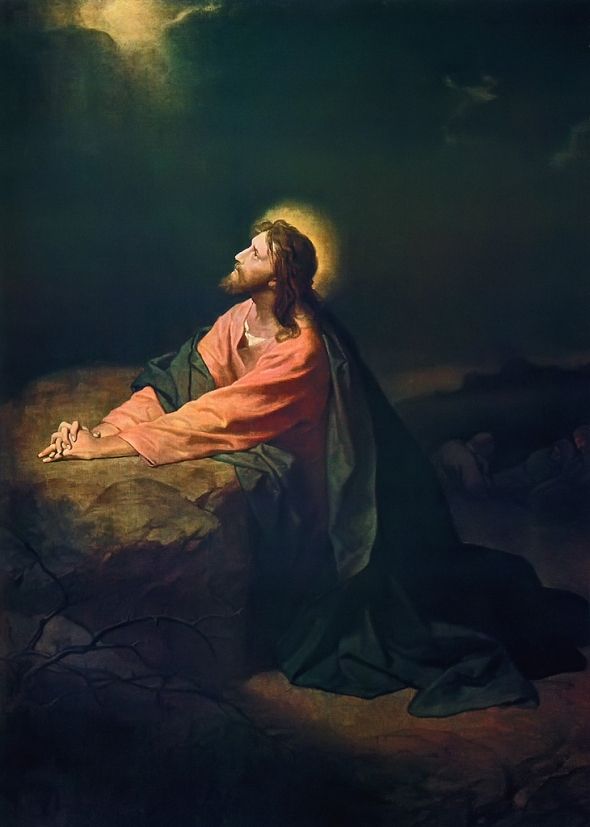
He started fidget—finger—started to touch me digitally with his fingers. And at that time, when he started getting closer to me, I—there’s a picture—I’m on the desk, a picture to the left of me is a picture of Jesus who’s at the rock praying, and to my left I look at the picture to my left, and I look into James Poole’s eyes. I turned away from the picture, looked into his eyes, and asked ‘Not in front of Jesus, please.’… He kept telling me that in order to be a good little girl for God, I had to do this. That God wanted me to do this. And I remember a burning…
Then, she says, he raped her.
Roosa tells a story about Poole molesting a 9-year-old girl in Portland, Oregon, while simultaneously having an affair with the girl’s mother. Poole supposedly told the girl’s mother he would quit the priesthood and marry her, but abruptly returned to Alaska. The girl’s mother committed suicide. According to Wall and Roosa, that same girl says she was molested by another priest, one who has been listed in at least three settlements in cases that reach back to the 1960s. They say that, in one incident, this priest was called to a house in Yakima to administer last rites to a dying woman in 1989. “He raped the woman on her deathbed,” Roosa says. “He told the family to go into the other room, the husband heard a weird noise, went into the bedroom, and caught him raping his unconscious wife.”
The woman didn’t die, and by the time Roosa and Wall caught up with her family last May, the church had offered the family half a million dollars. The family said they’d file a legal complaint if Roosa and Wall could guarantee more than half a million dollars in compensation.
“No,” Wall said. “Take it, bro.”
Within hours of the press conference on the sidewalk in front of Seattle University on January 14—which essentially alleges that Father Stephen Sundborg allowed molester priests to minister freely as members of the Northwest Jesuits when it was his responsibility, as Provincial, to keep them away from children—Sundborg denied having any information about the Jesuit “dumping ground” in Northwest Alaska:
The allegations brought against me are false. I firmly deny them. I want the victims and the entire community to know that. The complaint filed by the plaintiffs’ lawyers represents an unprincipled and irresponsible attack on my reputation. Let me be clear—my commitment to justice and reconciliation for all victims remains steadfast.
On January 31, Father Sundborg, through his spokesperson, responded to questions from The Stranger with this statement:
I want to be very clear: As Provincial of the Oregon Province of the Society of Jesus, I would never have put a child at risk. I was never aware of any claim of child abuse concerning either Fr. James Poole or Fr. Henry Hargreaves.
As I have said repeatedly in the past, as a member of the Society of Jesus, I personally and sincerely apologize for the pain that has been suffered through the actions of some members of our order. I am disappointed that the plaintiffs’ attorneys are attempting to use falsehoods and innuendo to fuel a media campaign. Their attack on my reputation is unprincipled and irresponsible. Nonetheless, I remain firm in my resolve to seek justice and reconciliation for all victims.
With the exception of Father Hargreaves allegedly raping James Doe 94 in 1992, no abuses—at least none that have been reported—occurred while Sundborg was Provincial.
Still, Wall says, “Stevie has a little problem.”
Hargreaves, Poole, and other problem priests continued to work in the ministry during Sundborg’s tenure between 1990 and 1996 and, in Elsie Boudreau’s words, “We know that he knew.”
Father Poole came under scrutiny as early as 1961, when complaints about his behavior reached Rome and the Father-General of the Jesuits initiated an investigation.
In 1994, Poole was sent to the Servants of the Paraclete—a Jesuit-run psychiatric facility for troubled priests in Jemez Springs, New Mexico—where, he later testified in a 2004 deposition, he learned that he had boundary issues, that he “wasn’t this great king and lover,” and that “French-kissing” a 12-year-old girl is “wrong.”
Poole denies raping anyone but admits to “French-kissing” Boudreau—and emphatically denies that French-kissing her was in any way sexual. “With Elsie, I have never had any sexual impulse,” he said in the 2004 deposition, “never had any sexual temptation.” Later in this same testimony, John Manly asked Poole whether he had ever French-kissed his own niece.
“No,” Poole replied.
“Why?” Manly asked.
Poole hesitated.
“Why not?” Manly insisted. “I think I know the answer, but I want you to say it.”
“We were not that close, for one thing,” Poole replied. “My brother had always lived away from us.”
“Any other reason?” Manly asked.
“No,” Poole said.
Monthly progress reports were sent to Sundborg during Poole’s treatment in Jemez Springs. After his release, Poole continued to work as a hospital chaplain in Alaska until November of 2003, when Roosa threatened to sue the Bishop of Fairbanks over the childhood abuse of Elsie Boudreau. Poole retired shortly thereafter and was sent to Spokane, to live in an apartment near Gonzaga University. (Attempts to contact Father Poole for comment were unsuccessful.)
Father Sundborg testified in 2005 that he sent at least eight priests—including Father Poole, Father James Laudwein, and Father Craig Boly—for psychiatric evaluation by Dr. Stuart Greenberg, a leading consultant on clerical sex abuse for the Northwest Jesuits. After their visits with Dr. Greenberg, Poole, Laudwein, and Boly were returned to active ministry.
At the time of Sundborg’s 2005 testimony, Father Laudwein was a defendant in a sex-abuse suit that ended in 2007 with a $50 million settlement, according to the Anchorage Daily News. And, in 1992, Father Boly wrote an essay for a book called Jesuits in Profile: Alive and Well in the U.S. about his attraction to high-school girls:
I remember being reprimanded more than once for spending too much time with visiting coeds from other local high schools. My rationalization was that if attractive young women brought their problems to me, it must be an opportunity for apostolic service. What I neglected to consider was what needs of my own the interactions with the women students were meeting.
Sundborg also contributed an essay to Jesuits in Profile, but testified in 2005 that he had no recollection of reading the book.
Dr. Greenberg—the counselor to whom Sundborg had sent Poole, Laudwein, Boly, and others for evaluation—was arrested in the summer of 2007 for surreptitiously filming staff members and patients using the bathroom at his office and, according to Roosa, filming himself masturbating while watching the films. A few weeks later, he rented a room at a motel in Renton, where he committed suicide. Police found him with a bunch of bottles of prescription pills and two slashed wrists.
“I wish I could offer you some adequate explanation,” his suicide note read. “I just don’t know. I deeply and profoundly apologize.”
This isn’t Sundborg’s first go-around with fending off a sex-abuse case. In 2006, the Jesuits settled a $350,000 suit against Father Michael Toulouse, a philosophy professor at Seattle University accused of abusing a 12-year-old boy in his residence in 1968. At the time of the settlement, Father Sundborg argued that Seattle University wasn’t liable, even though the abuse happened on campus, because the abuse occurred outside of his official duties as a teacher—a rare Catholic argument for the separation of church and sex.
Complaints against Toulouse (who died in 1976) date from 1950, when a Spokane father threatened to shoot Toulouse, who was then teaching at Gonzaga High School. Toulouse was transferred to Seattle, where he allegedly molested several boys, including the son of a widow in 1967. The widow and another Jesuit wrote to the province in 1968 requesting action. (Father Toulouse continued teaching at Seattle University until 1976.) When the widow’s son sought compensation in 1993, Sundborg wrote back, according to the Seattle Times: “There is nothing about this matter in the provincial files, in the personnel files of Fr. Toulouse, or in the files of Seattle University.”
That may be. But Father Thomas Royce, Provincial of the Northwest Jesuits from 1980 to 1986, just four years before Sundborg became Provincial, has testified that similar information about Jesuits does exist in the personnel files—that they contain information that is “special,” “not public,” and “not good.”
He called them “the hell files.”
Elsie Bourdreau is a Yu’pik Eskimo with short brown hair, plump cheeks, and, when she is not testifying at grim press conferences, a radiant smile. As Janet Doe 1, Boudreau was the first person to speak publicly about being abused by Father Poole. She kept silent about her abuse until 2005, when her daughter turned 10. “I was 10 when the abuse started,” she says. “And I just couldn’t shield it from my consciousness anymore.” She’s now employed as a consultant to law firms pursuing clerical sex-abuse cases, including the firms where Wall and Roosa work.
When Boudreau was a child, the villages of Northwest Alaska were only accessible by plane, boat, or dog sled. Many still are. For the most part, they didn’t have public schools, cops, or telephones. Many of the houses were one room and lacked food and consistent heat in the below-zero weather. “The perps would soften up their victims with food and warmth,” Wall says, “because that’s what the kids didn’t have. ‘It was always warmer in the rectory,’ they say. ‘There was always food in the rectory. There was always candy.'”
In those villages, the priests had unusual authority. “In the village, our elders loved the church and the priests so much,” Boudreau says. “They were like honored guests in our land. The priest had the utmost power, power that historically the village shaman would have had.” If children complained about the priests, it was tantamount to complaining about the village shaman. “I’ve talked to hundreds of victims in Alaska,” Boudreau says, “and many were physically hurt by parents for speaking about this.”
The priests came to occupy the role of shamans by a weird confluence of history and microbiology. In the early 1900s, a Spanish-influenza epidemic ripped through Northwest Alaska, sometimes killing entire villages. They called it “the Big Sickness” or “the Big Death.”
Winton Weyapuk was a child in Wales, Alaska, and was orphaned by the epidemic. In an interview from 1997, he recalled that the flu came on a dog sled. The mailman, on his monthly delivery, brought the corpse of a man who’d died on the way to Wales. Curious villagers crowded around the corpse. “The men, women, and children who came to see this body went home, and many got sick and most of them died before the next morning.”
Weyapuk’s father died that first night, so the family moved into an uncle’s house. Most everyone in the uncle’s house died, and Weyapuk and his brother Dwight lived in a one-room sod house with four corpses until someone found them. He recalls seeing white men building tripods over the sod houses, using block and tackle to pull frozen bodies up through the skylights, then blasting holes in the frozen ground with dynamite for mass graves. Family sled dogs, neglected and starving, roamed the streets and fought over human remains.
The shamans, normally counted on as healers, were helpless. The population was decimated, and the social structure had to be created from nothing: Another Wales resident remembers that, in the aftermath, so many families had been destroyed that an official from Nome came to the village with a stack of notarized wedding licenses. He lined up all the surviving men, all the surviving women, and all the surviving children, and built families at random.
Catholic missionaries made major inroads into these communities in the aftermath of the Big Sickness. (Along with the Baptists and Orthodox churches. The major churches had a summit in Sitka years prior and divided up their geographical spheres of influence.) The missionaries brought flour and coffee, built orphanages and schools. “They looked at the shamans as evil and of the devil,” Boudreau says. A new social order was created. In the villages of Northwest Alaska, the Jesuits stepped into a tailor-made power vacuum.
The history of child molestation in the Catholic Church goes back centuries. The first official decree on the subject was written at the Council of Elvira, held around A.D. 305 near Granada, Spain. The precise history is complicated, but the council is traditionally believed to have set down 81 rules for behavior, the 71st of which is: “Those who sexually abuse boys may not commune even when death approaches.” It was the harshest one-strike policy: If you’re caught abusing a child, you are not only laicized, but permanently excommunicated—damned for all time.
The other major condemnation of clerical sex abuse was The Book of Gomorrah, completed by radical church reformer Father Peter Damian (a Benedictine monk, as it happens, who became a cardinal) in 1051. He appealed directly to the pope about the abuse of children, as well as consensual sex among clergy—in howling language: “O unheard of crime! O outrage to be mourned with a whole fountain of tears!… What fruitfulness can still be found in the flocks when the shepherd is so deeply sunk in the belly of the devil!”
In the 1930s, a priest-psychiatrist—and also a Benedictine—named Reverend Thomas Verner Moore researched the higher-than-usual rates of insanity and alcoholism among Catholic clergy. He suggested the church build an asylum for priests. The U.S. Catholic Bishops turned down his request in 1936. Father Moore became a Carthusian hermit.
In 1947, Father Gerald Fitzgerald founded the Servants of the Paraclete in Jemez, New Mexico—the same institution Father Poole was to visit almost 50 years later.
In a 1957 letter to the Bishop of Manchester, Father Fitzgerald wrote that predatory priests (who he euphemistically refers to as “schizophrenic”) cannot be effectively treated and should not be allowed to continue in the ministry:
Their repentance and amendment is superficial and, if not formally at least subconsciously, is motivated by a desire to be again in a position where they can continue their wonted activity. A new diocese means only green pastures… We are amazed to find how often a man who would be behind bars if he were not a priest is entrusted with the cura animarum [the cure, or care, of souls].
By the early 1960s, Father Fitzgerald had seen enough chronic pedophiles that he did not want to treat them and have them rereleased into the ministry, but, as he proposed in a letter to Archbishop Davis, to build an “island retreat… but even an island is too good for these vipers.”
In 16 centuries, church policy had evolved from one strike you’re out to 30 strikes and you’re sent to an island in the Caribbean.
In 1965, according to an affidavit from Fitzgerald successor Father Joseph McNamara: “Father Gerald purchased an island in [the Caribbean], near Carriacou, which had an abandoned hotel, damaged by fire, on it. This hotel was entirely removed from any civilization… This was to be Father Gerald’s long sought after ‘island refuge,’ but it did not come to be. As is described below, Archbishop Davis ordered Father Gerald to sell the island.”
Shortly thereafter, Father Fitzgerald was asked to step down. “It all became too public,” Wall says. “The Holy See would never be able to explain Father Fitzgerald’s leper island for pedophile priests.”
In 1985, two priests and a lawyer—Father Michael Peterson, Dominican Father Thomas Doyle, and Ray Mouton—presented a report to the National Conference of Catholic Bishops. The report, which reads more like concerned advice than a condemnation, warns that high rates of abuse and high rates of recidivism for “treated” priests could cost the church over $1 billion and a major loss of credibility in the coming decade.
Later that year, in the first highly publicized case of a pedophile priest in the United States, Father Gilbert Gauthe admitted to abusing 37 boys in Louisiana. He accepted a plea bargain, was sentenced to 20 years, and served 10. By 1997, according to the New York Times, he had moved to Texas, where he was “arrested for fondling a 3-year-old boy” and put on supervised probation. (According to the Times, “Texas authorities did not know of his criminal record in Louisiana.”) In April 2008, he was arrested again for failing to register as a sex offender.
In 1993, Canice Connors, the director of St. Luke’s, a psychiatric institute for troubled clergy, told the Los Angeles Times: “The Catholic Church in North America possesses the greatest data bank of evaluation and treatment of non-incarcerated pedophiles on the continent. That data should be analyzed scientifically and shared with others studying the problem.” He was in Milwaukee to present his findings to the U.S. Conference of Bishops.
In 2003, the Archdiocese of Boston agreed to pay out $85 million to 552 victims of clerical sex abuse.
Also in 2003, in the midst of negotiations to settle four claims of clerical sex abuse with the Diocese of Fairbanks, one of the church’s mediators told Ken Roosa that the dioceses didn’t want to offer more than $10,000. “They said they couldn’t offer more money to an Alaska Native because they’d just get drunk and hurt each other,” Roosa said. “And it would just encourage more victims to come forward. Unbelievable.”
In September 2005, former Cardinal Joseph Ratzinger—who’d just become the pope—asked the justice department of the Bush administration to grant him immunity from prosecution in sex-abuse cases in the United States. Ratzinger, the onetime head of the Vatican’s Congregation for the Doctrine of the Faith, was accused of “conspiring to cover up the sexual molestation of three boys by a seminarian” in Texas, according to the Associated Press. Ratzinger had “written in Latin to bishops around the world, explaining that ‘grave’ crimes such as the sexual abuse of minors would be handled by his congregation. The proceedings of special church tribunals handling the cases were subject to ‘pontifical secret,'” Ratzinger’s letter said. The Bush administration granted Ratzinger the immunity.
In 2007, the Archdiocese of Los Angeles agreed to pay $660 million to more than 500 victims of clerical sex abuse.
Why does the church keep sending these priests, who have come to be such a major liability, back into ministry? “It’s all about keeping the stores open, keeping the revenue rolling,” Wall says. The Alaskan provinces in particular, Wall says, were a source of revenue—not from the Native population living there, but from parishioners in the lower 48 who were encouraged to donate for the Native ministry up north. “You could raise thousands to fund a mission that cost very little to run,” Wall says. “The profit margin is huge.”
The lawsuits against the Northwest Jesuits regarding abuses of Alaska Natives are not over. Within the coming weeks, Roosa and Wall say, more claims will be filed, more press conferences will be held, and more stories will come out.
“We talk about how we feel like we’re doing God’s work,” says Boudreau. “It’s something bigger than all of us. We’re working to reveal the truth of what happened.”
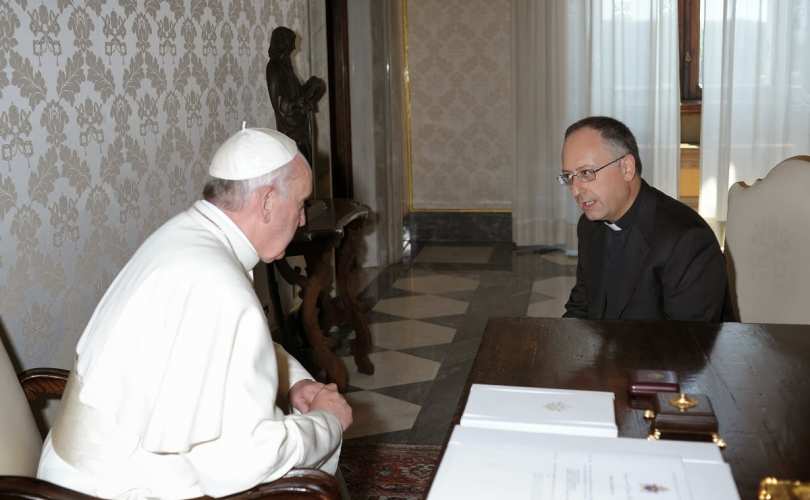
Pope Francis with close friend and advisor Fr. Antonio Spadaro, SJ
November 16, 2015
Two European bishops’ conferences and prominent Vatican observers are highlighting the significance of a recent article by one of Pope Francis’ closest confidants interpreting the Synod’s final report to allow Communion to “remarried” divorcees. They say the author’s interpretation signals the path Pope Francis will adopt himself.
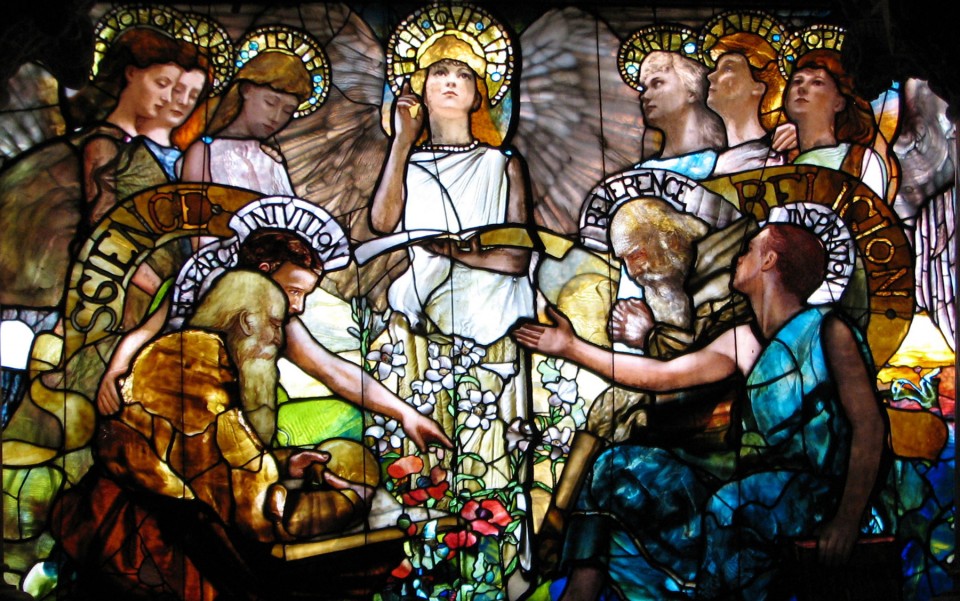
The centre panel Education from the Chittenden Memorial Window at Yale University depicting Science (left) and Religion (right). Courtesy Wikimedia
The Vatican still refuses to endorse evolutionary theory – setting a billion believers at odds with modern science
By John Farrell 8 May 2015
There was a moment in the recent history of the Roman Catholic Church when an influential Jesuit tried to forge a deep synthesis between religion and modern science. But he was muzzled by the Vatican, and Catholics have been paying for it ever since. Continue reading Can the Vatican evolve before it dissolves?→
The Under-secretary of the Pontifical Council for Inter-religious Dialogue, Msgr. Indunil Janakaratne Kodithuwakku, has given a lecture at a conference at the Confucius Institute at the Università Cattolica del Sacro Cuore in Milan.
Vatican City, October 2015 (VIS) – The role of the woman in the family, in society and in the Church, cultural differences, concerns regarding ethics in medicine, the situation of persecuted Christian families and the testimonies of those engaged in family catechesis were main themes of the interventions by auditors in the Synod Hall during the general congregations of Thursday 15 and Friday 16 October, published today. Continue reading Listen to women, say auditors to Synod Fathers→
Vatican City, 19 October 2015 (VIS) – On the occasion of the fiftieth anniversary of the institution of the Synod of Bishops, the Holy Father addressed the Synod Fathers in the Vatican’s Paul VI Hall. An introduction was given by Cardinal Lorenzo Baldisseri, and the president of the Episcopal Conference of Austria and cardinal archbishop of Vienna Christoph Schonborn pronounced a commemorative discourse.
Below are extensive extracts from the Holy Father’s discourse, in which he reiterated that the very name “Synod” – “walking together” – indicates what the Lord asks of us.
It was Our Lord Jesus Christ, Himself, who bestowed upon Simon Peter the grace to continue His teachings to the people of the world: to go and teach all nations -after He had returned to heaven, to His Almighty Father. Yet, two thousand years later we have Simon Peter’s, successor, Francis who has elevated himself so high in the worldly realm that, he forgets his place. Continue reading Jesus, demoted & forgotten in Congress and UN→

























 2016-03-18 Vatican Radio













 Vatican City, October 2015 (VIS) – The role of the woman in the family, in society and in the Church, cultural differences, concerns regarding ethics in medicine, the situation of persecuted Christian families and the testimonies of those engaged in family catechesis were main themes of the interventions by auditors in the Synod Hall during the general congregations of Thursday 15 and Friday 16 October, published today.



 The Loud Cry
You must be logged in to post a comment.