El testimonio de Nieves Ayress Moreno se levanta con la fuerza de la Verdad frente a los cobardes que niegan la tortura en Chile.
Testimonio del horror: Nieves Ayress (*), exprisionera de la Dictadura en Chile
Nueva York — El relato parece extraído de las historias de horror de Edgar Allan Poe, E.T. Hoffman, Guy de Maupassant o Bram Stoker.O más, de las transcripciones de los interrogatorios brutales en los campos nazis deconcentración de Dachau o Treblinka. Pero no lo es.
Tampoco es ficción de un literato dedicado a provocar estremecimientos de terror e insomnio en sus lectores. Es, simplemente, una página arran cada de la tragedia vivida en las ergástulas de las dictaduras militares de los años 70, instauradas, alegadamente, para defender la libertad y la democracia, amenazadas por la insurgencia de pueblos anhelantes de justicia social. La página siniestra vivida hace tres décadas por Luz de las Nieves Ayress Moreno, chilena, una activista comunitaria que reside desde hace 12 años en Nueva York, toma actualidad cuando una Comisión de la Verdad en Chile, acaba de entregar al presidente Ricardo Lagos un informe sobre la tortura ejercida por el régimen militar que encabezó por 17 años el general Augusto Pinochet Ugarte, quien, en una entrevista para una cadena de televisión hispana, en 2003, su autocalificó como “un ángel bueno”.
Lagos declaró sentirse “asqueado” de la lectura y el general Manuel Contreras, jefe la DINA, la policía política de Pinochet, dijo a los medios de prensa que “en la Dirección de Inteligencia Nacional no hubo ninguna política de tortura ni tampoco de detener gente para asesinarla, ni cosas por el estilo”.
Las reaccion es a esta declaración fueron desde la calificación de “cín i cas y perversas” hasta la de la ex ministra de Defensa, Michelle Bachelet, sobreviviente de las torturas en Villa Grimaldi, quien acusó a Contreras de ser “un cara de palo”.
Nieves Ayress tenía 23 años y era, según su relato, una joven estudiante que había sido influida, como casi todos los jóvenes de su generación, por la Revolución Cubana, el movimiento hippie, las reformas sociales, la guerra de Vietnam y los movimientos juveniles contestatarios de Francia que encabezaba Daniel Cohn Benditt o “Danny, el rojo”=. Lo que queríamos era un mundo más humano y igualitario, por eso me afilié al Ejército Nacional de Liberación en Bolivia en 1968 y trabajé con mujeres y niños en varias poblaciones pequeñas. Yo no maté a nadie, no robé, no cometí ningún delito. Mi pecado era ser joven, y apenas derrocado Allende los militares y los extremistas de derecha sospechaban de todo aquel que fuera joven” dice Nieves alinicio de su charla.
Su testimonio discurre fluido, haciendo difícil para su interlocutor conservar el pulso y la presión arterial normal al escuchar el lúgubre relato.
“El día del golpe yo estaba en casa. Sabíamos que la insurrección militar venía porque en mi familia se hacía política. Mis abuelos fueron los que junto a Recabarren fundaron los movimientos revolucionarios en Chile; mis padres, Virginia Moreno y Carlos Ayress, fundaron junto a Salvador Allende el Partido Socialista”.
“Mis cinco hermanos y yo pertenecimos siempre a movimientos sociales. El día 11 de septiembre de 1973 nos fuimos al barrio pobre de La Legua donde se produjeron enfrentamientos con los militares. Una semana después fui detenida por primera vez y llevada al Estadio Nacional. Estuve detenida por dos semanas y empecé a ser torturada. Permanecí enclaustrada en una torre, sola, y desde allí veía los golpes y las torturas a otros presos. Me pusieron en libertad sin darme ninguna explicación pero en enero de 1974 caí por segunda vez a órdenes de la DINA que dirigía el general Manuel Contreras.
Cuando me detuvieron yo estaba en la fábrica de mi padre. Me esposaron y me llevaron a la casa de nuestra familia en San Miguel y detuvieron también a mi padre, Carlos Ayress, y a mi hermano Tato. De allí me condujeron a un centro de torturas en el número 38 de la calle Londres, donde permanecí dos semanas sola e incomunicada y fui tratada salvajemente. Las torturas incluían golpes, choques eléctricos a las partes más sensibles del cuerpo como ojos, senos, ano, vagina, nariz, oídos y dedos. Un método muy común era el que ellos llamaban ‘pau de arara’, introducido por torturadores br
asileños que experimentaron con nosotros. Este consistía en amarrarnos de pies y manos y colgarnos cabeza abajo. En esa posición nos aplicaban choques eléctricos en el ano. Otra forma era ‘el teléfono’. Nos golpeaban con fuerza y simultáneamente los oídos. Desnuda y encapuchada fui torturada en presencia de mi padre y hermano e intentaron que tuviera relación sexual con ellos. También me obligaban a presenciar como torturaban a mi padre y de otros amigos que se encontraban presos. En los baños de la prisión de la calle Londres fui repetidamente violada”.
“Aunque no supe quienes eran mis torturadores en ese sitio, por sus voces pude entender que eran argentinos y paraguayos quienes me convencieron que estaba en Buenos Aires. En una sesión de torturas sufrí un colapso cardíaco. Los verdugos se asustaron y pidieron unas medicinas a un sitio de la calle Arturo Pratt. Fue así como supe que estaba en Santiago”. “Calculo que fue en febrero de 1974 cuando me llevaron a otra prisión en Tejas Verdes donde estuve incomunicada. Este era otro sitio de entrenamiento de torturadores y los recuerdos que tengo son de absoluta brutalidad. Me forzaron a realizar actos sexuales con un perro que había sido especialmente preparado para este tipo de abuso. También colocaban ratas dentro de mi vagina y luego me daban choques eléctricos. Las ratas, desesperadas, hundían sus garras en mi interior. Se orinaban y defecaban en mi cuerpo. Después me inocularon el virus de la toxoplasmósis. Fui violada constantemente y forzada a tener sexo oral con mis captores. Me cortaron las capas superficiales del vientre con un cuchillo y las orejas. Luego me ponían alcohol en las heridas y me aplicaban corriente eléctrica. Toda vía pueden verse las cicatrices en mi cuerpo. Me introdujeron botellas de Coca Cola por el ano y me gritaban ‘Esto es para que sientas el Imperio’”.
“El general Manuel Contreras ha declarado hace pocos días que en la DINA nunca se torturó a nadie. Yo puedo decir que en una ocasión fui torturada por el propio Manuel Contreras y una mujer alemana que estaba presa, de quien decían que nos parecíamos y debíamos ser hermanas. A Contreras lo pude ver porque la venda que cubría mis ojos estaba floja. Después lo reconocí en fotografías”. “Un ex agente. Samuel Fuenzalida Devia, declaró a un diario digital chileno que el general Manuel Contreras, quien acaba de ser condenado en su país a 12 años de prisión, supervisaba las torturas en Londres 38”.
“A las mujeres se les aplicaba corriente en los genitales y en los senos. También eran quemadas con cigarrillos”, dijo Fuenzalida y agregó que Contreras le dijo en una ocasión que “debía estar orgulloso de pertenecer a la DINA”.
“En abril de 1974, cuando había sido llevada a la Cárcel de Mujeres de la calle Vicuña Mackenna, que estaba administrada por una orden de monjas, caí en cuenta que estaba embarazada. Un doctor de apellido Mery, militar que ejercía en la Universidad Católica, me confirmó el embarazo y me dijo que yo debía estar orgullosa de tener ‘un hijo de la patria’, es decir un producto de violaciones de los militares. Mi situación causó una gran controversia internacional pues mi madre y toda mi familia había denunciado mi prisión y torturas. Fui entrevistada por la Cruz Roja Internacional, Amnistía Internacional, Comisión Kennedy, Comisión de Derechos Humanos de la OEA, el cardenal Silva Enríquez y esposas de los militares. Me ofrecieron la libertad si no denunciaba las violaciones y el embarazo. Las monjas ofrecieron ayudarme para pedir un permiso que me permitiera abortar. Tenía que elevar una solicitud al cardenal y éste elevarla al Papa. En Chile el aborto era penado por la ley y yo estaba en muy mala condición física, muy débil, así que decidí tener el hijo. Después de haber sobrevivido a tanto tiempo de detención y crueles maltratos, no iba a dar a los militares el gusto de morirme. Sin embargo en mayo tuve un aborto espontáneo pero no recibí atención médica ni medicinas”.
“De Vicuña Mackenna me llevaron a Tres Álamos, otro campo de concentración. Fui sometida nuevamente a violaciones, amenazas y hasta un simulacro de fusilamiento. En diciembre de 1976 salí expulsada de Chile junto a 17 presos políticos entre los que estaban mis compañeros Víctor Toro, Gladys Díaz, el doctor Luís Corbalán. El decreto de expulsión señalaba que no podíamos volver jamás a nuestra patria. Con la solidaridad de mucha gente conseguí quedarme a vivir en Berlín”.
“A fines de 1977 fui a Cuba. En el hospital Calixto García, sin tener que pagar un centavo, me trataron de la toxoplasmosis, me reconstruyeron la vagina y todo mi cuerpo para que pudiera engendrar, me trataron las infecciones vaginales, la descalcificación y la sordera provocada por ‘el teléfono’, me arreglaron las cicatrices del cuerpo y las orejas y me operaron los pies deformados por el maltrato. También me dieron terapia psicológica en una muestra de solidaridad de los cubanos imposible de pagar”.
“Pese a todo lo que me hicieron los sicarios de Pinochet pude sobrevivir. Tengo aún secuelas psicológicas por todo lo que me tocó vivir. Siento dolor permanente en el cuello, las manos, las rodillas y los pies; tengo marcas y cicatrices en todo mi cuerpo. Cuando veo una rata siento un dolor reflejo en la vagina. Siento ansiedad, pesadillas y depresión. He superado algunas de esas secuelas, por ejemplo el miedo al encierro surgido por las violaciones que sufrí en el baño de la prisión de la calle Londres, pero sigo siendo muy sensible emocionalmente. Mi familia fue dividida, destruida y toda mi vida cambió después del golpe militar”.
“Pero, al fin, yo estoy aquí, resucitada. Con mi esposo, Víctor Toro, preso y torturado igual que yo, tenemos una hija, Rosita, quien estudia en la Universidad de Nueva York. A los 21 años regresé a Chile con ella, y pude decir a mis torturadores militares: ¡Aquí estoy yo y aquí está mi hija. Me torturaron pero no me destruyeron, no me jodieron por que tuve una hija!”.
(*) Nieves Ayress enfatiza que su testimonio no persigue ninguna compasión. Sólo consignar
un ejemplo para que los sucesos de Chile, no se repitan nunca.
__
Información disponible en el sitio ARCHIVO CHILE,Web del Centro Estudios
NOTA : El portal del CEME es un archivo histórico, social y político básicamente de Chie. No persigue ningún fin de lucro. La versión electrónica de documentos se provee únicamente con fines de información y preferentemente educativo culturales. Cualquier reproducción destinada a otros fines de berá obtener los permisos que correspondan, porque los documentos incluidos en el portal
son de propiedad intelectual de sus autores o editores. Los contenidos de cada fuente, son de responsabilidad de sus respect i vos autores.
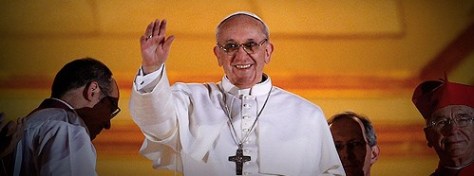
Pope Francis was born in Buenos Aires on 17 December 1936, the son of Italian immigrants.
His father Mario was an accountant employed by the railways and his mother Regina Sivori was a committed wife dedicated to raising their five children. He graduated as a chemical technician and then chose the path of the priesthood, entering the Diocesan Seminary of Villa Devoto. On 11 March 1958 he entered the novitiate of the Society of Jesus. He completed his studies of the humanities in Chile and returned to Argentina in 1963 to graduate with a degree in philosophy from the Colegio de San José in San Miguel. From 1964 to 1965 he taught literature and psychology at Immaculate Conception College in Santa Fé and in 1966 he taught the same subject at the Colegio del Salvatore in Buenos Aires. From 1967-70 he studied theology and obtained a degree from the Colegio of San José.
On 13 December 1969 he was ordained a priest by Archbishop Ramón José Castellano. He continued his training between 1970 and 1971 at the University of Alcalá de Henares, Spain, and on 22 April 1973 made his final profession with the Jesuits. Back in Argentina, he was novice master at Villa Barilari, San Miguel; professor at the Faculty of Theology of San Miguel; consultor to the Province of the Society of Jesus and also Rector of the Colegio Máximo of the Faculty of Philosophy and Theology.
On 31 July 1973 he was appointed Provincial of the Jesuits in Argentina, an office he held for six years. He then resumed his work in the university sector and from 1980 to 1986 served once again as Rector of the Colegio de San José, as well as parish priest, again in San Miguel. In March 1986 he went to Germany to write a doctoral thesis on Romano Guardini; his superiors then sent him to the Colegio del Salvador in Buenos Aires and next to the Jesuit Church in the city of Córdoba as spiritual director and confessor.
It was Cardinal Antonio Quarracino, Archbishop of Buenos Aires, who wanted him as a close collaborator. So, on 20 May 1992 Pope John Paul II appointed him titular Bishop of Auca and Auxiliary of Buenos Aires. On 27 May he received episcopal ordination from the Cardinal in the cathedral. He chose as his episcopal motto, miserando atque eligendo, and on his coat of arms inserted the ihs, the symbol of the Society of Jesus.
He gave his first interview as a bishop to a parish newsletter, Estrellita de Belém. He was immediately appointed Episcopal Vicar of the Flores district and on 21 December 1993 was also entrusted with the office of Vicar General of the Archdiocese. Thus it came as no surprise when, on 3 June 1997, he was raised to the dignity of Coadjutor Archbishop of Buenos Aires. Not even nine months had passed when, upon the death of Cardinal Quarracino, he succeeded him on 28 February 1998, as Archbishop, Primate of Argentina and Ordinary for Eastern-rite faithful in Argentina who have no Ordinary of their own rite.
Three years later at the Consistory of 21 February 2001, John Paul ii created him Cardinal, assigning him the title of San Roberto Bellarmino. He asked the faithful not to come to Rome to celebrate his creation as Cardinal but rather to donate to the poor what they would have spent on the journey. As Grand Chancellor of the Catholic University of Argentina, he is the author of the books: Meditaciones para religiosos (1982), Reflexiones sobre la vida apostólica (1992) and Reflexiones de esperanza (1992).
In October 2001 he was appointed General Relator to the 10th Ordinary General Assembly of the Synod of Bishops on the Episcopal Ministry. This task was entrusted to him at the last minute to replace Cardinal Edward Michael Egan, Archbishop of New York, who was obliged to stay in his homeland because of the terrorist attacks on September 11th. At the Synod he placed particular emphasis on “the prophetic mission of the bishop”, his being a “prophet of justice”, his duty to “preach ceaselessly” the social doctrine of the Church and also “to express an authentic judgement in matters of faith and morals”.
All the while Cardinal Bergoglio was becoming ever more popular in Latin America. Despite this, he never relaxed his sober approach or his strict lifestyle, which some have defined as almost “ascetic”. In this spirit of poverty, he declined to be appointed as President of the Argentine Bishops’ Conference in 2002, but three years later he was elected and then, in 2008, reconfirmed for a further three-year mandate. Meanwhile in April 2005 he took part in the Conclave in which Pope Benedict XVI was elected.
As Archbishop of Buenos Aires — a diocese with more than three million inhabitants — he conceived of a missionary project based on communion and evangelization. He had four main goals: open and brotherly communities, an informed laity playing a lead role, evangelization efforts addressed to every inhabitant of the city, and assistance to the poor and the sick. He aimed to re-evangelize Buenos Aires, “taking into account those who live there, its structure and its history”. He asked priests and lay people to work together. In September 2009 he launched the solidarity campaign for the bicentenary of the Independence of the country. Two hundred charitable agencies are to be set up by 2016. And on a continental scale, he expected much from the impact of the message of the Aparecida Conference in 2007, to the point of describing it as the “Evangelii Nuntiandi of Latin America”.
Workshop 30 November – 1 December 2016 – One of the key issues today concerns the place of the human person in a growing digital environment of increasing complexity that not only expands the range of his or her capacities, but also may compete with them or even replace them. Over the past fifty years, robots and computers have progressively supplemented humans, initially only in relatively simple computational and manipulation tasks, but more recently in higher cognitive tasks that used to be the prerogative of the human brain, including language, mathematics, probabilistic reasoning and decision making. Continue reading Power and Limitations of Artificial Intelligence→
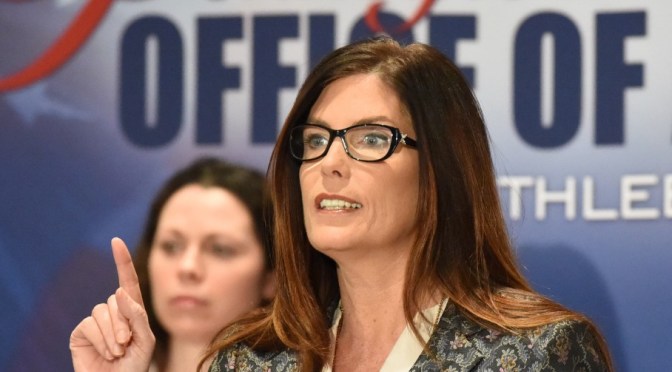
By Michelle Boorstein and Julie Zauzmer March 3 2016
A Catholic diocese in Pennsylvania announced Thursday that it will post the names online of priests credibly accused of sexually abusing children, a decision that came two days after a dramatic grand jury report alleged a decades-long cover-up.
Rachel Mike, who won a settlement in a case involving Father Poole, at her confirmation in the summer of 1975. Behind her is Father George Endal, accused of raping or molesting several boys and allegedly walking in on another priest performing oral sex on a 6-year-old boy and doing nothing to stop it.
Alaska Natives are accusing the Catholic Church of using their remote villages as a “dumping ground” for child-molesting priests—and blaming the president of Seattle University for letting it happen.
by Brendan Kiley
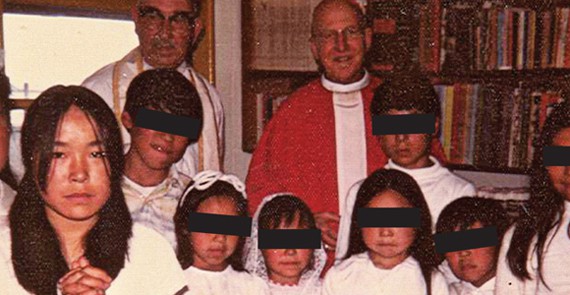
Father James Poole in Nome, Alaska, with parish kids, in a photo taken sometime in the 1970s.The remote region in Alaska the lawsuit alleges was a molester priest “dumping ground.”
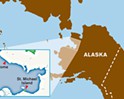
One spring afternoon in 1977, 15-year-old Rachel Mike tried to kill herself for the third time. An Alaska Native, Rachel was living in a tiny town called Stebbins on a remote island called St. Michael. She lived in a house with three bedrooms and nine siblings. Rachel was a drinker, depressed, and starving. “When my parents were drinking, we didn’t eat right,” she says. “I just wanted to get away from the drinking.”
Rachel walked to the bathroom to fetch the family rifle, propped in the bathtub with the dirty laundry (the house didn’t have running water). To make sure the gun worked, Rachel loaded a shell and blew a hole in her bedroom wall. Her father, passed out on his bed, didn’t hear the shot. Rachel walked behind their small house. Her arms were too short to put the rifle to her head, so she shot herself in her right leg instead.
Rachel was found screaming in a pool of blood by her Auntie Emily and flown 229 miles to a hospital in Nome. The doctor asked if she wanted to see a priest. She said yes. In walked Father James Poole—a popular priest, radio personality on KNOM, and, according to allegations in at least five lawsuits, serial child rapist. Father Poole has never been convicted of a crime, but the Jesuits have settled numerous sex-abuse claims against him since 2005, in excess of $5 million, according to an attorney involved in four of those five lawsuits. Exact figures aren’t available because some of the settlements involve confidentiality agreements. The Jesuits have never let a single case against Father Poole go to trial.
In a 2005 deposition, Rachel testified that she had been molested by Father Poole in 1975, while in Nome for her second suicide attempt, an attempted overdose of alcohol and pills. He’d come sit by her bed, put his hand under the hospital blanket, and fondle her, she said.
She traveled between Stebbins and Nome several times in the late 1970s, spending time in hospitals and receiving homes. By 1977, Rachel testified, Poole had given her gonorrhea, and by 1978 she was pregnant with his child. In an interview with The Stranger, she said Poole encouraged her to get an abortion and tell the doctors she had been raped by her father. She followed his advice. “He brainwashed me,” she said. “He messed up my head, man.”
Rachel Mike’s father died in 2004. A year later, she heard Elsie Boudreau, another survivor of Poole’s abuse, being interviewed on the radio. Listening to Boudreau, Rachel was moved to finally tell the truth.
“He’s gone, and I’ll never have a chance to tell him in person,” she said, talking about her father between heaving sobs. “I was scared. In a way he knew, but—he never even touched me.”
“This man,” says Anchorage-based attorney Ken Roosa, referring to Poole, “has left a trail of carnage behind him.”
The only reason Poole is not in jail, Roosa says, is the statute of limitations. And the reason he’s still a priest, being cared for by the church?
“Jim Poole is elderly,” answered Very Reverend Patrick J. Lee, head of the Northwest Jesuits, by e-mail. “He lives in a Jesuit community under an approved safety plan that includes 24-hour supervision.”
Roosa has another theory—that Poole knows too much. “They can’t put him on the street and take away his reason for keeping quiet,” Roosa says. “He knows all the secrets.”
Father James Poole’s story is not an isolated case in Alaska. On the morning of January 14 in Seattle, Ken Roosa and a small group Alaska Natives stood on the sidewalk outside Seattle University to announce a new lawsuit against the Jesuits, claiming a widespread conspiracy to dump pedophile priests in isolated Native villages where they could abuse children off the radar.
“They did it because there was no money there, no power, no police,” Roosa said to the assembled cameras and microphones. “It was a pedophile’s paradise.” He described a chain of poor Native villages where priests—many of them serial sex offenders—reigned supreme. “We are going to shine some light on a dark and dirty corner of the Jesuit order.”
The suit, filed in the superior court of Bethel, Alaska, the day before, accuses several priests of being offenders and conspirators. Among the alleged conspirators is Father Stephen Sundborg, who is the current president of Seattle University and was Provincial of the Oregon Province of Jesuits from 1990 through 1996. (The Oregon Province includes Washington, Oregon, Montana, Idaho, and Alaska; as Provincial, Sundborg was head of the entire province.) The suit alleges that while Sundborg was head of the Northwest Jesuits, he had access to the personnel files of several pedophile priests, including one named Father Henry Hargreaves, whom he allowed to remain in the ministry. “As a direct result of Father Sundborg’s decision,” the suit alleges, “Father Hargreaves was able to continue molesting children, including but not limited to James Doe 94, who was raped by Father Hargreaves in 1992, when James Doe was approximately 6 years old.”
Roosa and his associate Patrick Wall (a former Benedictine monk who once worked as a sex-abuse fixer for the Catholic Church) said they knew of 345 cases of molestation in Alaska by 28 perpetrators who came from at least four different countries.
This concentration of abuses is orders of magnitude greater than Catholic sex-abuse cases in other parts of the United States. Today, Roosa said, there are 17,000 Catholics in the diocese of Fairbanks, though there was a much smaller number during the peak of the abuse. Roosa compared this lawsuit to the famous Los Angeles suits of 2001, which claimed 550 victims of abuse in a Catholic population of 3.4 million.
These abusers in Alaska, Wall said, were specifically sent to Alaska “to get them off the grid, where they could do the least amount of damage” to the church’s public image.
One by one, the Alaska Natives—including Elsie Boudreau, the woman whom Rachel Mike had heard on the radio—took their turns before the cameras and microphones, talking softly and nervously and choking back tears. “I am Flo Kenny,” a woman with a gray ponytail and sunglasses said carefully. “I am 74 years old. And I’ve kept silent for 60 years. I am here for all the ones who cannot speak—who are dead, who committed suicide, who are homeless, who are drug addicts. There’s always been a time, an end of secrets. This is the time.”
Alphonsus Abouchuk, wearing a black leather jacket and sunglasses, talked about how poor his family was and how the priests used to give him quarters after abusing him.
Rena Abouchuk, his sister, cried while she read a letter to a Franciscan monk named Anton Smario (currently living in Concord, California) who taught her catechism classes. “You did so many evil things to young children,” she read, gripping her letter in one hand and an eagle feather tied to a small red sachet in the other. “God will never forgive you… You took a lot of lives.” Six of her cousins, she later said, committed suicide because of Brother Smario.
The lawsuit states that Brother Smario offered children food and juice to coax them to stay after class: “He then would unzip his pants, and completely expose his genitals to these children, and masturbate to ejaculation as he walked around the classroom. He would ask the girls to touch his penis and would rub his erect penis on their backs, necks, and arms. Sometimes he would wipe or rub his semen on the girls after he ejaculated.”
According to the allegations, Father Joseph Lundowski molested or raped James Does 29, 59–71, and 73–94, plus Janet Does 4–7—a total of 40 children—giving them “hard candy, money he stole from the collection plate, cooked food, baked goods, beer, sacramental wine, brandy, and/or better grades (silver, blue, or gold stars) on their catechism assignments in exchange for sexual favors.”
The lawsuit also alleges Father George Endal raped and molested several boys—and, as Smario and Lundowski’s boss, was the person who put Lundowski in charge of the boys dormitory in the Holy Rosary Mission School in Dillingham, Alaska, where catechism classes were split between Smario (in charge of the girls) and Lundowski (in charge of the boys). On separate occasions, Father Endal and another priest named Norman E. Donohue—who allegedly raped James Doe 69—walked in on Lundowski while he was molesting children and either quietly left the room or did nothing to stop it.
Father Francis Fallert, principal of the Copper Valley School and head of the all the Alaska Jesuits from 1976 to 1982, is accused of molesting Janet Doe 6.
The sheer concentration of known sex offenders in these isolated communities begins to look less like an accident than a plan. Their institutional protection looks less like an embarrassed cover-up than aiding and abetting. And the way the church has settled case after case across the country, refusing to let most of them go to trial for a public airing, is starting to look like an admission of guilt.
When Patrick Wall wore monk’s robes, he must’ve looked like Friar Tuck. A former all-state football lineman, Wall has broad shoulders, a brawny neck, short reddish hair, and a habit of calling people “bro.”
We met last week in Sea-Tac Airport’s Alaska Airlines Board Room—a two-story business lounge, just past the security check, with conference tables, ergonomic chairs next to computer stations, and free espresso. He and Ken Roosa were there to meet with a client. Wall lives in California, Roosa lives in Anchorage, and many of their clients are on the West Coast, so they’ve done a lot of business in the Board Room. “I like to spend the night at home,” Wall says, setting his airplane reading—The Name of the Rose—on the conference-room table.
Wall’s first call as a sex-abuse fixer knocked on his door one morning in 1991, while he was brushing his teeth. Wall was not yet a priest, just a monk studying at St. John’s University in Minnesota. The abbot came to his room before class with an urgent matter regarding another monk and said Wall would be moving into the boy’s prep-school dormitory—immediately. The other monk “had an incident with a 14-year-old in the shower.” Wall was to take his place.
Taken aback, Wall threw up every objection he could think of. He didn’t own a computer and used the communal ones in the monastery. “We’ll buy you a laptop.” He helped with mass at a local parish. “We’ll reassign you to campus ministry.” He was on call for the volunteer fire department. “Not anymore.” The abbot wouldn’t take no for an answer.
So Wall packed up, moved into the boys dormitory, quickly intuited who else on the floor had been abused (5 out of the 90 residents), and coaxed them into talking about what had happened. Those cases never became public and were settled out of court. “If you’re good,” Wall says, “the assignments build.” Wall was so good, he was ordained a year early and kept busy, working as many as 13 cases per month.
The job was harrowing and frustrating. “If you’re the cleaner, you rarely find out the resolution to these things,” Wall says. “Because survivors had to sign confidentiality agreements.” The ultimate objective, for a cleaner, was to keep things quiet so the details never became public or went to trial. Wall slowly came to believe that his superiors were more concerned with protecting their public image than caring for survivors. It was, he says, a dark time, not least because he was struggling with his own vows of celibacy. In 1998, he asked to be laicized. By 2001, he was married to a ballet dancer and had a newborn daughter. By 2002, he was hired as a full-time researcher for the law firm Manly and Stewart investigating clerical sex-abuse cases.
Since then, he and Roosa—who often collaborate on cases with attorney John Manly—have worked over 250 cases together, all of them settled without going to trial. “I would like to see any of these cases go to trial to expose the corruption of the system,” Wall says. But the church would rather pay the money than subject itself to public scrutiny, and survivors generally prefer to avoid the increased emotional turmoil of a trial. “There was one survivor who went through 11 days of questioning, of deposition,” Roosa says. “The defense lawyers can make it so painful.”
“If you bend a young plant, it grows at an angle,” Roosa says. “Child sex abuse bends the character and maturation of a person—the abuse isn’t the injury as much as the effect it has on people.”
Father Poole’s alleged abuses are particularly egregious, earning him a special place in Roosa’s and Wall’s hearts. He is their archetypal bad guy, their Dr. Mengele of the clerical sex-abuse world: Their clients have described, in sworn testimony, Poole pressing his erections against girls during junior-high dances, being caught by his own mother while masturbating in front of young girls, and much worse. “The defense lawyers have been so disgusted with Poole,” Roosa says, “that they’ve told me off the record, ‘anything you tell me about Poole, I’d believe.'”
According to a victim identified as Jane Doe 5 in a 2006 complaint, Poole first raped her during a private catechism class when she was 6 years old. From a direct transcript of her testimony:
He started fidget—finger—started to touch me digitally with his fingers. And at that time, when he started getting closer to me, I—there’s a picture—I’m on the desk, a picture to the left of me is a picture of Jesus who’s at the rock praying, and to my left I look at the picture to my left, and I look into James Poole’s eyes. I turned away from the picture, looked into his eyes, and asked ‘Not in front of Jesus, please.’… He kept telling me that in order to be a good little girl for God, I had to do this. That God wanted me to do this. And I remember a burning…
Then, she says, he raped her.
Roosa tells a story about Poole molesting a 9-year-old girl in Portland, Oregon, while simultaneously having an affair with the girl’s mother. Poole supposedly told the girl’s mother he would quit the priesthood and marry her, but abruptly returned to Alaska. The girl’s mother committed suicide. According to Wall and Roosa, that same girl says she was molested by another priest, one who has been listed in at least three settlements in cases that reach back to the 1960s. They say that, in one incident, this priest was called to a house in Yakima to administer last rites to a dying woman in 1989. “He raped the woman on her deathbed,” Roosa says. “He told the family to go into the other room, the husband heard a weird noise, went into the bedroom, and caught him raping his unconscious wife.”
The woman didn’t die, and by the time Roosa and Wall caught up with her family last May, the church had offered the family half a million dollars. The family said they’d file a legal complaint if Roosa and Wall could guarantee more than half a million dollars in compensation.
“No,” Wall said. “Take it, bro.”
Within hours of the press conference on the sidewalk in front of Seattle University on January 14—which essentially alleges that Father Stephen Sundborg allowed molester priests to minister freely as members of the Northwest Jesuits when it was his responsibility, as Provincial, to keep them away from children—Sundborg denied having any information about the Jesuit “dumping ground” in Northwest Alaska:
The allegations brought against me are false. I firmly deny them. I want the victims and the entire community to know that. The complaint filed by the plaintiffs’ lawyers represents an unprincipled and irresponsible attack on my reputation. Let me be clear—my commitment to justice and reconciliation for all victims remains steadfast.
On January 31, Father Sundborg, through his spokesperson, responded to questions from The Stranger with this statement:
I want to be very clear: As Provincial of the Oregon Province of the Society of Jesus, I would never have put a child at risk. I was never aware of any claim of child abuse concerning either Fr. James Poole or Fr. Henry Hargreaves.
As I have said repeatedly in the past, as a member of the Society of Jesus, I personally and sincerely apologize for the pain that has been suffered through the actions of some members of our order. I am disappointed that the plaintiffs’ attorneys are attempting to use falsehoods and innuendo to fuel a media campaign. Their attack on my reputation is unprincipled and irresponsible. Nonetheless, I remain firm in my resolve to seek justice and reconciliation for all victims.
With the exception of Father Hargreaves allegedly raping James Doe 94 in 1992, no abuses—at least none that have been reported—occurred while Sundborg was Provincial.
Still, Wall says, “Stevie has a little problem.”
Hargreaves, Poole, and other problem priests continued to work in the ministry during Sundborg’s tenure between 1990 and 1996 and, in Elsie Boudreau’s words, “We know that he knew.”
Father Poole came under scrutiny as early as 1961, when complaints about his behavior reached Rome and the Father-General of the Jesuits initiated an investigation.
In 1994, Poole was sent to the Servants of the Paraclete—a Jesuit-run psychiatric facility for troubled priests in Jemez Springs, New Mexico—where, he later testified in a 2004 deposition, he learned that he had boundary issues, that he “wasn’t this great king and lover,” and that “French-kissing” a 12-year-old girl is “wrong.”
Poole denies raping anyone but admits to “French-kissing” Boudreau—and emphatically denies that French-kissing her was in any way sexual. “With Elsie, I have never had any sexual impulse,” he said in the 2004 deposition, “never had any sexual temptation.” Later in this same testimony, John Manly asked Poole whether he had ever French-kissed his own niece.
“No,” Poole replied.
“Why?” Manly asked.
Poole hesitated.
“Why not?” Manly insisted. “I think I know the answer, but I want you to say it.”
“We were not that close, for one thing,” Poole replied. “My brother had always lived away from us.”
“Any other reason?” Manly asked.
“No,” Poole said.
Monthly progress reports were sent to Sundborg during Poole’s treatment in Jemez Springs. After his release, Poole continued to work as a hospital chaplain in Alaska until November of 2003, when Roosa threatened to sue the Bishop of Fairbanks over the childhood abuse of Elsie Boudreau. Poole retired shortly thereafter and was sent to Spokane, to live in an apartment near Gonzaga University. (Attempts to contact Father Poole for comment were unsuccessful.)
Father Sundborg testified in 2005 that he sent at least eight priests—including Father Poole, Father James Laudwein, and Father Craig Boly—for psychiatric evaluation by Dr. Stuart Greenberg, a leading consultant on clerical sex abuse for the Northwest Jesuits. After their visits with Dr. Greenberg, Poole, Laudwein, and Boly were returned to active ministry.
At the time of Sundborg’s 2005 testimony, Father Laudwein was a defendant in a sex-abuse suit that ended in 2007 with a $50 million settlement, according to the Anchorage Daily News. And, in 1992, Father Boly wrote an essay for a book called Jesuits in Profile: Alive and Well in the U.S. about his attraction to high-school girls:
I remember being reprimanded more than once for spending too much time with visiting coeds from other local high schools. My rationalization was that if attractive young women brought their problems to me, it must be an opportunity for apostolic service. What I neglected to consider was what needs of my own the interactions with the women students were meeting.
Sundborg also contributed an essay to Jesuits in Profile, but testified in 2005 that he had no recollection of reading the book.
Dr. Greenberg—the counselor to whom Sundborg had sent Poole, Laudwein, Boly, and others for evaluation—was arrested in the summer of 2007 for surreptitiously filming staff members and patients using the bathroom at his office and, according to Roosa, filming himself masturbating while watching the films. A few weeks later, he rented a room at a motel in Renton, where he committed suicide. Police found him with a bunch of bottles of prescription pills and two slashed wrists.
“I wish I could offer you some adequate explanation,” his suicide note read. “I just don’t know. I deeply and profoundly apologize.”
This isn’t Sundborg’s first go-around with fending off a sex-abuse case. In 2006, the Jesuits settled a $350,000 suit against Father Michael Toulouse, a philosophy professor at Seattle University accused of abusing a 12-year-old boy in his residence in 1968. At the time of the settlement, Father Sundborg argued that Seattle University wasn’t liable, even though the abuse happened on campus, because the abuse occurred outside of his official duties as a teacher—a rare Catholic argument for the separation of church and sex.
Complaints against Toulouse (who died in 1976) date from 1950, when a Spokane father threatened to shoot Toulouse, who was then teaching at Gonzaga High School. Toulouse was transferred to Seattle, where he allegedly molested several boys, including the son of a widow in 1967. The widow and another Jesuit wrote to the province in 1968 requesting action. (Father Toulouse continued teaching at Seattle University until 1976.) When the widow’s son sought compensation in 1993, Sundborg wrote back, according to the Seattle Times: “There is nothing about this matter in the provincial files, in the personnel files of Fr. Toulouse, or in the files of Seattle University.”
That may be. But Father Thomas Royce, Provincial of the Northwest Jesuits from 1980 to 1986, just four years before Sundborg became Provincial, has testified that similar information about Jesuits does exist in the personnel files—that they contain information that is “special,” “not public,” and “not good.”
He called them “the hell files.”
Elsie Bourdreau is a Yu’pik Eskimo with short brown hair, plump cheeks, and, when she is not testifying at grim press conferences, a radiant smile. As Janet Doe 1, Boudreau was the first person to speak publicly about being abused by Father Poole. She kept silent about her abuse until 2005, when her daughter turned 10. “I was 10 when the abuse started,” she says. “And I just couldn’t shield it from my consciousness anymore.” She’s now employed as a consultant to law firms pursuing clerical sex-abuse cases, including the firms where Wall and Roosa work.
When Boudreau was a child, the villages of Northwest Alaska were only accessible by plane, boat, or dog sled. Many still are. For the most part, they didn’t have public schools, cops, or telephones. Many of the houses were one room and lacked food and consistent heat in the below-zero weather. “The perps would soften up their victims with food and warmth,” Wall says, “because that’s what the kids didn’t have. ‘It was always warmer in the rectory,’ they say. ‘There was always food in the rectory. There was always candy.'”
In those villages, the priests had unusual authority. “In the village, our elders loved the church and the priests so much,” Boudreau says. “They were like honored guests in our land. The priest had the utmost power, power that historically the village shaman would have had.” If children complained about the priests, it was tantamount to complaining about the village shaman. “I’ve talked to hundreds of victims in Alaska,” Boudreau says, “and many were physically hurt by parents for speaking about this.”
The priests came to occupy the role of shamans by a weird confluence of history and microbiology. In the early 1900s, a Spanish-influenza epidemic ripped through Northwest Alaska, sometimes killing entire villages. They called it “the Big Sickness” or “the Big Death.”
Winton Weyapuk was a child in Wales, Alaska, and was orphaned by the epidemic. In an interview from 1997, he recalled that the flu came on a dog sled. The mailman, on his monthly delivery, brought the corpse of a man who’d died on the way to Wales. Curious villagers crowded around the corpse. “The men, women, and children who came to see this body went home, and many got sick and most of them died before the next morning.”
Weyapuk’s father died that first night, so the family moved into an uncle’s house. Most everyone in the uncle’s house died, and Weyapuk and his brother Dwight lived in a one-room sod house with four corpses until someone found them. He recalls seeing white men building tripods over the sod houses, using block and tackle to pull frozen bodies up through the skylights, then blasting holes in the frozen ground with dynamite for mass graves. Family sled dogs, neglected and starving, roamed the streets and fought over human remains.
The shamans, normally counted on as healers, were helpless. The population was decimated, and the social structure had to be created from nothing: Another Wales resident remembers that, in the aftermath, so many families had been destroyed that an official from Nome came to the village with a stack of notarized wedding licenses. He lined up all the surviving men, all the surviving women, and all the surviving children, and built families at random.
Catholic missionaries made major inroads into these communities in the aftermath of the Big Sickness. (Along with the Baptists and Orthodox churches. The major churches had a summit in Sitka years prior and divided up their geographical spheres of influence.) The missionaries brought flour and coffee, built orphanages and schools. “They looked at the shamans as evil and of the devil,” Boudreau says. A new social order was created. In the villages of Northwest Alaska, the Jesuits stepped into a tailor-made power vacuum.
The history of child molestation in the Catholic Church goes back centuries. The first official decree on the subject was written at the Council of Elvira, held around A.D. 305 near Granada, Spain. The precise history is complicated, but the council is traditionally believed to have set down 81 rules for behavior, the 71st of which is: “Those who sexually abuse boys may not commune even when death approaches.” It was the harshest one-strike policy: If you’re caught abusing a child, you are not only laicized, but permanently excommunicated—damned for all time.
The other major condemnation of clerical sex abuse was The Book of Gomorrah, completed by radical church reformer Father Peter Damian (a Benedictine monk, as it happens, who became a cardinal) in 1051. He appealed directly to the pope about the abuse of children, as well as consensual sex among clergy—in howling language: “O unheard of crime! O outrage to be mourned with a whole fountain of tears!… What fruitfulness can still be found in the flocks when the shepherd is so deeply sunk in the belly of the devil!”
In the 1930s, a priest-psychiatrist—and also a Benedictine—named Reverend Thomas Verner Moore researched the higher-than-usual rates of insanity and alcoholism among Catholic clergy. He suggested the church build an asylum for priests. The U.S. Catholic Bishops turned down his request in 1936. Father Moore became a Carthusian hermit.
In 1947, Father Gerald Fitzgerald founded the Servants of the Paraclete in Jemez, New Mexico—the same institution Father Poole was to visit almost 50 years later.
In a 1957 letter to the Bishop of Manchester, Father Fitzgerald wrote that predatory priests (who he euphemistically refers to as “schizophrenic”) cannot be effectively treated and should not be allowed to continue in the ministry:
Their repentance and amendment is superficial and, if not formally at least subconsciously, is motivated by a desire to be again in a position where they can continue their wonted activity. A new diocese means only green pastures… We are amazed to find how often a man who would be behind bars if he were not a priest is entrusted with the cura animarum [the cure, or care, of souls].
By the early 1960s, Father Fitzgerald had seen enough chronic pedophiles that he did not want to treat them and have them rereleased into the ministry, but, as he proposed in a letter to Archbishop Davis, to build an “island retreat… but even an island is too good for these vipers.”
In 16 centuries, church policy had evolved from one strike you’re out to 30 strikes and you’re sent to an island in the Caribbean.
In 1965, according to an affidavit from Fitzgerald successor Father Joseph McNamara: “Father Gerald purchased an island in [the Caribbean], near Carriacou, which had an abandoned hotel, damaged by fire, on it. This hotel was entirely removed from any civilization… This was to be Father Gerald’s long sought after ‘island refuge,’ but it did not come to be. As is described below, Archbishop Davis ordered Father Gerald to sell the island.”
Shortly thereafter, Father Fitzgerald was asked to step down. “It all became too public,” Wall says. “The Holy See would never be able to explain Father Fitzgerald’s leper island for pedophile priests.”
In 1985, two priests and a lawyer—Father Michael Peterson, Dominican Father Thomas Doyle, and Ray Mouton—presented a report to the National Conference of Catholic Bishops. The report, which reads more like concerned advice than a condemnation, warns that high rates of abuse and high rates of recidivism for “treated” priests could cost the church over $1 billion and a major loss of credibility in the coming decade.
Later that year, in the first highly publicized case of a pedophile priest in the United States, Father Gilbert Gauthe admitted to abusing 37 boys in Louisiana. He accepted a plea bargain, was sentenced to 20 years, and served 10. By 1997, according to the New York Times, he had moved to Texas, where he was “arrested for fondling a 3-year-old boy” and put on supervised probation. (According to the Times, “Texas authorities did not know of his criminal record in Louisiana.”) In April 2008, he was arrested again for failing to register as a sex offender.
In 1993, Canice Connors, the director of St. Luke’s, a psychiatric institute for troubled clergy, told the Los Angeles Times: “The Catholic Church in North America possesses the greatest data bank of evaluation and treatment of non-incarcerated pedophiles on the continent. That data should be analyzed scientifically and shared with others studying the problem.” He was in Milwaukee to present his findings to the U.S. Conference of Bishops.
In 2003, the Archdiocese of Boston agreed to pay out $85 million to 552 victims of clerical sex abuse.
Also in 2003, in the midst of negotiations to settle four claims of clerical sex abuse with the Diocese of Fairbanks, one of the church’s mediators told Ken Roosa that the dioceses didn’t want to offer more than $10,000. “They said they couldn’t offer more money to an Alaska Native because they’d just get drunk and hurt each other,” Roosa said. “And it would just encourage more victims to come forward. Unbelievable.”
In September 2005, former Cardinal Joseph Ratzinger—who’d just become the pope—asked the justice department of the Bush administration to grant him immunity from prosecution in sex-abuse cases in the United States. Ratzinger, the onetime head of the Vatican’s Congregation for the Doctrine of the Faith, was accused of “conspiring to cover up the sexual molestation of three boys by a seminarian” in Texas, according to the Associated Press. Ratzinger had “written in Latin to bishops around the world, explaining that ‘grave’ crimes such as the sexual abuse of minors would be handled by his congregation. The proceedings of special church tribunals handling the cases were subject to ‘pontifical secret,'” Ratzinger’s letter said. The Bush administration granted Ratzinger the immunity.
In 2007, the Archdiocese of Los Angeles agreed to pay $660 million to more than 500 victims of clerical sex abuse.
Why does the church keep sending these priests, who have come to be such a major liability, back into ministry? “It’s all about keeping the stores open, keeping the revenue rolling,” Wall says. The Alaskan provinces in particular, Wall says, were a source of revenue—not from the Native population living there, but from parishioners in the lower 48 who were encouraged to donate for the Native ministry up north. “You could raise thousands to fund a mission that cost very little to run,” Wall says. “The profit margin is huge.”
The lawsuits against the Northwest Jesuits regarding abuses of Alaska Natives are not over. Within the coming weeks, Roosa and Wall say, more claims will be filed, more press conferences will be held, and more stories will come out.
“We talk about how we feel like we’re doing God’s work,” says Boudreau. “It’s something bigger than all of us. We’re working to reveal the truth of what happened.”
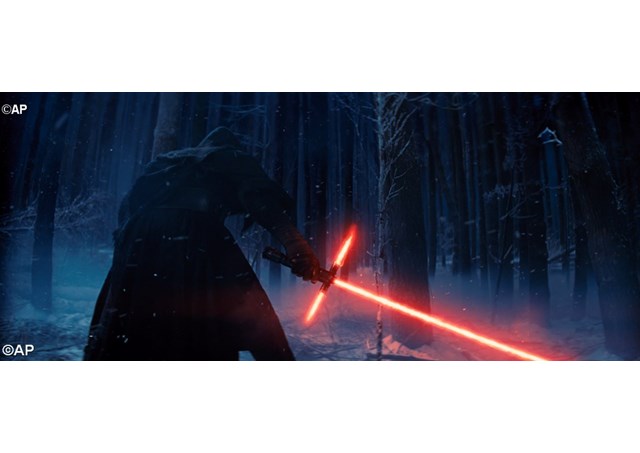
A scene from the latest installation of the Star Wars movie franchise. The Vatican newspaper L’Osservatore Romano has offered its take on the blockbuster film. – AP
21/12/2015 15:57 (Vatican Radio)
The newest edition of the Star Wars franchise has broken box office records, and made over $517 million after its first weekend of release. Star Wars: The Force Awakens is the first movie in the series since Disney bought the franchise, and the first made without the oversight of George Lucas. Continue reading Vatican newspaper reviews Star Wars: The Force Awakens→
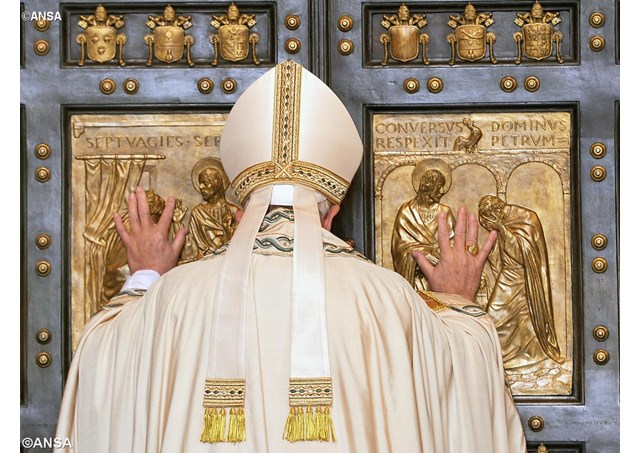
Pope Francis pushing open the Holy Door of Saint Peter’s – ANSA
09/12/2015 10:14 (Vatican Radio)
On the 8th of December, Feast of the Immaculate Conception, Pope Francis pushed open the Holy Door of Saint Peter’s Basilica. A symbolic gesture to mark the opening of the Extraordinary Holy Year dedicated to Mercy.
Pope Francis received the participants in a major international congress under the sponsorship of the Congregation for Catholic Education on Saturday morning. For four days this week, more than 2 thousand educators, administrators, students and teachers from around the world have been examining the challenges facing the mission of Catholic education in the 21st century, under the umbrella of Educating today and tomorrow: a passion renewed. Continue reading Pope Francis: educate openness to transcendence, practice of mercy→
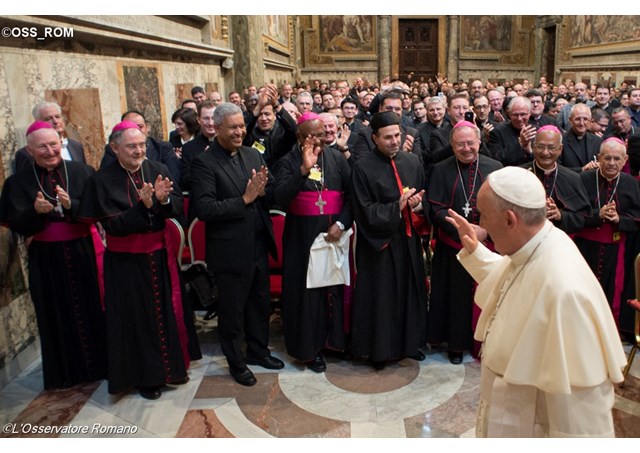
Pope Francis meets participants of a conference on the Vatican II documents on the priesthood – OSS_ROM
20/11/2015 14:47 (Vatican Radio)
Pope Francis on Friday said a good priest “creates serenity,” and a priest “that is often sad, nervous, or has a hard character” is not good for himself or his people.
The Holy Father was addressing a Conference sponsored by the Congregation for the Clergy marking the fiftieth anniversary of the proclamation of the Vatican II decrees Presbyterorum ordinis [Decree on the Ministry and Life of Priests] and Optatam Totius [Decree on Priestly Training]. Continue reading Pope Francis: Priests should not often be sad or nervous→
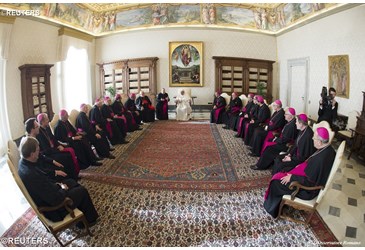
Pope Francis meets with German bishops in Rome on their ad limina visit. – REUTERS
2015-11-20 11:07 (Vatican Radio)
Pope Francis on Friday told the bishops of Germany the upcoming Jubilee of Mercy offers the opportunity to “rediscover the sacraments of Penance and the Eucharist.”
The bishops were meeting with the Holy Father during their ad limina visit to Rome.
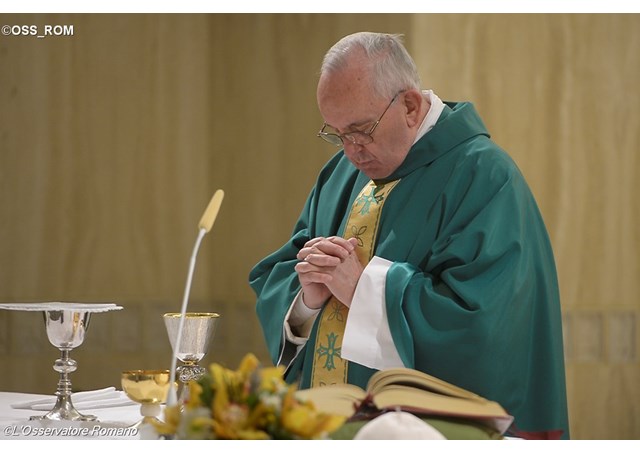
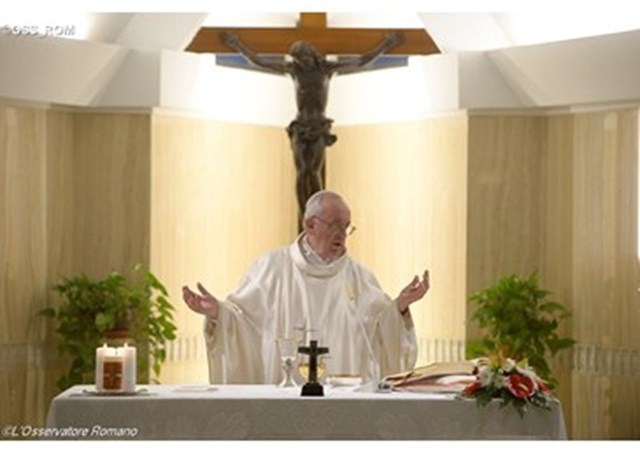
“The whole world is at war,” and the rejection of the “path of peace” means that God Himself, that Jesus Himself, weeps. This was the message of Pope Francis to the faithful following the readings of the day at Mass on Thursday morning in the Casa Santa Marta.
The importance of safeguarding our Christian identity and not living double lives: that was the theme at the heart of Pope Francis’ homily at the Santa Marta Mass on Tuesday morning. The Pope based his words on the daily readings which focus on the need for coherence between our spiritual and our temporal lives. Continue reading Pope warns against temptations of leading a double life→
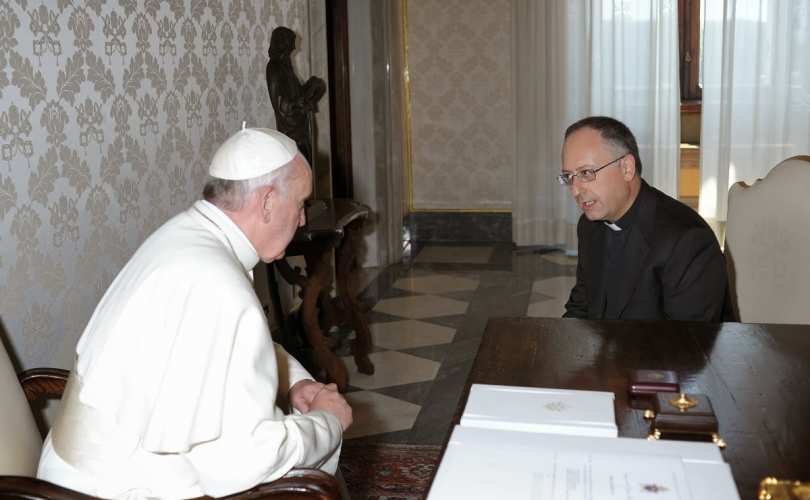
Pope Francis with close friend and advisor Fr. Antonio Spadaro, SJ
November 16, 2015
Two European bishops’ conferences and prominent Vatican observers are highlighting the significance of a recent article by one of Pope Francis’ closest confidants interpreting the Synod’s final report to allow Communion to “remarried” divorcees. They say the author’s interpretation signals the path Pope Francis will adopt himself.
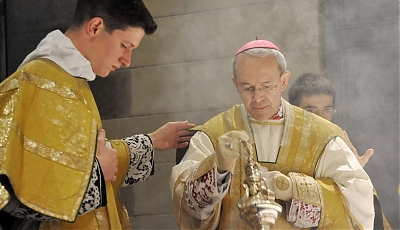
His Excellency Bishop Athanasius Schneider, one of the most visible prelates working on the restoration of the traditional Latin Mass and faith, has penned a nearly 5,000-word response to the Synod exclusively for our readers.
RORATE EXCLUSIVE: Bishop Athanasius Schneider reaction to Synod
We want to express our heartfelt gratitude to His Excellency for taking the time to analyze and express his views on one of the most critical events in Church history — one that he too sees as a “back door” to Holy Communion for adulterers, a rejection of Christ’s teaching and a Final Report full of “time bombs.”
In the coming days, we will also publish an interview with His Excellency, on a wide range of topics. For now, we bring you this important work, exclusively for our readers.
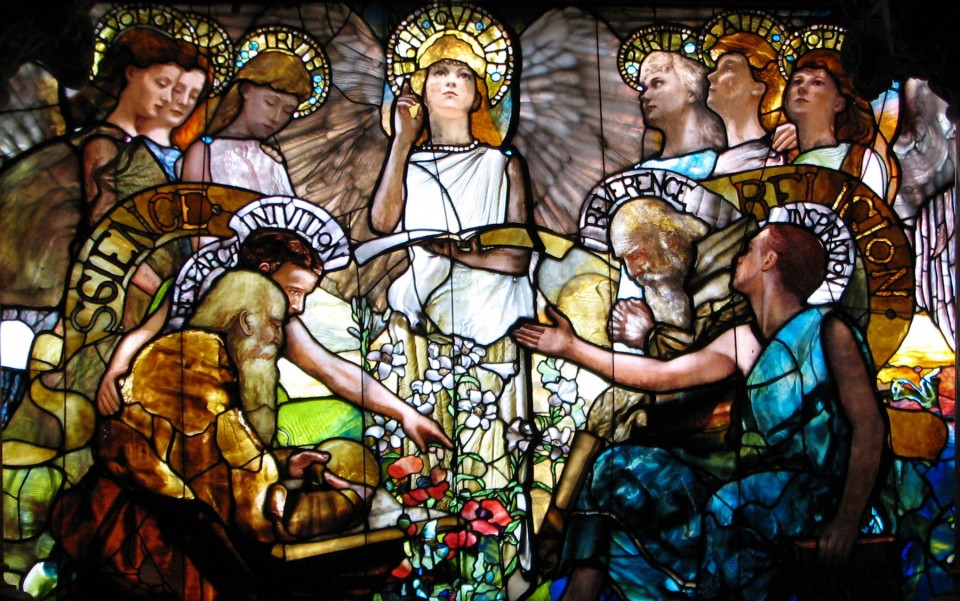
The centre panel Education from the Chittenden Memorial Window at Yale University depicting Science (left) and Religion (right). Courtesy Wikimedia
The Vatican still refuses to endorse evolutionary theory – setting a billion believers at odds with modern science
By John Farrell 8 May 2015
There was a moment in the recent history of the Roman Catholic Church when an influential Jesuit tried to forge a deep synthesis between religion and modern science. But he was muzzled by the Vatican, and Catholics have been paying for it ever since. Continue reading Can the Vatican evolve before it dissolves?→
With yesterday’s retirement of Bishop Joachim Reinelt the Berlin Church Province is close to completing a significant generational shift. For the first time since the province, which consists of the Metropolitan Archdiocese of Berlin and the Dioceses of Görlitz and Dresden-Meiβen, was established in its modern form in 1994*, a new generation of bishops is set to take over.
In July 2010, the bishop of Görlitz, Konrad Zdarsa, was moved to Augsburg, and he can be considered something of a transitional bishop, having helmed Görlitz for only three years. His predecessor, Bishop Rudolf Müller, had been Görlitz’s chief shepherd for almost 20 years. In June of last year, Bishop Wolfgang Ipolt became the new bishop.
In February of last year, Georg Cardinal Sterzinsky retired as Archbishop of Berlin, making way for Rainer Maria Woelki to become the youngest member of the College of Cardinals as of three days ago.
Big day in Berlin today, as Archbishop Heiner Koch is installed as its third archbishop and tenth bishop overall. The installation, starting at 11 o’clock local time, will be streamed live via www.katholisch.de and www.domradio.de.
Opening the ceremony is Bishop Wolfgang Ipolt, bishop of Görlitz, as he is the senior bishop of the province composed of Berlin and its two suffragan dioceses, Görlitz and Dresden-Meißen. With that latter see vacant, he is also the only bishop available to do that job. Bishop Görlitz will lead the archbishop to his cathedra, after which the latter officially take possession of it.
Archbishop Koch will also be receiving his pallium from the Apostolic Nuncio during the installation Mass. It had already been granted and collected by him on 29 June, but as the woollen band denoting his office of metropolitan archbishop is now officially bestowed in the home dioceses, each of these…
With the appointment of Bishop Heiner Koch to Berlin, the German capital has an archbishop again after an almost eleven-month vacancy. He leaves the Diocese of Dresden-Meißen, a suffragan of Berlin, vacant after less than two-and-a-half years, making it on of two empty sees in Germany, the other being Limburg.
Who is Archbishop-elect Heiner Koch? Like his predecessor in Berlin, Cardinal Woelki, he was born in the Archdiocese of Cologne, in Düsseldorf. He is less than a week away from his 61st birthday, has been a priest for 35 years (he was ordained on his 26th birthday in 1980) and a bishop for nine years. He is the third archbishop of Berlin, but the tenth ordinary since Berlin became a diocese in 1930. Six of his predecessors were made cardinals.
The new archbishop studied Catholic theology, philosophy and pedagogy at the University of Bonn and is a Doctor of Theology. After his…
The president of the German Bishops’ Conference, Cardinal Reinhard Marx, has made some comments about the upcoming second session of the Synod on the family, as the bishops of Germany are discussing the topic in their spring plenary in Hildesheim. While the full text of his words has not been published, we have to make do with interpretations, which is always risky business. Cardinal Marx, speaking for the conference as a whole, has rightly said that we should not reduce the Synod to the question of divorced and remarried Catholics, but of course that does happen, especially when the bishops explain their own intentions on this topic.
About the role of Rome in the pastoral realities of the local churches, Cardinal Marx said the following:
“We are not a subsidiary of Rome. Every bishops’ conference is responsible for the pastoral care in their area and has to proclaim the Gospel in…
Earlier today we had a short Synod intervention from Cardinal Danneels, and now one of the longest, from Cardinal Reinhard Marx. It’s also one of the most fearless, as the German cardinal talks about some of the topics that he has been criticised heavily for: Communion for divorced and remarried Catholics and graduality.
Like the intervention of Bishop Bode, Cardinal Marx’s text is based heavily on the life experiences of the faithful concerned. And while it is essential for the Church to meet people where they are, I do miss the essential aspect of our faith: that is a revelation faith. Its foundation is objective truth, and while the way we relate to that truth, communicate it and help people achieve it (acknowledged by Cardinal Marx as he discusses our call to holiness) can and should vary according to circumstances, that truth does and can not. In the debate about…
In his blog, Bishop Jan Hendriks speaks about the headline topic of the Synod of Bishops that was concluded this weekend. Rather than limiting the question to whether divorced and remarried Catholics should receive Communion, Bishop Hendriks identifies the greater problem of receiving without due preparation or even awareness. Communion, he says, has become a social event:
“In the media and the discussions outside the Synod much emphasis was given to divorced people who had remarried and the conditions under which they could perhaps receive Holy Communion. Beforehand, the Pope had already repeatedly stated that this was not the most important issue and certainly not the panacea for all problems. There is, however, a problem to such an extent that, certainly in our western society, everyone goes to receive Communion, without the necessary preparation: without faith in the Eucharist, without remorse over sins, without Confession, without the desire to follow Christ and…


























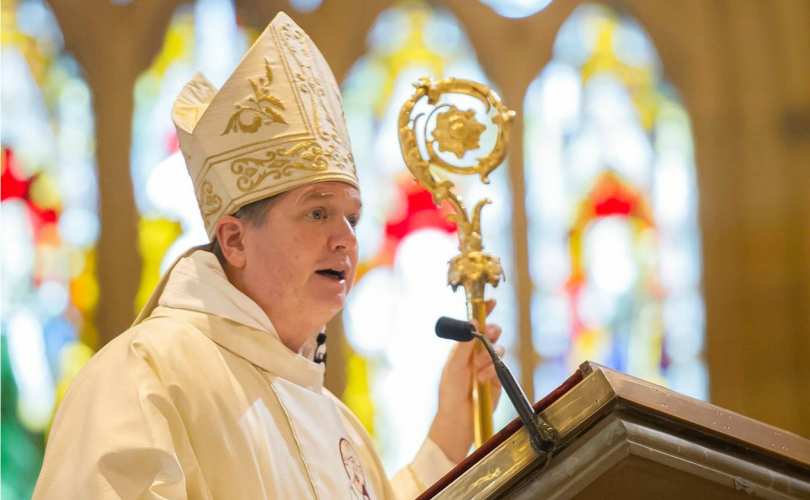






 With yesterday’s retirement of Bishop Joachim Reinelt the Berlin Church Province is close to completing a significant generational shift. For the first time since the province, which consists of the Metropolitan Archdiocese of Berlin and the Dioceses of Görlitz and Dresden-Meiβen, was established in its modern form in 1994*, a new generation of bishops is set to take over.
 Big day in Berlin today, as Archbishop Heiner Koch is installed as its third archbishop and tenth bishop overall. The installation, starting at 11 o’clock local time, will be streamed live via
 With the appointment of Bishop Heiner Koch to Berlin, the German capital has an archbishop again after an almost eleven-month vacancy. He leaves the Diocese of Dresden-Meißen, a suffragan of Berlin, vacant after less than two-and-a-half years, making it on of two empty sees in Germany, the other being Limburg.
 The new archbishop studied Catholic theology, philosophy and pedagogy at the University of Bonn and is a Doctor of Theology. After his…
 The president of the German Bishops’ Conference, Cardinal Reinhard Marx, has made some comments about the upcoming second session of the Synod on the family, as the bishops of Germany are discussing the topic in their spring plenary in Hildesheim. While the full text of his words has not been published, we have to make do with interpretations, which is always risky business. Cardinal Marx, speaking for the conference as a whole, has rightly said that we should not reduce the Synod to the question of divorced and remarried Catholics, but of course that does happen, especially when the bishops explain their own intentions on this topic.

 “In the media and the discussions outside the Synod much emphasis was given to divorced people who had remarried and the conditions under which they could perhaps receive Holy Communion. Beforehand, the Pope had already repeatedly stated that this was not the most important issue and certainly not the panacea for all problems. There is, however, a problem to such an extent that, certainly in our western society, everyone goes to receive Communion, without the necessary preparation: without faith in the Eucharist, without remorse over sins, without Confession, without the desire to follow Christ and…
 The Loud Cry
You must be logged in to post a comment.