Tag Archives: Politics

The Gates Foundation said Tuesday it will pledge $1.6 billion over the next five years to Gavi, the Vaccine Alliance, a global public-private partnership that promotes childhood vaccination in the world’s poorest countries.

This article was originally published by The Defender — Children’s Health Defense’s News & Views Website.

U.S. and U.K. cuts in funding to Gavi, the Vaccine Alliance, mean the Gates Foundation is poised to be the biggest donor to both Gavi and the WHO. Critics said Gates’ latest funding commitment has less to do with protecting global public health and more to do with increasing his global influence.

Continue reading The Gates Foundation said Tuesday it will pledge $1.6 billion over the next five years to Gavi, the Vaccine Alliance, a global public-private partnership that promotes childhood vaccination in the world’s poorest countries.

Crisis Management Role play Actors -is there a link to false flag events?

https://www.youtube.com/watch?v=pJiUGukxZLQ

CrisisCast produces disaster dramas and role play actors specially trained by psychologists in criminal and victim behaviour for crisis management and disaster recovery simulations.

We provide highly interactive live scenarios with roleplay, injects, film clips and TV breaking news stories, social and print media posts drilling and exercising a wide variety of potential risks and all facilitated by an experienced Gold Command trainer.

Some of the leading independent schools in the world have used CrisisCast to reassure themselves that the critical incident plan they have in place is adequate, to exercise their management teams in key responses.  The added value of a learning experience that builds confidence and strengthens ties within the Incident Response Team – or any school team – is proving to be of major added value to clients.

All of our school scenarios build towards an exciting press conference with lights, cameras and hostile reporters.

Source: CrisisCast


A legitimate training resume illustrated on their website? Is it feasible that this could be utilised by governments and NGOs to facilitate their own political agendas and propaganda – of course it could. So all you need would be a bank of trained actors.

So my thought for today would be – for every event involving emotional turmoil and mass murder being reported on mainstream media, stop and ask yourself the questions: Could this be a bunch of actors? Are there any bodies? Disbelieve it to begin with – and go factfind the truth for yourself. Until you find the truth – it’s a false flag and someone is pushing their agenda!

NB: One of CrisisCast clients was G4S – how interesting?

Can it be true? A Catholic Croat’s protest

Not even when he received the protest sent him by Dr. Prvislav Grisogno, a Catholic Croat and former Minister in the Royal Yugoslav cabinet, did Archbishop Stepinac speak up. Continue reading Can it be true? A Catholic Croat’s protest

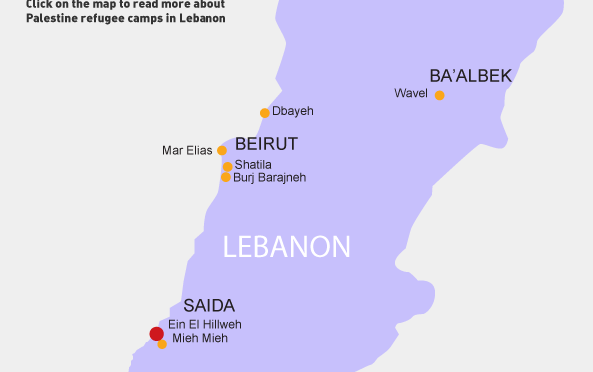
Palestinian Refugee Camps in Lebanon | UNRWA

Some 450,000 refugees are registered with UNRWA in Lebanon, with many living in the country’s 12 refugee camps.

Palestine refugees represent an estimated ten per cent of the population of Lebanon. They do not enjoy several important rights; for example, they cannot work in as many as 20 professions. Because they are not formally citizens of another state, Palestine refugees are unable to claim the same rights as other foreigners living and working in Lebanon. Among the five UNRWA fields, Lebanon has the highest percentage of Palestine refugees living in abject poverty.

Continue reading Palestinian Refugee Camps in Lebanon | UNRWA

FASCISM: Is real. Religious Politics

Fascism is being used by governments and religious institutions worldwide. Propaganda bombards us via the bought media selling us the false flags exercises that are being implemented to move hearts and minds. Meanwhile modern day ‘Dr Mengeles’ are funded to produce medical experiments from Ebola to Zika and HIV to cancer throughout the world. Continue reading FASCISM: Is real. Religious Politics

Pope Francis CEO gains 1 million Instagram followers in under 12 hours

The article below was featured on CNN.money.  Now that begs the question – what religious interest has CNN Financial reporting.  The short answer is None.  That’s right – there is nothing religious to report here. The significant role players are two CEOs of two business organisations where God takes a back seat or does not exist at all, or not in the Christian sense anyway.  The omnipotent god here is Money and that is what CNN.money is reporting on.

If you have been misled into believing that the leader of the Catholic church is going to save your soul, then you’re wrong. It is Jesus that saves souls.  This alleged, so-called Christian leader is more interested in making money than he is in praying to Jesus directly. Who is his God? He’ll pray to God, and to Christ- but Pope Francis never prays directly to Jesus.  And as we are advised:

And the light of the lamp shall shine no more at all in thee: and the voice of the bridegroom and the bride shall be heard no more at all in thee. For thy merchants were the great men of the earth: for all nations have been deceived by thy enchantments.
(Rev 18:23)

Continue reading Pope Francis CEO gains 1 million Instagram followers in under 12 hours

TPP and Access to Affordable Medicines

The Trans-Pacific Partnership would provide large pharmaceutical firms new rights and powers to increase medicine prices and limit consumers’ access to cheaper generic drugs. This would include extensions of monopoly drug patents that would allow drug companies to raise prices for more medicines and even allow monopoly rights over surgical procedures. For people in developing countries involved in the TPP, these rules could be deadly – denying consumers access to HIV/AIDS, tuberculosis and cancer drugs. Continue reading TPP and Access to Affordable Medicines

2 More Holistic Doctors Found Dead in Suspicious Circumstances — Total Number is Now 12

I chatted again with lead journalist Erin Elizabeth from HealthNutNews.com (video below) about the mysterious series of deaths of holistic/alternative doctors which began earlier this summer.

We’ve covered much of the story only to come up with more questions than answers.

Why are so many dying in such a small amount of time? Why are so many of them being called ‘suicides,’ against the good judgement of the close family members and friends of the deceased? Continue reading 2 More Holistic Doctors Found Dead in Suspicious Circumstances — Total Number is Now 12

CLIMATEGATE: A CRIME AGAINST HUMANITY

Let me preface this by saying I come from a science background myself, but all too often science gets hijacked and distorted for political or economic gain, or simply makes goofs which are perpetuated by arrogance! Continue reading CLIMATEGATE: A CRIME AGAINST HUMANITY

Global Apollo programme seeks to make clean energy cheaper than coal

Earthrise: Famous image of Earth taken from the Apollo 8 mission on 24 December 1968. Photograph: Alamy

Sir David King calls for £15bn a year R&D spending on clean energy to make it cheaper than coal power globally, in emulation of space race research efforts Continue reading Global Apollo programme seeks to make clean energy cheaper than coal

Dr. Tim Ball Responds To Gore Video

Gore’s Google Earth climate change scare, 35 major errors

Bob Parks imageBy Bob Parks — Bio and Archives  September 29, 2009

It’s an honor to know people who know about what they’re talking about to contrast the ignorant, propagandist opinion of people like Al Gore. Regarding Gore’s Google Earth climate change scare, I asked Dr. Timothy Ball for a retort.

Continue reading Dr. Tim Ball Responds To Gore Video

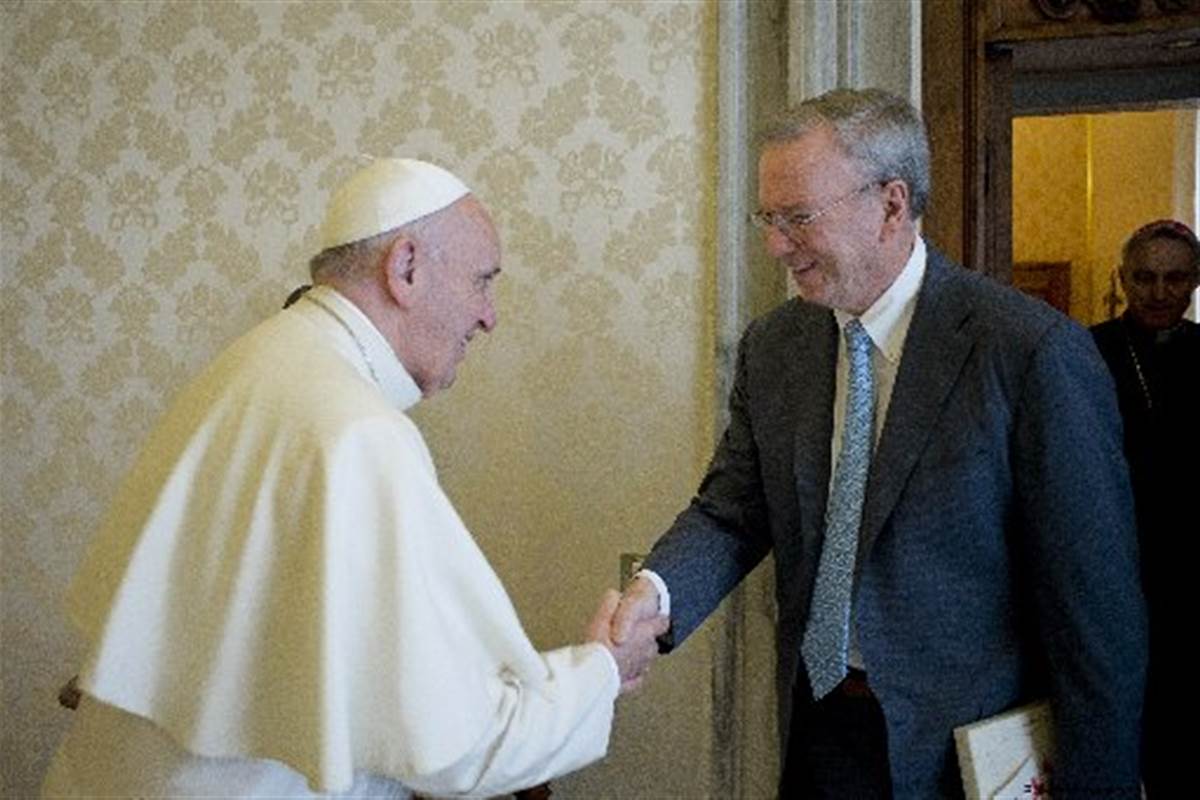
Google’s Eric Schmidt Meets With Pope Francis at the Vatican

by James Eng

Eric Schmidt, executive chairman of Google parent company Alphabet, had an unusual meeting on his calendar on Friday — a private sit-down with Pope Francis at the Vatican.Neither Google nor the Vatican would comment on what the two discussed during the meeting, said to have lasted 15 minutes.

Related: Pope Francis Explains why the Internet is a ‘Gift from God’

A video report from the TV news agency Rome Reports showed the pontiff shaking hands with Schmidt and Jared Cohen, director of Google Ideas. Schmidt said to Francis, “I want to work with you to make these points. … We will make it happen.” The pope responded, “Pray for me. Don’t forget.” It’s not known what the two were referring to.

Although Francis has admitted he doesn’t know how to work a computer and has called the Internet a “gift from God,” he is no stranger to Google products. The 79-year-old pontiff has hosted two Google Hangouts from the Vatican, including one in which he confessed he’s a “dinosaur” when it comes to technology.

Pope Francis is also a social media star, racking up more than 8.4 million followers on Twitter.

Source: NBC News

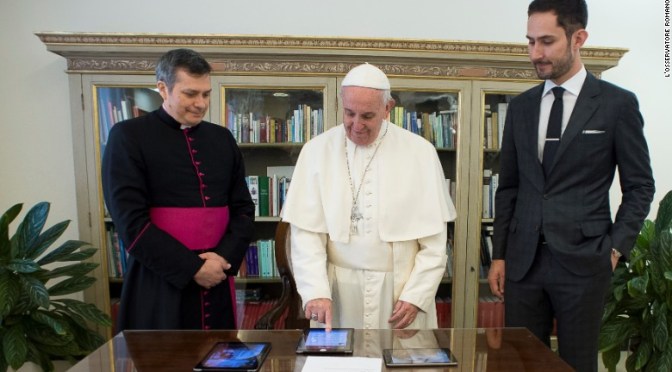
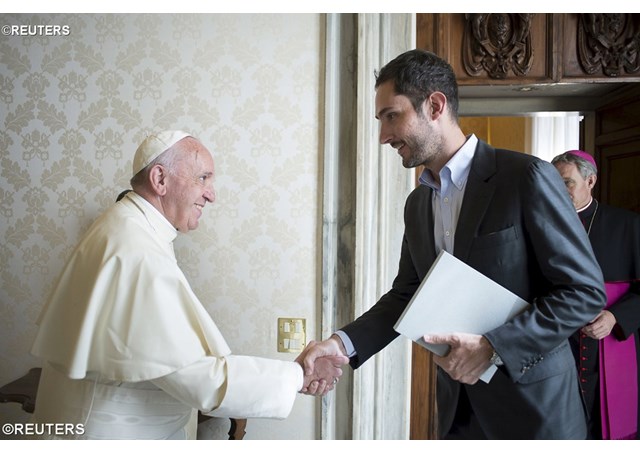
Pope Francis meets with CEO of Instagram, Kevin Systrom

Pope Francis meets with , Kevin Systrom, the CEO and co-founder of Instagram, the photo-sharing social network – REUTERS

27/02/2016 15:04

(Vatican Radio) Pope Francis on Friday met with the CEO and co-founder of Instagram, Kevin Systrom. The photo-sharing social network was founded in 2010, and bought by Facebook in 2012. Over 300 million people use the service each month. Continue reading Pope Francis meets with CEO of Instagram, Kevin Systrom

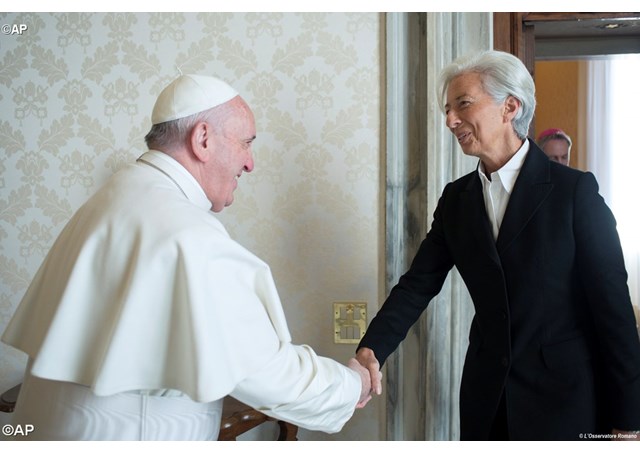
Pope Francis meets with IMF’s Christine Lagarde

ap3260812_articolo

18/01/2016 14:19

(Vatican Radio) Pope Francis on Monday met in the Vatican with Christine Lagarde, the Managing Director of the International Monetary Fund.

The two also met in the Vatican on 10 December 2014.

The International Monetary Fund (IMF) is composed of 188 countries, was established in 1944 to help manage countries’ balance of payments. According to its website, it is

“working to foster global monetary cooperation, secure financial stability, facilitate international trade, promote high employment and sustainable economic growth, and reduce poverty around the world.”

Source: Vatican Radio

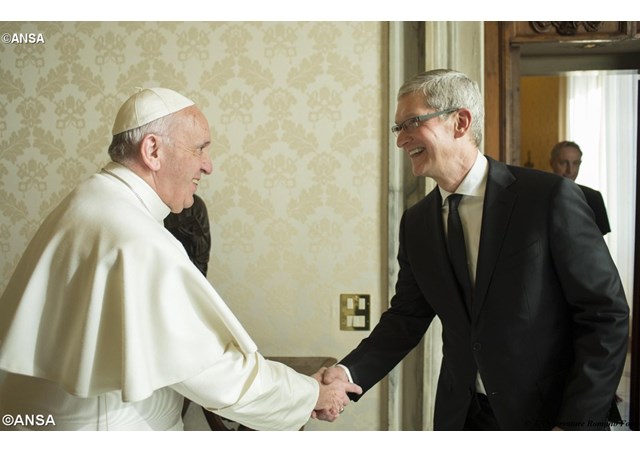
Pope Francis receives Apple CEO

Pope Francis shakes hands with Apple’s Tim Cook during a private audience in the Vatican on Friday , 22 January, 2016 – ANSA

22/01/2016 17:33

Pope Francis met with the CEO of Apple Inc., Tim Cook, on Friday. The private audience took place in the Apostolic Palace in the Vatican.

Source: Vatican Radio


Was this a religious meeting or was this the meeting of two CEOs?

Did the Pope explore with Tim Cook the need to move away from exploiting human beings with exposure to pornography and encourage him to take steps to manage this situation in line with Christian values?

The use of technology promoting, or indeed, encouraging human beings to sin is explicitly and directly opposed to the will of Almighty God.  Surely, the Pope, as an alleged moral and religious figure in the world, should be making the chasm between the promoters of “sin” wider, rather than narrower.

What is the Moral proclamation that the Pope gives to business leaders?

Does the Pope offer any Christian morality to business leaders? Is he displaying the moral characteristics representative and expected from supposed “Mosaic” leadership within the catholic church?

The answer to that is simply and sadly, no.

There should be condemnation of the business pursuits of companies like Apple and the likes and what they stand for -by the Pope and other religious leaders- but there is none.  There seems to be a lack of moral leadership in the catholic church.

There is no “Mosaic” proclamation – ‘Are you for God?’

So does this all come down to what the Pope might consider “prudence”.

It is what it is, and “this is the avenue,” on the back of which the teachings of the church will be promoted. Why? Because the Pope, the church and it’s ministers promote an indifferent message towards it’s[catholic church] buddy system established with the likes of Apple’s CEO.

Well if that is the case then the scarlet and red is using “sin” to create business – which is deplorable and must be abhorred.

Gore’s Dual Role: Advocate and Investor

By JOHN M. BRODER NOV. 2, 2009

WASHINGTON — Former Vice President Al Gore thought he had spotted a winner last year when a small California firm sought financing for an energy-saving technology from the venture capital firm where Mr. Gore is a partner. Continue reading Gore’s Dual Role: Advocate and Investor

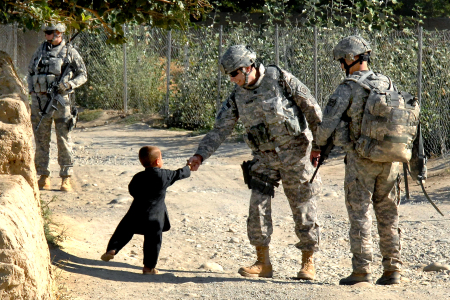
None So Brave – “De Oppresso Liber”

“De Oppresso Liber”

(To Liberate the Oppressed) ~~Motto of the U.S. Army Special Forces

A poignant Afghan proverb declares,

“Cowards cause harm to brave men.”

Continue reading None So Brave – “De Oppresso Liber”

31,487 Scientists say NO to Climate Change Alarmists

The Global Warming Petition project;
Started by Dr Art Robinson in response to the false alarm over CO2;
http://www.petitionproject.org/seitz_…
and Continue reading 31,487 Scientists say NO to Climate Change Alarmists

What is a LFTR? Molten-fueled, salt-cooled nuclear power | Molten Salt Reactors (incl Liquid Fluoride Thorium Reactor)

by George Lerner | Aug 25, 2012 |

Nuclear power produces a million times as much energy as fossil fuels, per pound of fuel, without releasing pollution or affecting climate. People think nuclear power releases lots of radiation, but actually fossil fuels release more radioactive material.

We don’t have to use a Light Water Reactor to generate nuclear power. Though we’ve been using LWR almost exclusively, it is not the best type of nuclear reactor, it is the design that coal/oil companies, who owned and still own USA Congress, picked in the 1960s. Continue reading What is a LFTR? Molten-fueled, salt-cooled nuclear power | Molten Salt Reactors (incl Liquid Fluoride Thorium Reactor)

Jorge Mario Bergoglio: The “Dirty War” Pope

Image: Bergoglio with Military Dictator General Jorge Videla

By Bill Van Auken, March 16, 2013

For over a week, the media has subjected the public to a tidal wave of euphoric banality on the Roman Catholic Church’s selection of a new pope.

This non-stop celebration of the dogma and ritual of an institution that for centuries has been identified with oppression and backwardness is stamped with a deeply undemocratic character. It is reflective of the rightward turn of the entire political establishment and its repudiation of the principles enshrined in the US Constitution, including the wall of separation between church and state.

What a far cry from the political ideals that animated those who drafted that document. Continue reading Jorge Mario Bergoglio: The “Dirty War” Pope

“Washington’s Pope”? Who is Pope Francis?

Cardinal Jorge Mario Bergoglio and Argentina’s “Dirty War”

By Prof Michel Chossudovsky, September 25, 2015

In the course of the last two years, Pope Francis has been portrayed in chorus by the Western media as an antiwar activist and a left leaning champion of “Liberation Theology” committed to World peace and global poverty alleviation. His September 24 speech to the US Congress was described as “stunning in the breadth, depth, and conviction of its progressivism.” “If President Barack Obama had delivered the text of Pope Francis’s speech to Congress Thursday [September 24, 2015] as a State of the Union address, he would have risked being denounced by Republicans as a socialist.” Continue reading “Washington’s Pope”? Who is Pope Francis?

Chilean Judge Says Pinochet Is Fit for Trial

By LARRY ROHTER DEC. 14, 2004

BUENOS AIRES, Dec. 13 -A Chilean judge ruled Monday that Gen. Augusto Pinochet was competent to stand trial for human rights abuses that occurred during his nearly 17 years as Chile’s dictator and immediately charged him with nine counts of kidnapping and one of murder.

Judge Juan Guzmán Tapia also ordered that General Pinochet, 89, be placed under house arrest and confined to his mansion on the outskirts of Santiago, the Chilean capital. The former dictator’s lawyer, Pablo Rodríguez, accused the judge of trampling on the general’s human rights and announced that he would appeal the decision. Later Monday, General Pinochet’s defense team filed an injunction with the Santiago Court of Appeals, effectively freezing the house arrest until the court rules on it, according to Chilean news accounts.. Continue reading Chilean Judge Says Pinochet Is Fit for Trial

The Folly Of The United Nations (U.N.) Peacekeeping

by Dale Van Atta
Readers Digest, November, 1995

Not only have its efforts to bring peace often been failures, but the organisation itself is riddled with waste, fraud and abuse.

AS THE United Nations approaches its fiftieth anniversary this year, Reader’s Digest assigned Roving Editor Dale Van Atta to examine U.N. operations and effectiveness. For four months he interviewed dozens of officials and poured over U.N. budget documents and confidential files. He found an institution in critical need of reform.

This article, on the U.N.’s peacekeeping operations; is the first of two reports. Part 2 will appear next month.

Sonja’s Kon-Tiki Café is a notorious Serbian watering hole ten kilometres north of Sarajevo. While Serb soldiers perpetrated atrocities in nearby Bosnian villages, local residents reported that U.N. peacekeepers from France, Ukraine, Canada and New Zealand regularly visited Sonja’s, drinking and eating with these very same soldiers — and sharing their women.

The women of Sonja’s, however, were actually prisoners of the Serb soldiers. As one soldier, Borislav Herak, would later confess, he visited Sonja’s several times a week, raping some of the 70 females present and killing two of them.

U.N. soldiers patronised Sonja’s even after a Sarajevo newspaper reported where the women were coming from. A U.N. spokesman excused the incident by saying no-one was assigned to read the newspaper. The U.N. soldiers who frequented Sonja’s also neglected to check out the neighbourhood. Just over 60 metres away, a concentration camp held Bosnian Muslims in inhuman conditions. Of 800 inmates processed, 250 disappeared and are presumed dead.

Tragically, Sonja’s Kon-Tiki illustrates much of what has plagued U.N. peacekeeping operations: incompetent commanders, undisciplined soldiers, alliances with aggressors, failure to prevent atrocities and at times even contributing to the horror. And the level of waste, fraud and abuse is overwhelming.

Until recently, the U.N. rarely intervened in conflicts. When it did, as in Cyprus during the 1960s and ’70s, it had its share of success. But as the Cold War ended, the U.N. became the world’s policeman, dedicated to nation building and peacekeeping. By the end of 1991, it was conducting 11 peacekeeping operations at an annual cost of $615 million. In three years, the numbers rose to 18 operations and $3.3 billion — with Australian taxpayers paying 1.5 per cent of the bill.

Have the results justified the steel cost? Consider the U.N.’s top four peacekeeping missions:

Bosnia In June 1991, Croatia declared its independence from Yugoslavia and was recognised by the U.N. The Serbian-dominated Yugoslav army invaded Croatia, ostensibly to protect its Serbian minority. After the Serbs agreed to a cease-fire, the U.N. sent in a 14,000-member U.N. Protection Force (UNPROFOR) to build a new nation. (The mission has since mushroomed to over 40,000 personnel, becoming the most extensive and expensive peacekeeping operation ever.)

After neighbouring Bosnia declared its independence in March 1992, the Serbs launched a campaign of “ethnic cleansing” against the Muslims and Croats who made up 61 per cent of the population. Rapidly the Serbs gained control of two-thirds of Bosnia, which they still hold.

Bosnian Serbs swept into Muslim and Croat villages and engaged in Europe’s worst atrocities since the Nazi Holocaust. Serbian thugs raped at least 20,000 women and girls. In barbed-wire camps, men, women and children were tortured and starved to death. Girls as young as six were raped while parents were forced to watch. In one case, three Muslim girls were chained to a fence, raped by Serb soldiers for three days, then drenched with petrol and set on fire.

While this was happening, the UNPROFOR troops stood by and did nothing to help. Designated military “observers” counted artillery shells — and the dead.

Meanwhile, evidence emerged that there was a serious corruption problem. Accounting procedures were so loose that the U.N. overpaid $2.3 million on a $28-million fuel contract. Kenyan peacekeepers stole 95,000 litres of fuel and sold it to the Serbs.

Corruption charges were routinely dismissed as unimportant by U.N. officials. Sylvana Foa, then spokesperson for the U.N. Human Rights Commission in Geneva, said it was no surprise that “out of 14,000 pimply 18-year-olds, a bunch of them should get up to hanky-panky” like blackmarket dealings and visiting brothels.

When reports persisted, the U.N. finally investigated. In November 1993 a special commission confirmed that some terrible but “limited” misdeeds had occurred. Four Kenyan and 19 Ukrainian soldiers were dismissed from the U.N. force.

The commission found no wrongdoing at Sonja’s Kon-Tiki, but its report, locked up at U.N. headquarters and never publicly released, is woefully incomplete. The Sonja’s Kon-Tiki incidents were not fully investigated, for example, because the Serbs didn’t allow U.N. investigators to visit the site, and the soldiers’ daily logbooks had been destroyed.

Meanwhile, Russian troop commanders collaborated with the Serb aggressors. According to U.N. personnel at the scene, Russian battalion commander Colonel Viktor Loginov and senior officer Colonel Aleksandr Khromchenkov attended lavish feasts hosted by a Serbian warlord called “Arkan,” widely regarded as one of the worst perpetrators of atrocities. It was also common knowledge that Russian officers directed that U.N. tankers unload petrol at Arkan’s barracks. During one cease-fire, when Serbian materiel was locked in a U.N. storage area, a Russian apparently gave the keys to the Serbs, who removed 51 tanks. Eventually, Khromchenkov was repatriated. Loginov, after finishing his tour of duty, joined Arkan’s Serbian forces.

Problems remained, however, under the leadership of another Russian commander, Major General Aleksandr Perelyakin. Belgian troops had been blocking the movement of Serb troops across a bridge in northeastern Croatia, as required by U.N. Security Council resolutions. Perelyakin ordered the Belgians to stand aside. Reluctantly they did so, permitting one of the largest movements of Serbian troops and equipment into the region since the 1991 cease-fire. According to internal U.N. reports, the U.N. spent eight months quietly trying to pressure Moscow to pull Perelyakin back, but the Russians refused. The U.N. finally dismissed him last April.

Cambodia In 1991, the China and the Soviet Union helped broker a peace treaty among three Cambodian guerrilla factions and the Vietnamese-installed Cambodian government, ending 21 years of civil war. To ease the transition to Cambodia’s first democratic government; the U.N. created the U.N. Transitional Authority in Cambodia, called UNTAC. In less than two years, about 20,000 U.N. peacekeepers and other personnel were dispatched at a cost of $2.4 billion.

Some of the Cambodian “peacekeepers” proved to be unwelcome guests — especially a Bulgarian battalion dubbed the “Vulgarians.” In northwest Cambodia, three Bulgarian soldiers were killed for “meddling” with local girls. One Bulgarian was treated for 17 different STDs. The troops’ frequent carousing once sparked a mortar-rifle battle with Cambodian soldiers at a brothel.

The Bulgarians were not the sole miscreants in Cambodia, as internal U.N. audits later showed. Requests from Phnom Penh included 6500 flak jackets — and 300,000 condoms. In the year after the U.N. peacekeepers arrived, the number of prostitutes in Phnom Penh more than tripled.

U.N. mission chief Yasushi Akashi waved off Cambodian complaints with a remark that “18-year-old hot-blooded soldiers” had the right to drink a few beers and chase “young beautiful beings.” Akashi did post an order: “Please do not park your U.N. vans near the nightclubs” (i.e., brothels). At least 150 U.N. peacekeepers got AIDS in Cambodia; 5000 of the troops came down with STDs. Meanwhile, more than 1000 generators were ordered, at least 330 of which, worth nearly $4 million, were never used for the mission. When U.N. personnel started spending the $300 million budgeted for “premises and accommodation,” rental costs became so inflated that locals could barely afford to live in their own country. Some $102 million was spent buying vehicles, including hundreds of surplus motorcycles and minibuses. When 100 12-seater minibuses were needed, 850 were purchased — an “administrative error,” UNTAC explained, that cost $10.6 million.

Despite the excesses, the U.N. points with pride to the free election that UNTAC sponsored in May 1993. Ninety per cent of Cambodia’s 4.7 million voters defied death threats from guerrilla groups and went to the polls.

Unfortunately, the election results have been subverted by the continued rule of the Cambodian People’s Party — the Vietnamese-installed communist government, which lost at the ballot box. In addition, the Khmer Rouge — the guerrilla group that butchered over a million countrymen in the 1970s — have refused to disarm and demobilise. So it was predictable that they would repeatedly break the cease-fire and keep up their killing. The U.N. has spent nearly $2.5 billion, but there is no peace in Cambodia.

Somalia When civil war broke out in this African nation, the resulting anarchy threatened 4.5 million Somalis — over half the population — with severe malnutrition and related diseases. U.N. Secretary General Boutros Boutros-Ghali, the first African (and Arab) to hold the position, argued eloquently for a U.N. peacekeeping mission to ensure safe delivery of food and emergency supplies. The U.N. Operation in Somalia (UNOSOM) was deployed to Mogadishu, the capital, in September 1992. It was quickly pinned down at the airport by Somali militiamen and was unable to complete its mission.

A U.S. task force deployed in December secured the Mogadishu area, getting supplies to the hungry and ill. After the Americans left, the U.N. took over in May 1993 with UNOSOM II. The $2.5-million-a-day operation transformed the former U.S. embassy complex into a 32hectare walled city boasting air-conditioned housing and a golf course. When U.N. officials ventured out of the compound, their “taxis” were helicopters that cost $640,000 a week.

The published commercial rate for Mogadishu—U.S. phone calls was $6.30 a minute, but the “special U.N. discount rate” was $10.78. Unauthorised personal calls totalled more than $2.5 million, but the U.N. simply picked up the tab and never asked the callers to pay.

Meanwhile, the peacekeeping effort disintegrated, particularly as warlord Mohammed Aidid harassed UNOSOM II troops. As the civil war continued, Somalis starved. But U.N. peacekeepers — on a food budget of from South America, beef from Australia and frozen fish from New Zealand and the Netherlands.

Thousands of metres of barbed wire arrived with no barbs; hundreds of light fixtures to illuminate the streets abutting the compound had no sockets for light bulbs. What procurement didn’t waste, pilferage often took care of. Peacekeeping vehicles disappeared with regularity. Egyptian U.N. troops were suspected of largescale black-marketing of minibuses.

But these losses were eclipsed in a single night by a thief who broke into a U.N. office in Mogadishu and took $5 million in cash. The office door was easy pickings: its lock could be jemmied with a credit card. The money, stored in a filing cabinet, had been easily visible to dozens of U.N. employees. While the case has not been solved, one administrator was dismissed and two others were disciplined. UNOSOM II itself was later shut down, leaving Somalia to the same clan warfare that existed when U.N. troops were first deployed two years before.

Rwanda Since achieving independence in 1962, Rwanda has erupted in violence between the majority Hutu tribe and minority Tutsis. The U.N. had a peacekeeping mission in that nation, but it fled as the Hutus launched a new bloodbath in April 1994. Only 270 U.N. troops stayed behind, not enough to prevent the butchery of at least 14 local Red Cross workers left exposed by the peacekeepers’ swift flight. The U.N. Security Council dawdled as the dead piled up, a daily horror of shootings, stabbings and machete hackings. The Hutus were finally driven out by a Tutsi rebel army in mid-1994.

Seven U.N. agencies and more than 100 international relief agencies rushed back. With a budget of some $256 million, the U.N. tried unsuccessfully to provide security over Hutu refugee camps in Rwanda and aid to camps in neighbouring Zaire.

The relief effort was soon corrupted when the U.N. let the very murderers who’d massacred half a million people take over the camps. Rather than seeking their arrest and prosecution, the U.N. made deals with Hutu thugs, who parlayed U.N. food, drugs and other supplies into millions of dollars on the black market.

Earlier this year the U.N. began to pull out of the camps. On April 22 at the Kibeho camp in Rwanda, the Tutsi-led military opened fire on Hutu crowds. Some 2000 Hutus were killed. Where was the U.N.? Overwhelmed by the presence of nearly 2000 Tutsi soldiers, the 200 U.N. peacekeepers did nothing. A U.N. spokesman informed Reader’s Digest, meekly, that the UN. was on the scene after the slaughter for cleanup and body burial.

With peacekeeping operations now costing over $3.8 billion a year, reform is long overdue. Financial accountability can be established only by limiting control by the Secretariat, which routinely withholds information about peacekeeping operations until the last minute — too late for the U.N.’s budgetary committee to exercise oversight. In December 1993, for example, the budget committee was given only one day to approve a $770-million budget that would extend peacekeeping efforts into 1994.

More fundamentally, the U.N. needs to re-examine its whole peacekeeping approach, for the experiment in nation building has been bloody and full of failure. Lofty ideas to bring peace everywhere in the world have run aground on reality: member states with competing interests in warring territories, the impossibility of lightly armed troops keeping at bay belligerent enemies, and the folly of moving into places without setting achievable goals.

“It has been a fundamental error to put U.N. peacekeepers in place where there is no peace to keep,” says Sam Nunn, a member of the US Senate Armed Services Committee.” We’ve seen very vividly that the U.N. is not equipped, organised or financed to intervene and fight wars.”

Global Warming: Ten Facts and Ten Myths on Climate Change

Originally published by GR in 2009

Ten facts about climate change

1.     Climate has always changed, and it always will. The assumption that prior to the industrial revolution the Earth had a “stable” climate is simply wrong. The only sensible thing to do about climate change is to prepare for it.

2.    Accurate temperature measurements made from weather balloons and satellites since the late 1950s show no atmospheric warming since 1958.  In contrast, averaged ground-based thermometers record a warming of about 0.40 C over the same time period. Many scientists believe that the thermometer record is biased by the Urban Heat Island effect and other artefacts.

3.    Despite the expenditure of more than US$50 billion dollars looking for it since 1990, no unambiguous anthropogenic (human) signal has been identified in the global temperature pattern.

Continue reading Global Warming: Ten Facts and Ten Myths on Climate Change

Changing views of how to change the world

Homi Kharas | March 10, 2016 9:32am

europe_satelliteimage001_16x9
REUTERS/NASA – A nighttime view of Europe made possible by the ?day-night band? of the Visible Infrared Imaging Radiometer Suite (VIIRS) is seen in a global composite assembled from data acquired by the Suomi National Polar-orbiting Partnership (Suomi NPP) satellite in 2012 and released by NASA October 2, 2014 .

World leaders concluded three large agreements last year. Each represents a vision of how to change the world.

There is a common thread to these agreements. They each reflect a new theory of how to change the world that is not made explicit but has evolved as a matter of practice. Understanding this new theory is crucial to successful implementation strategies of the three agreements. Continue reading Changing views of how to change the world

Lectio Magistralis by Professor Jeffrey D. Sachs~how to achieve a holistic path to sustainable development.

1 July 2013

Source: Pontifical Academy of Sciences

Hillary Clinton caught buying Twitter followers- do you trust her?

Anna Giaritelli  Posted on April 8, 2014

Twitter page “Faith and Value Voters for Hillary Clinton 2016” — the verified @Faith4Hillary account — was caught last week after having allegedly purchased 12,000 fake followers, roughly 42 percent of its total following. Continue reading Hillary Clinton caught buying Twitter followers- do you trust her?

‘Serious failings’ at BBC let Jimmy Savile abuse 72 people

“Serious failings” at the BBC allowed Jimmy Savile to sexually abuse 72 people without detection for decades, according to a damning report published on Thursday, which insisted that the corporation still had lessons to learn from the affair.

Dame Janet Smith, who started the independent inquiry in October 2012, found that despite what had happened with Savile, those worked at the BBC were still worried about reporting potential abuse and taking on the broadcaster’s stars.

© Guardian Composite Dame Janet Smith found that although the criminal behaviour was largely the fault of the perpetrators, the BBC could have stopped it but failed to do so.

She concluded that “an atmosphere of fear still exists today in the BBC possibly because obtaining work in the BBC is highly competitive and many people no longer have the security of an employment contract”.

It was incumbent on the BBC to examine its culture today, Smith added, particularly when it came to the continued fear of speaking out and its attitudes towards “the talent”, or on-screen presenters.

In total, Savile sexually assaulted 57 females and 15 boys. Three incidents of rape and attempted rape took place on BBC premises, Smith said, and the youngest victim to whom Smith spoke was eight years old at the time of the offence.

The report, which runs to is 372,400 words, made for “sorry reading” for the BBC, said Smith, a former court of appeal judge.

It examines sexual abuse perpetrated by Savile and Stuart Hall, who was released in December after serving half of a five-year jail term for historical indecent assaults against girls aged between nine and 17.

A “macho culture” of sexism and sexual harassment and an “atmosphere of fear” led many employees to keep quiet about concerns, she wrote. She found BBC staff “more worried about reputation than the safety of children”.

Regarding abuse by stars and others at the BBC, Smith concluded that the criminal behaviour was largely the fault of the perpetrators, the broadcaster could have stopped it but failed to do so.

However, the report ultimately concludes that there is no evidence that the BBC as a corporate body was aware of Savile’s conduct and therefore cannot be convicted of any offence.

It also concludes that BBC staff failed to report Hall indulging in “inappropriate sexual conduct” partly because he was seen as an “untouchable” celebrity, a report found.

Staff at BBC Manchester knew the former It’s a Knockout host was taking women into his dressing room for sex, although not that some of them were under age, a report by former high court judge Dame Linda Dobbs found.

The report said he had abused 21 female victims at the BBC, with the youngest aged 10, between 1967 and 1991, but no complaints were passed on to senior management.

In conclusion, Smith writes: “The delivery of these reports presents an opportunity for the BBC to take steps to ensure that history cannot repeat itself.”

In a final verdict which may disappoint campaigners for victims, her “overarching recommendation” was that the BBC should carry out a further review and subsequent audit of its current management.

After speaking to more than 800 people, Smith concluded:

  • Cultural factors at the corporation prevented staff from reporting sexual complaints to senior staff – especially when concerning what she calls “the talent”, a problem which she suggests still exists today.
  • Some members of BBC staff – junior and middle-ranking – were aware of Savile’s inappropriate sexual conduct in connection with his work for the BBC but there is no evidence that any senior member of staff was aware of Savile’s conduct.
  • Several “wake-up calls” should have alerted BBC management to Savile’s behaviour as early as 1969 but did not.
  • No complaints were made about Savile to the BBC’s duty office, as would be the appropriate procedure, although there were eight occasions on which complaints were made in other ways.
  • The first complaint was made in the late 1960s and concerned Savile inappropriately kissing a member of staff in Manchester, while subsequent complaints related to sexual assault.
  • There were occasions when senior BBC staff did not find out about things which they ought to have found out about.
  • There was during the period covered by the investigation a culture within the BBC which made it difficult to complain or to “rock the boat”.

Although largely completed a year ago, the report was delayed by the police investigations and sent to the BBC itself a week ago.

In the report, Smith says: “The BBC should examine its attitude towards ‘the talent’. I have reported that the BBC appeared at least in the past to be tolerant of inappropriate conduct by the stars because they were more valuable to the BBC than the BBC’s own values.

“The BBC should leave members of the talent in no doubt as to the standards of the behaviour expected of them.”

“The first reason for this is because of a deference or even adulation which was, and still can be, accorded to celebrity in our society,” she says.

The report found that one complainant was told to “keep your mouth shut; he is a VIP” while talent were “treated with kid gloves and rarely challenged”.

The review found that Savile would “gratify himself whenever the opportunity arose” and in “virtually every one of the BBC premises at which he worked”, which included BBC Television Theatre, Television Centre, Broadcasting House, Egton House, Lime Grove studios and studios in Leeds, Manchester and Glasgow.

“Savile had a voracious sexual appetite,” Smith writes. “He was obsessively interested in sex.”

Smith said Savile’s tactic with young girls was to invite them to watch him perform either on radio or television as a “form of grooming”.

“He used his celebrity status, his entree to the BBC and his connections with other stars as bait with which to draw young girls into his sphere.”

In addition to unnamed supervisors and technical staff who worked on shows like Top of the Pops, Smith lists other examples of people who knew or suspected Savile was behaving inappropriately or illegally.

  • Canon Colin Semper, a producer of Speakeasy, worked with Savile and “clearly did think Savile had sex with a lot of girls, some of whom might have been underage”.
  • Louis Theroux became aware of a credible allegation that in the late 1960s or early 1970s Savile had sex with a 15-year-old. Theroux spoke to David Mortimer, an executive producer at the BBC.
  • Mark Lawson saw Savile assault a female member of Front Row staff. He told Front Row editor John Goudie.
  • Douglas Muggeridge, the controller of Radio 1 and Radio 2 heard rumours about Savile. He held a meeting with Savile, Derek Chinnery, head of programmes for Radio 1 and Doreen Davies, an executive producer.
  • Rodney Collins, a BBC Radio publicity officer, heard rumours too but had no hard evidence.

Source: The Guardian